- A four pillars of destiny reading is a scope document: it assigns each layer of a life to a question, and refuses the rest.
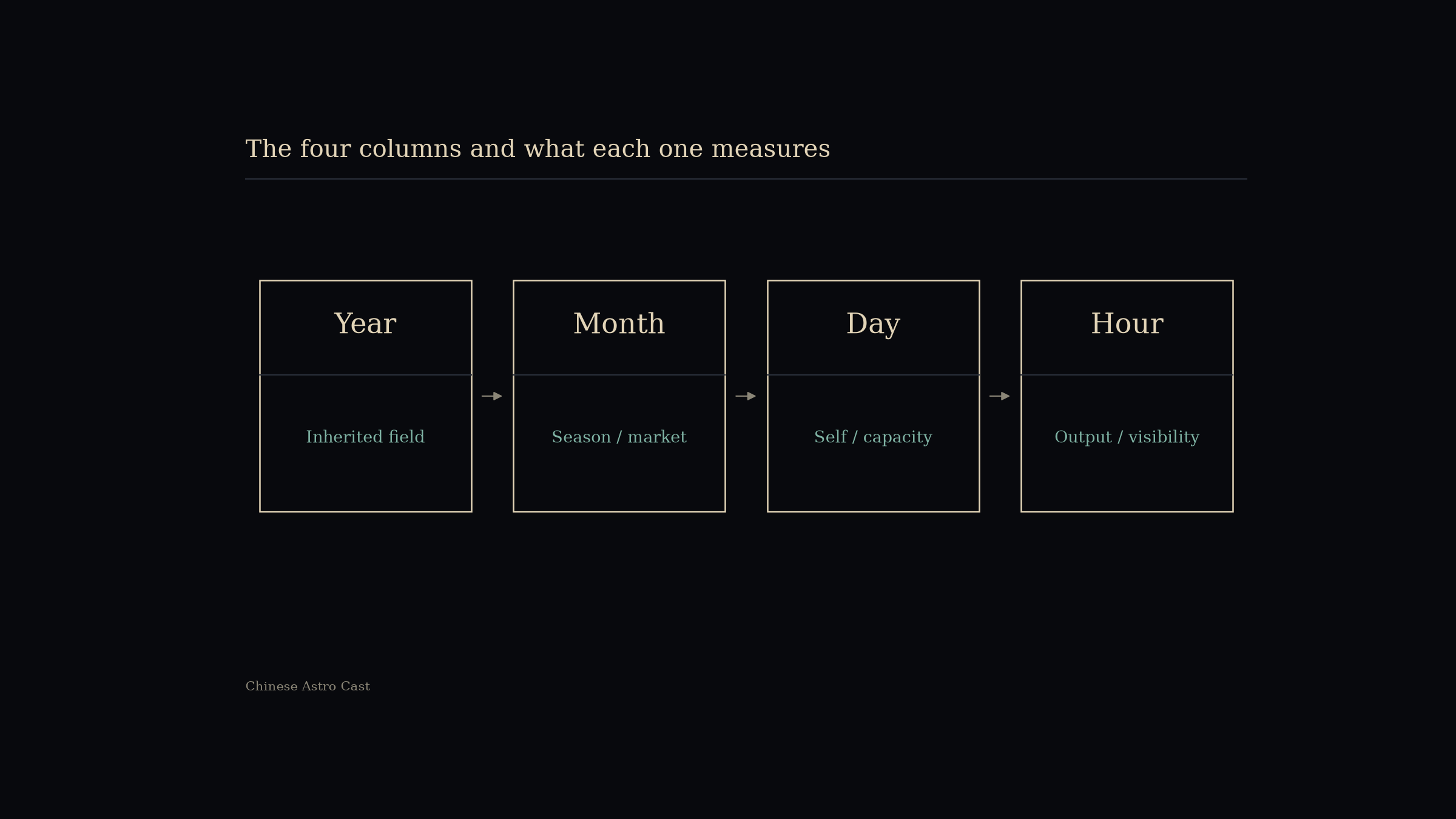
- The eight characters are four columns — inherited field, season, self, output — and each column answers a different decision.
- Read them in order, year to hour, because each column constrains the next one rather than restating it.
- Read as structure, the chart describes capacity and environment; it never predicts an outcome.
Most four pillars of destiny readings fail on scope, not on interpretation. The buyer receives four stems, four branches and eight paragraphs of adjectives, then has to guess which part applies to a decision. The term translates 四柱, four columns, and what separates a complete reading from a fragment is structural rather than poetic.
What four pillars of destiny actually measures
The four pillars are the birth moment written in the Chinese solar calendar: one column each for year, month, day and hour. Every column pairs a heavenly stem above an earthly branch. The stem states a function, a capability that can be deployed on request. The branch states the ground that function stands on: season, relations, and the hidden stems buried inside it. Eight characters, read as four layers of a single structure.
The layers answer different questions. The year column describes the inherited field: generation, family baseline, the conditions nobody negotiated. The month column describes season, and it carries the most weight, because season is the market climate the person was formed inside. The day column holds the Day Master, the stem that describes the self, with the branch beneath it covering the private register: partnership, the body, what a person returns to when unobserved. The hour column describes execution, and what gets wanted after the visible career ends.
Read that way, the system classifies conditions. It does not classify people. Jung made a similar move when he separated the self from the background of inherited material it forms against, on the observation that what looks like character is often a response to the field. Four pillars of destiny does not describe who you are. It describes the weather you were built for, then prices the cost of operating outside it.
Why it matters for decision-makers
Two executives with comparable track records can carry very different marginal cost for the same seat. A structure supported by strong Metal and Fire tolerates confrontation, short feedback loops and public reversals; it sharpens under friction. A structure heavy in Earth and Water does its best work across long horizons and low noise, and pays a visible price in a chaotic room. That is hiring information. It is not a verdict about the person, and it tells you where a capable one will be expensive, which is the part a reference call never surfaces.
The columns also time. Luck pillars arrive as ten-year segments, each with its own stem and branch, and they re-weight the natal structure instead of replacing it. A decennial that reinforces the Day Master is one to expand in; a decennial that attacks it is one to consolidate and renegotiate inside. Applied to capital, the distinction turns concrete: a well-supported decade can carry an eighteen to thirty month build before returns are required, while an attacking decade argues for shorter duration, smaller cheques, more frequent checkpoints and revenue inside two quarters. The strategy stays. What moves is the term structure it can carry.
Common misreadings
Two errors recur. The first is reading the four columns as four personality types instead of four layers of one structure, which produces a shopping list of traits and no read on support. The second is treating the year pillar as identity. It is the least negotiable part of the chart and also the least personal: the month branch sets season, and season usually dominates inheritance. A third, subtler error is scoring the chart, counting elements as if a balanced structure were better. Balance is not an achievement. It is a different set of constraints.
How to read four pillars of destiny in order
Work sequentially; the order is the method. First, fix the birth time to the minute and calibrate it to true solar time. Civil clock time is a different quantity from the solar time the calendar used, and the gap is longitude plus the equation of time, which reaches roughly a quarter of an hour in either direction. Second, state the Day Master plainly, element and polarity, and refuse to interpret anything else until you can. Third, read the month branch. It is the season, and it outranks the year column in almost every judgement.
Fourth, map the remaining seven characters onto the ten gods by their relation to the Day Master: same element gives the Peer and the Competitor, what it produces gives the Creator and the Iconoclast, what it controls gives the Steward and the Venture Capitalist, what controls it gives the Institutional Architect and the Strategic Commander, what produces it gives the Scholar and the Visionary Tactician. Fifth, tally support against drain, meaning how much of the structure feeds the Day Master and how much extracts from it. Only then add the luck pillars as a timeline. A timeline laid over an unread structure narrates your own assumptions back to you.
Worked example
A finance chief runs a Fire Day Master born in the month of the Rat, the deep-winter branch where Water peaks and Water controls Fire. Nothing in the natal structure bridges the two: no Wood converts the attack into fuel. The operating record matched the structure. Cost programmes landed early and held; multi-year growth mandates stalled twice, both approved in December, when the attacking season peaked and planning optimism ran highest against the chart’s weakest quarter.
The downstream damage was quiet because it looked like discipline. Two expansion programmes were funded, then descoped within nine months, and each was explained afterwards as a market call rather than a timing error. The procedural rule that followed was cheap: move capital commitments out of the month that duplicates the natal attack, and route them through a Wood bridge, meaning written business cases, staged gates, and an operator hired for origination instead of another analyst. The chart stayed as it was. The calendar of decisions moved.
The year boundary is 立春, the second of the 24 solar terms tabulated by the Hong Kong Observatory, not 1 January — which is why a February birthday can carry the previous year’s pillar.
Where the four pillars stop — the Ziwei cross-check
Four pillars answer a question about conditions and timing: what a person is built to carry, and when the carrying cost changes. They are weaker on location, meaning which domain of a life a pressure actually lands in. That is the division of labour with Ziwei Dou Shu, whose twelve palaces partition a life into domains: Soul, Wealth, Career, Spouse, Health and the rest, each holding assigned archetypal forces. BaZi gives the climate. Ziwei gives the address.
The value of running both is the disagreement, not the confirmation. When a BaZi structure shows an attacking decade and the Ziwei Career palace is simultaneously thin on supporting forces, two independent derivations have converged on one warning, and that convergence is what makes a reading usable in front of a board. When they diverge, the honest output is a narrower claim rather than a louder one. Anyone who wants both systems run against a single birth record, with points of agreement and friction both marked, can use the $29 Master Astrological Codex Bundle. It was built for the comparison, not for a longer single-system report.
Operating directive
Calibrate the birth time before you buy any reading; an hour off by one two-hour window can change the hour stem and rewrite the execution layer. Ask any practitioner which of the four columns they weight most, and treat a vague answer as a signal. Demand the support-and-drain tally in writing, as ratios rather than adjectives. Keep every reading tied to a decision you actually face this quarter, because a structure with no decision attached decays into trivia within a month. For a single-system read of your own four columns, with the ten gods and the current decennial marked, the $19 The BaZi Blueprint stays deliberately narrow: one birth record, one structure, no theatre.
If you want the raw columns before buying anything, the free BaZi calculator returns the four pillars and the day master from a single birth record.
Four pillars of destiny is a discipline of scope. It tells you which layer of a life answers which question, and it declines the questions it cannot reach.
About the editor. Edward reviews every article against the site’s chart tables and the engine output quoted here. Last updated November 2026.
Leave a Reply