2026 is 丙午, Bing Wu, the fire horse, and the honest structural reading of it is a pressure pattern rather than a forecast. An annual pillar names the elemental weather a year imposes on every chart at once; what it does to your own chart depends on which of your branches it meets. BaZi does not predict events, and any version of 2026 that tells you what will happen is selling something the system cannot produce.
- Chinese year 2026 is 丙午 (Bing Wu): yang fire over the horse branch, the forty-third pillar of the sixty-term cycle.
- The year opens at 立春 on 4 February 2026, not on 1 January and not on Chinese New Year, which falls on 17 February. The thirteen days between them matter.
- 丙午 is one element doubled, yang fire standing on the branch where fire peaks, so it reads as a single univocal pressure: visibility, exposure, speed.
- What it does to an individual chart is a relation question. In the example below, 午 forms six-harmony with 未, a fire frame with 戌, and no relation whatever with 辰.
What an annual pillar measures
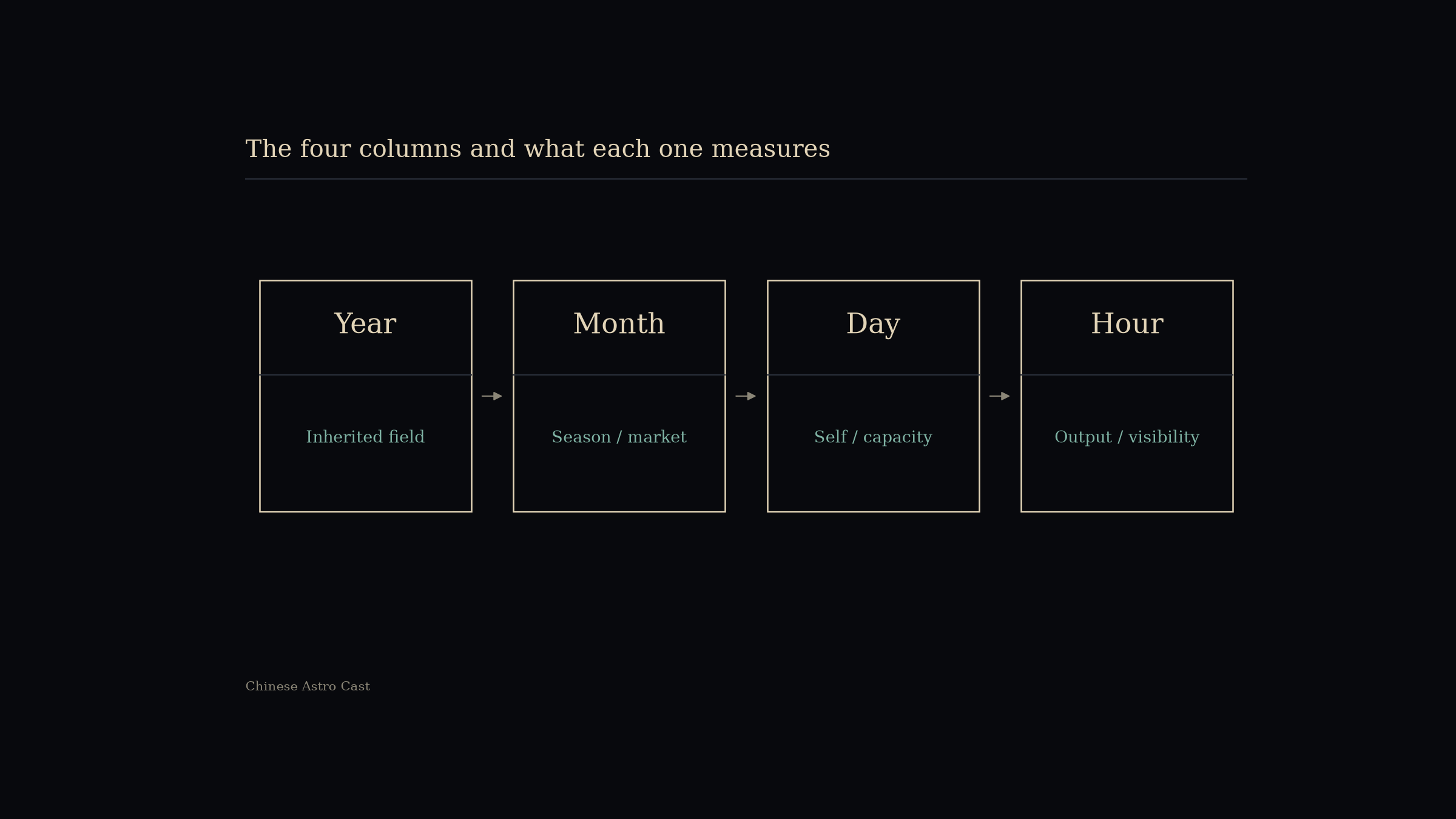
A natal chart is four stem-and-branch pairs, fixed at birth: year, month, day, hour. The annual pillar, 流年, is a fifth layer laid over that structure one year at a time. It is a single pair, the same pair for every person alive, and 2026 returns 丙午 from our engine’s annual series, followed by 丁未 in 2027 and 戊申 in 2028.
The annual pillar is not a second natal chart, so it cannot describe a temperament. Nor is it a planetary transit, though Western year-ahead readings occupy the same slot in a client’s mind. And it carries no verdict: nothing in the sixty-term cycle contains the word success or failure.
One pair, read at three levels
The stem names a quality of movement, something close to what the year’s activity looks like from outside. The branch names a field or a season: the environment that activity happens inside. The third level is the only personal one, and it is a relation. How does that branch sit against the four branches you already carry, through clash (沖), six-harmony (六合), punishment (刑), harm (害) or the three-part frames (三合)? Two people born the same week can meet one year with a harmony and a clash respectively, which is why a year-level reading that ignores the chart is a horoscope column in older vocabulary.
Why the Horse year starts in February
Search volume for the year of the horse 2026 predictions clusters in the last quarter, which is also when the two calendars start disagreeing in public. Chinese New Year 2026 falls on 17 February. In chart terms the Horse year begins on 4 February, at the solar term 立春 (Spring Commences). Both dates come from the Hong Kong Observatory’s Gregorian-Lunar conversion table for 2026, which lists Bing Wu as the year name on its own first line.
The thirteen days that change a reading
The sexagenary year rolls at a solar term because the cycle is keyed to the sun’s position, not to the moon. The lunar new year is a festival date; 立春 is an astronomical boundary. Anyone born between 4 and 17 February 2026 therefore carries 丙午 in a properly built chart while every consumer zodiac page calls them a snake, 乙巳, the year that ended. It is also why two apps can return different animals for one birth certificate: one uses the lunar new year, the other uses 立春. That is a design decision rather than a bug, and our comparison of why BaZi calculators disagree runs the same boundary through a real timestamp.
Reading 丙午
丙 is yang fire: the light that falls on things, the will to be seen, clarity used as an instrument. The classical twelve-stage table puts 丙 at 帝旺, peak prosperity, in 午, the branch where fire is strongest. So the stem stands on the ground it was built for, and the two hidden stems inside 午, 丁 (yin fire) and 己 (yin earth), supply the only internal texture the pillar has.
Why doubling reads as one signal and not two
Because both halves point the same way, 丙午 holds no internal argument. A mixed pillar negotiates with itself; this one does not. The practical consequence is that the year behaves as one pressure applied at one angle, which makes it easier to read and harder to soften. For a 丙 day master, 午 is 羊刃, the blade, so the pillar doubles that person’s own element and sharpens the edge it lands on.
For anyone else the pillar converts into ten-god language. Against a 甲 day master, 丙 reads as 食神, the Creator; the branch’s 丁 reads as 傷官, the Iconoclast; its 己 reads as 正財, the Steward. Output, expression and a wealth channel arrive together, along with the exposure that comes from being legible.
What 2026 does to one chart
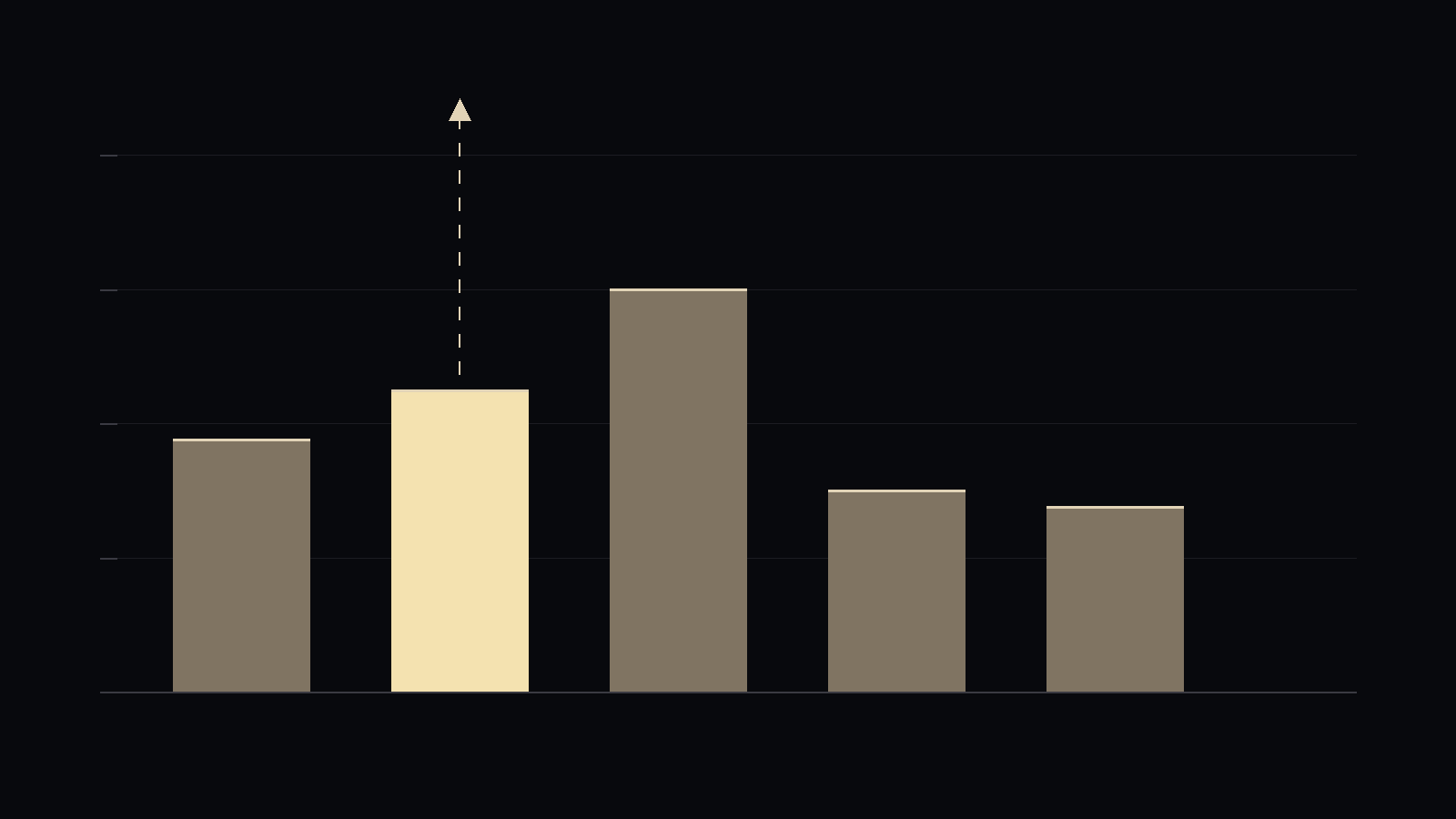
Our engine returns one worked profile for 20 July 1982, 13:21 in Changshu: 壬戌 year, 丁未 month, 甲辰 day, 辛未 hour, day master 甲 (yang wood). True solar time corrects that timestamp by −3.28 minutes, the element distribution reads Wood 18.8, Fire 22.5, Earth 30.0, Metal 15.0, Water 13.8, and the luck sequence runs forward from age 6 with 辛亥 current across ages 36 to 45.
2026’s 午 meets three of those branches. It forms six-harmony with both 未, the month and hour branches, and a half fire frame with the 戌 in the year pillar. The day pillar, 甲辰, stands clear: 辰 and 午 share no relation at all. Read structurally, the year presses on the month column (the working environment) and the hour column (output, and what gets built late), not on the day pillar where identity sits.
Where the reading stops
It stops short of naming an event, a month or a number. The relations above say where pressure lands and in what register, not what the person will do about it. A chart already carrying 30.0 earth and 22.5 fire enters a fire year with the fire channel fed twice and the earth channel still dominant, which describes more visible output over an unchanged base. That is a description of conditions, not an outcome.
The procedural rule that follows is narrow enough to use. When an annual pillar meets a branch by six-harmony, treat that column’s subject as the year’s live surface; when it misses a pillar entirely, treat that pillar as a protected channel and keep its most exposed work out of the year. For this chart the month and hour columns carry 2026, and the day pillar, which governs how a decision is actually made, is left to its own rhythm.
The operating directive
One scenario, read as tradition reads it. A software company wants to close a funding round in the second half of 2026 and has the choice of running its disclosure and diligence work in spring or pushing it into autumn. 丙午 favours what is already legible: documentation, published metrics, named references. The classical implication is that fire years reward work moved into the open early and cost more for work left latent, so the directive is to advance the disclosure work rather than delay it. Avoid scheduling the close on a day whose branch clashes the signatory’s own day branch, which is a separate discipline covered in the guide to auspicious dates.
The same logic applies to a hire. A public-facing role, a chief financial officer or a head of communications, inherits the year’s register, which is why the classical reading treats visibility roles as heavier in a 丙午 year than in the two earth-metal years that follow. The reading produces a map; the decision stays with the person holding it. The BaZi Blueprint is the $19 single-chart document that produces that map: four pillars, element distribution, luck sequence. Where a reading has to reconcile two systems, the annual pillar against palace topology, the Master Codex Bundle carries both in one volume.
About the editor. Edward edits ChineseAstroCast and reviews every article against the site’s chart tables. Last updated November 2026.