Qin Qiang

  • Year of the Horse 2026: Reading the Bing Wu Pillar

    Year of the Horse 2026: Reading the Bing Wu Pillar

    2026 is 丙午, Bing Wu, the fire horse, and the honest structural reading of it is a pressure pattern rather than a forecast. An annual pillar names the elemental weather a year imposes on every chart at once; what it does to your own chart depends on which of your branches it meets. BaZi does not predict events, and any version of 2026 that tells you what will happen is selling something the system cannot produce.

    • Chinese year 2026 is 丙午 (Bing Wu): yang fire over the horse branch, the forty-third pillar of the sixty-term cycle.
    • The year opens at 立春 on 4 February 2026, not on 1 January and not on Chinese New Year, which falls on 17 February. The thirteen days between them matter.
    • 丙午 is one element doubled, yang fire standing on the branch where fire peaks, so it reads as a single univocal pressure: visibility, exposure, speed.
    • What it does to an individual chart is a relation question. In the example below, 午 forms six-harmony with 未, a fire frame with 戌, and no relation whatever with 辰.

    What an annual pillar measures

    A natal chart is four stem-and-branch pairs, fixed at birth: year, month, day, hour. The annual pillar, 流年, is a fifth layer laid over that structure one year at a time. It is a single pair, the same pair for every person alive, and 2026 returns 丙午 from our engine’s annual series, followed by 丁未 in 2027 and 戊申 in 2028.

    The annual pillar is not a second natal chart, so it cannot describe a temperament. Nor is it a planetary transit, though Western year-ahead readings occupy the same slot in a client’s mind. And it carries no verdict: nothing in the sixty-term cycle contains the word success or failure.

    One pair, read at three levels

    The stem names a quality of movement, something close to what the year’s activity looks like from outside. The branch names a field or a season: the environment that activity happens inside. The third level is the only personal one, and it is a relation. How does that branch sit against the four branches you already carry, through clash (沖), six-harmony (六合), punishment (刑), harm (害) or the three-part frames (三合)? Two people born the same week can meet one year with a harmony and a clash respectively, which is why a year-level reading that ignores the chart is a horoscope column in older vocabulary.

    Why the Horse year starts in February

    Search volume for the year of the horse 2026 predictions clusters in the last quarter, which is also when the two calendars start disagreeing in public. Chinese New Year 2026 falls on 17 February. In chart terms the Horse year begins on 4 February, at the solar term 立春 (Spring Commences). Both dates come from the Hong Kong Observatory’s Gregorian-Lunar conversion table for 2026, which lists Bing Wu as the year name on its own first line.

    The thirteen days that change a reading

    The sexagenary year rolls at a solar term because the cycle is keyed to the sun’s position, not to the moon. The lunar new year is a festival date; 立春 is an astronomical boundary. Anyone born between 4 and 17 February 2026 therefore carries 丙午 in a properly built chart while every consumer zodiac page calls them a snake, 乙巳, the year that ended. It is also why two apps can return different animals for one birth certificate: one uses the lunar new year, the other uses 立春. That is a design decision rather than a bug, and our comparison of why BaZi calculators disagree runs the same boundary through a real timestamp.

    Reading 丙午

    丙 is yang fire: the light that falls on things, the will to be seen, clarity used as an instrument. The classical twelve-stage table puts 丙 at 帝旺, peak prosperity, in 午, the branch where fire is strongest. So the stem stands on the ground it was built for, and the two hidden stems inside 午, 丁 (yin fire) and 己 (yin earth), supply the only internal texture the pillar has.

    Why doubling reads as one signal and not two

    Because both halves point the same way, 丙午 holds no internal argument. A mixed pillar negotiates with itself; this one does not. The practical consequence is that the year behaves as one pressure applied at one angle, which makes it easier to read and harder to soften. For a 丙 day master, 午 is 羊刃, the blade, so the pillar doubles that person’s own element and sharpens the edge it lands on.

    For anyone else the pillar converts into ten-god language. Against a 甲 day master, 丙 reads as 食神, the Creator; the branch’s 丁 reads as 傷官, the Iconoclast; its 己 reads as 正財, the Steward. Output, expression and a wealth channel arrive together, along with the exposure that comes from being legible.

    What 2026 does to one chart

    Our engine returns one worked profile for 20 July 1982, 13:21 in Changshu: 壬戌 year, 丁未 month, 甲辰 day, 辛未 hour, day master 甲 (yang wood). True solar time corrects that timestamp by −3.28 minutes, the element distribution reads Wood 18.8, Fire 22.5, Earth 30.0, Metal 15.0, Water 13.8, and the luck sequence runs forward from age 6 with 辛亥 current across ages 36 to 45.

    2026’s 午 meets three of those branches. It forms six-harmony with both 未, the month and hour branches, and a half fire frame with the 戌 in the year pillar. The day pillar, 甲辰, stands clear: 辰 and 午 share no relation at all. Read structurally, the year presses on the month column (the working environment) and the hour column (output, and what gets built late), not on the day pillar where identity sits.
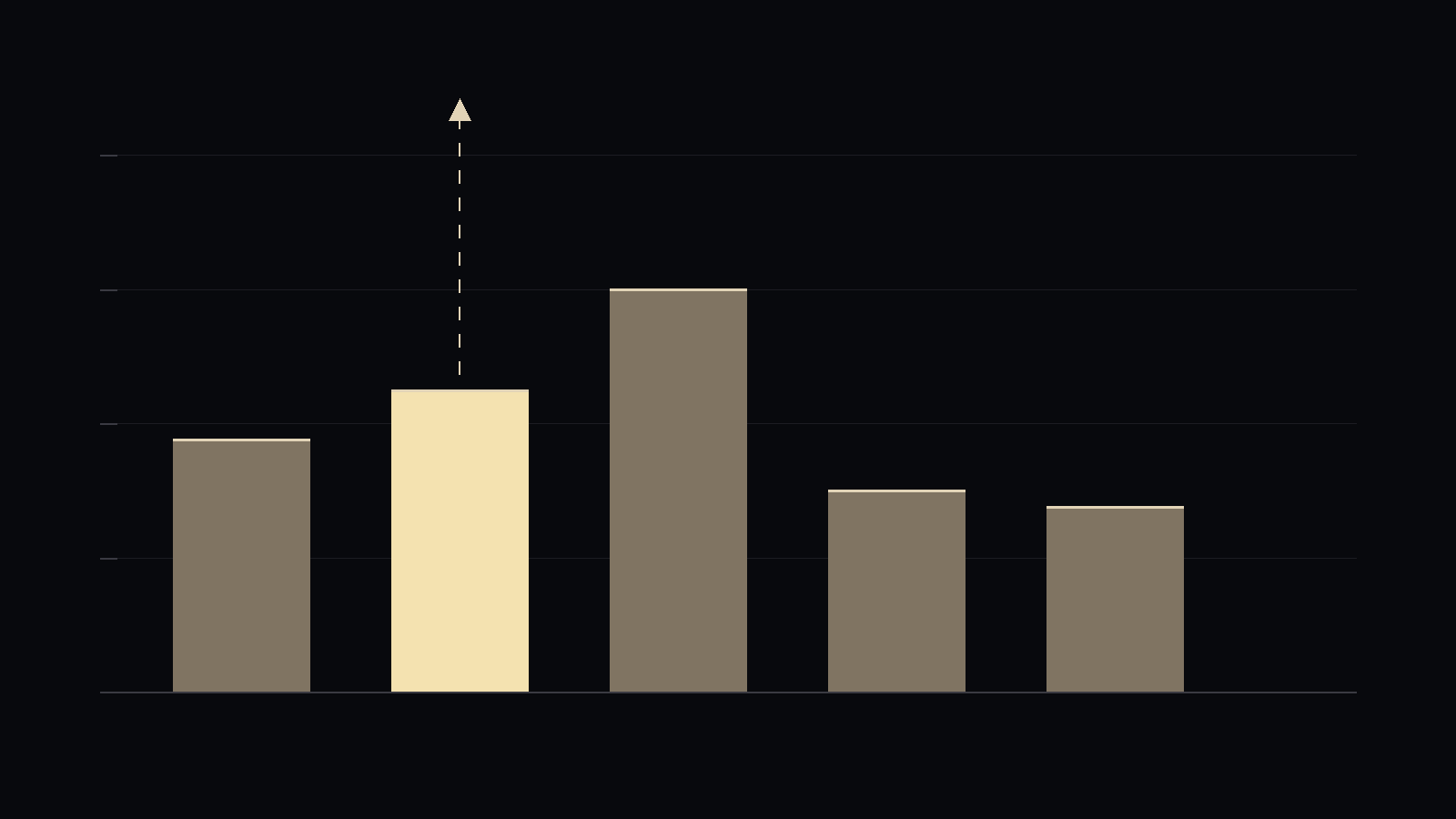
    Bar chart of the five-element distribution for a 1982 BaZi chart, fire at 22.5 percent marked as the element the 2026 Bing Wu pillar doubles
    The example chart’s element distribution as the engine returns it: Wood 18.8, Fire 22.5, Earth 30.0, Metal 15.0, Water 13.8. Earth already leads. The gold column is fire, the element 丙午 doubles in 2026, sustained at 22.5 but given a second source rather than a new ceiling.

    Where the reading stops

    It stops short of naming an event, a month or a number. The relations above say where pressure lands and in what register, not what the person will do about it. A chart already carrying 30.0 earth and 22.5 fire enters a fire year with the fire channel fed twice and the earth channel still dominant, which describes more visible output over an unchanged base. That is a description of conditions, not an outcome.

    The procedural rule that follows is narrow enough to use. When an annual pillar meets a branch by six-harmony, treat that column’s subject as the year’s live surface; when it misses a pillar entirely, treat that pillar as a protected channel and keep its most exposed work out of the year. For this chart the month and hour columns carry 2026, and the day pillar, which governs how a decision is actually made, is left to its own rhythm.

    The operating directive

    One scenario, read as tradition reads it. A software company wants to close a funding round in the second half of 2026 and has the choice of running its disclosure and diligence work in spring or pushing it into autumn. 丙午 favours what is already legible: documentation, published metrics, named references. The classical implication is that fire years reward work moved into the open early and cost more for work left latent, so the directive is to advance the disclosure work rather than delay it. Avoid scheduling the close on a day whose branch clashes the signatory’s own day branch, which is a separate discipline covered in the guide to auspicious dates.

    The same logic applies to a hire. A public-facing role, a chief financial officer or a head of communications, inherits the year’s register, which is why the classical reading treats visibility roles as heavier in a 丙午 year than in the two earth-metal years that follow. The reading produces a map; the decision stays with the person holding it. The BaZi Blueprint is the $19 single-chart document that produces that map: four pillars, element distribution, luck sequence. Where a reading has to reconcile two systems, the annual pillar against palace topology, the Master Codex Bundle carries both in one volume.

    About the editor. Edward edits ChineseAstroCast and reviews every article against the site’s chart tables. Last updated November 2026.
  • Reading an Astrology Chart: What Positions Actually Measure

    Reading an Astrology Chart: What Positions Actually Measure

    An astrology chart is a coordinate reading of one moment, not a description of a person. Every wheel and every set of pillars fixes a time and a place inside a repeating cycle, and the interpretation comes afterwards.

    • A chart records where a moment sits in a coordinate system. Interpretation is downstream of that recording step.
    • The wheel measures ecliptic geometry; the four pillars measure a sixty-step cycle. Vocabulary does not transfer between them.
    • Both need the clock: the wheel for house cusps, the pillars for the local apparent Sun.
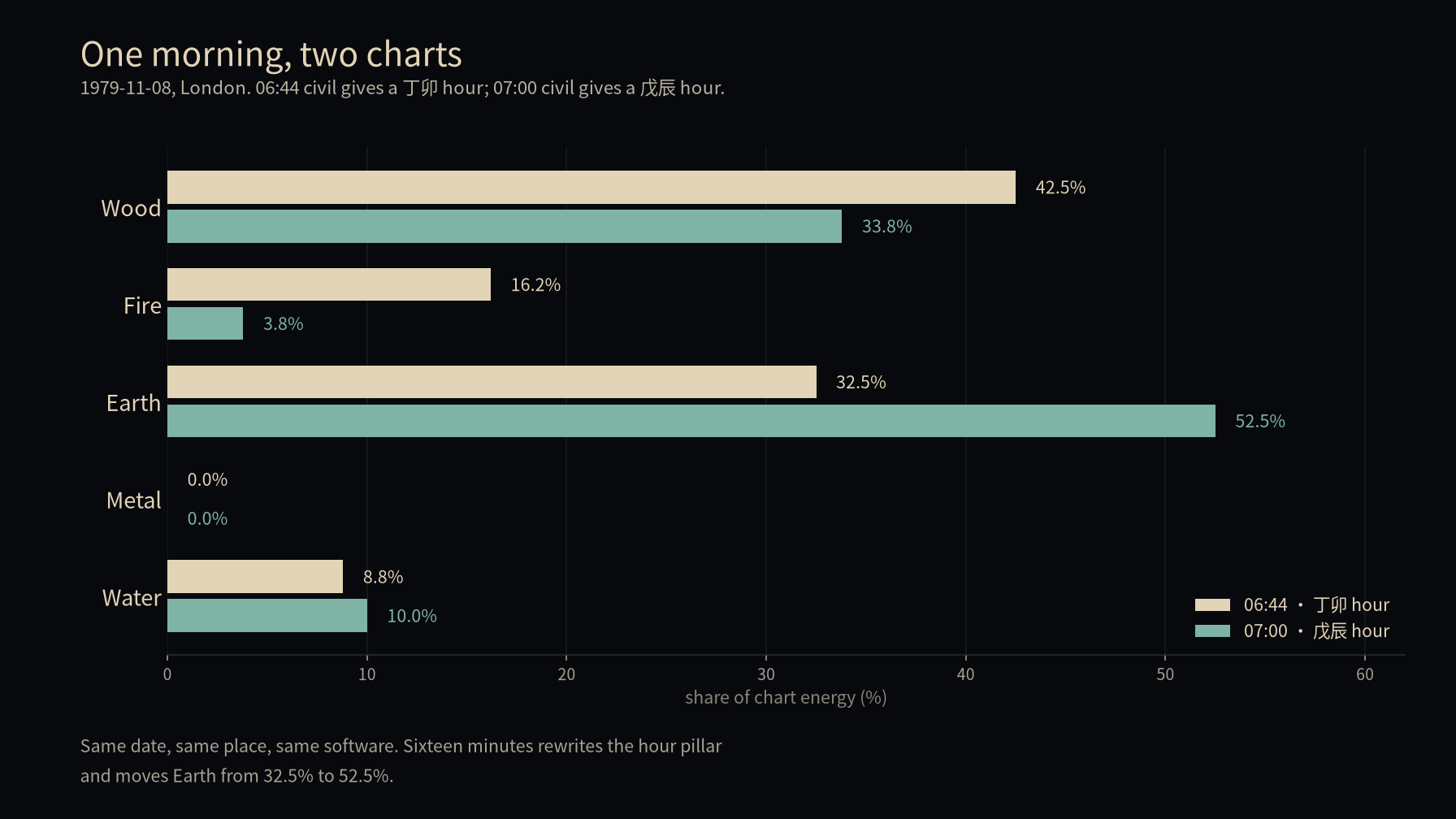
    • Our engine returns 32.5% Earth at 06:44 and 52.5% at 07:00 on the same London morning.

    What an astrology chart actually measures

    Strip the symbolism and a chart is a timestamp with an address. It takes one moment of local time, one latitude and one longitude, and converts them into positions on a ruler that repeats: the ecliptic divided into signs, or the sexagenary cycle divided into stems and branches. Nothing in the diagram is about character until a reader assigns meaning to a position.

    Two rulers over one snapshot

    The Western wheel divides the ecliptic into twelve sectors of thirty degrees measured from the March equinox, then plots each body by its ephemeris position. Aspects are angular separations. Houses are the local sky split by a system that depends on latitude and clock time. Reading it is geometry.

    The four pillars take four slices of the same moment, year through hour, and write each as one heavenly stem over one earthly branch, drawn from a cycle that repeats every sixty steps. The year turns at Lichun rather than on 1 January. The month turns at each major solar term rather than on the first of the month. There are no planets in it and no houses. Reading is relational: every other character is classified by its elemental relation to the day stem.

    The psychological parallel holds if you keep it precise. A chart behaves like a well-normed instrument, constraining what can be said before interpretation begins. Jung treated such systems as structured projective surfaces, useful because they force a reader to account for the parts of a life he would rather skip. The instrument is not the error. The error is a reader who takes the scale for the object being measured.

    Why chart structure matters at a decision table

    Executives reach for chart language because it is compact and non-accusatory. Saying that a chart carries no output channel lands differently from saying a founder never says what he thinks, and it invites a different reply. That is a fair use of the vocabulary: a short way to hold a hard conversation about functions and costs.

    The use turns bad when the diagram becomes evidence about a candidate. A chart can name an over-supplied function and an absent one. For a 己 Earth day master, Wood is the officer element, the authority imposed from outside, and Metal is the output element, what the person makes and says. A profile with Wood at 42.5 per cent and Metal at 0.0 describes a heavy external mandate and a thin expressive channel. That is a structural claim, and it converts into a staffing question rather than a judgement.

    Three questions a chart cannot answer

    • Whether a person will perform. No distribution of elements predicts competence at a specific job.
    • Which of two candidates is better. A chart reads one profile; selection compares profiles against a role specification.
    • When an event will happen. Timing layers describe pressure and receptivity, and the class of event is not specified.
    Bar chart comparing the five-element shares of one astrology chart at 06:44 and 07:00, where the hour pillar changes from Ding Mao to Wu Chen
    One birth record, sixteen minutes apart. The hour pillar changes, and so does the whole element distribution.

    How to read a chart in the right order

    Most bad readings are sequencing errors rather than symbol errors. The order below is the one our own tools follow, and skipping a step is what produces confident nonsense.

    1. Fix the record. Civil date, civil time, city. A chart without a birth time cannot place houses or an hour pillar, and no later step repairs that.
    2. Convert the clock. Move civil time to local apparent solar time. In London on 8 November 1979 the correction is +15.57 minutes; in Shanghai in July it runs the other way.
    3. Place the axes. Houses and ascendant for the wheel, year through hour pillars for the Chinese chart. This is where two apps first disagree.
    4. Locate the reference point. The day stem in a BaZi chart, the ascendant and its ruler in a Western one. Everything else is classified relative to it.
    5. Read the distribution, not the keywords. Shares across five elements carry more information than any single term in a glossary.
    6. Attach one decision. A reading that changes nothing you were going to do this quarter was entertainment.

    Worked example: one morning, sixteen minutes apart

    Our engine returns four pillars for a London birth on 8 November 1979 at 06:40: 己未 year, 乙亥 month, 己卯 day, 丁卯 hour, with a day master of 己 Earth and Wood at 42.5, Earth at 32.5, Fire at 16.2, Water at 8.8 and Metal at 0.0 per cent. The month stem 乙 classifies as the Strategic Commander, the hour stem 丁 as the Visionary Tactician, the year stem 己 as the Peer.

    Move the clock to 07:00 and the hour pillar becomes 戊辰. Earth rises to 52.5 per cent and Fire falls to 3.8. The reading changes from a chart with a working resource channel to one crowded with peers, and nothing about the person changed except the minute on the certificate. That is the argument for treating the fixing step as data and the interpretation as argument. The day master calculator prints the first half of that record with no interpretation attached, which is the right place to start, and we set out the boundary rules in more detail in the BaZi versus Western astrology comparison.

    Where this goes wrong

    Three failure modes cover most of the damage. The first is a chart built on a guessed birth time: rectification by anecdote produces an hour pillar that is fiction, and fiction at the hour layer propagates into every timing claim after it. The second is vocabulary transfer, reading a 冲 as an opposition aspect or a palace as a house, which yields sentences no tradition would defend. The third, and the expensive one, is treating a distribution as a verdict in a hiring or equity conversation, where a compact metaphor should have stayed a metaphor.

    Operating directive

    Confirm the birth record before you accept any chart of your own, and keep the civil time, the true solar time and the correction in one document. Read the reference point first and the glossary last. Ask of every reading which decision it would change, then discard the ones that change nothing. When a chart enters a room, say plainly that it describes a structure and not a performance record.

    The full structural reading, including the ten-god classification of all four pillars, is what $19 The BaZi Blueprint produces for one profile. The $29 Master Codex Bundle adds the twelve-palace layer for readers who want the second geometry beside the first.

    Hong Kong Observatory publishes the solar-term tables that fix the month and year boundaries used above.

    An astrology chart rewards fixing before it rewards meaning, which is why the checkable half of it belongs first.

    About the editor. Edward edits ChineseAstroCast and reviews every article against the site’s chart tables before publication. Last updated November 2026.

  • BaZi Compatibility: Reading Two Charts for Fit

    BaZi Compatibility: Reading Two Charts for Fit

    BaZi compatibility is a structural comparison of two charts, not a verdict on a relationship. The classical method weighs the day pillar first — the position that describes how a person meets the world — and then the balance of the five elements across both charts. What comes out is a description of where two operating styles will grate and where one chart supplies what the other lacks.

    • Compatibility is read on the day pillar of each chart, not on the birth-year animal; the animal is a twelve-year unit shared by roughly one person in twelve.
    • The fixed tables that pair the twelve branches — six harmonies, six clashes, six harms — describe process friction, not affection. A harmony does not promise a happy partnership and a clash does not forbid one.
    • Element percentages are the second axis: a chart carrying 0% Metal and a chart carrying 15% Metal are describing a supply relationship, not a personality match.
    • For a co-founder or a key hire, the useful output is a list of decisions that should not be shared, not a score out of ten.

    What compatibility actually compares

    Two people born in the same year share an animal and almost nothing else. The year pillar is the outermost ring of a BaZi chart — it describes the environment a person was born into, not the person. Compatibility readings that stop at the animal are comparing two twelve-year cohorts, which is why they produce the same answer for millions of people and no useful answer for any one of them.

    The classical method (合婚, the reading of a pair) works on the day pillar instead. The day stem is the Day Master, the reference point the whole chart is interpreted around; the day branch is the position that classical texts assign to the spouse palace. Whatever else a chart says, that branch is where a practitioner starts when two charts are laid beside each other.

    The day branch is the hinge

    The twelve branches have three fixed relation tables, each a lookup rather than a judgement. Six pairs form a harmony (子丑, 寅亥, 卯戌, 辰酉, 巳申, 午未). Six pairs clash, sitting directly opposite each other on the ring (子午, 丑未, 寅申, 卯酉, 辰戌, 巳亥). Six pairs harm (子未, 丑午, 寅巳, 卯辰, 申亥, 酉戌).

    Most readings skip the third table; it matters most in working relationships. A clash is loud. Two positions pull in opposite directions and the first meeting shows it. A harm is quiet — classically the least dramatic of the conflict pairs, describing friction in routine coordination rather than open opposition. Two people who agree on strategy and cannot agree on sequencing are usually looking at a harm, not a clash.

    Why the hour pillar is worth the trouble

    The hour pillar is where clock time becomes a problem. Our engine calibrates every birth to local apparent solar time before it assigns a branch; a birth recorded at 13:21 civil time in Changshu on 20 July 1982 resolves to 13:17:44 after a −3.27 minute correction. That shift is small enough to leave the hour unchanged. In Singapore the same correction runs to −74 minutes, and a 09:45 birth lands in the previous branch entirely. The Hong Kong Observatory’s conversion tables make that adjustment auditable.

    Two charts, side by side

    Take a worked pair from the engine. Chart A: 20 July 1982, 13:21, Changshu — 壬戌 year, 丁未 month, 甲辰 day, 辛未 hour, Day Master 甲 (Wood). Chart B: 17 February 1979, 07:40, New York — day pillar 乙卯, Day Master 乙 (Wood).

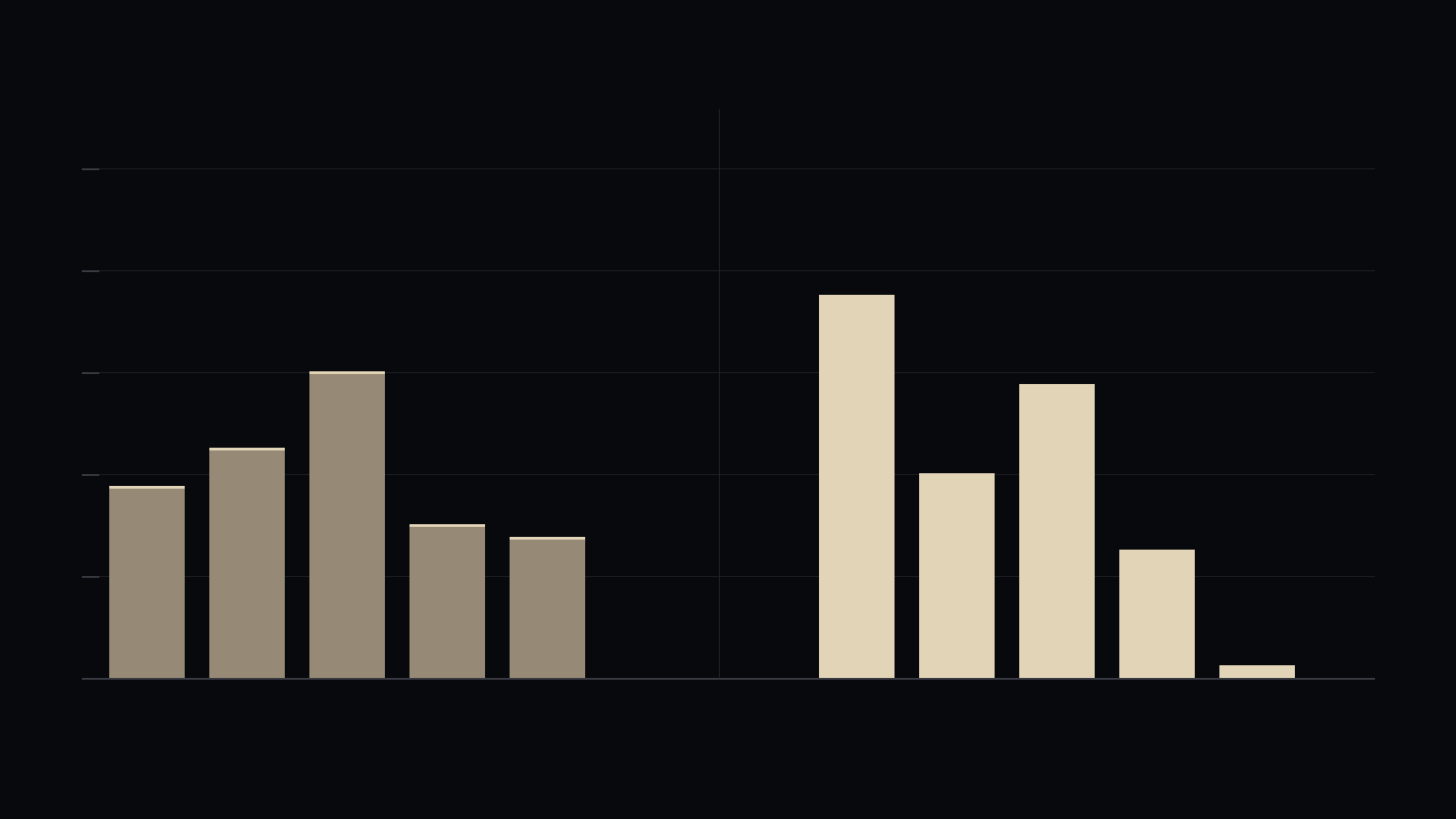
    They look similar on the element axis. A carries Wood 18.8%, Fire 22.5%, Earth 30.0%, Metal 15.0%, Water 13.8%. B carries Wood 37.5%, Fire 20.0%, Earth 28.8%, Metal 12.5%, Water 1.2%. Fire and Earth sit within two points of each other; Metal within three. A reading that scored element similarity would call this a strong match.

    The day branches disagree. A’s day branch is 辰; B’s is 卯. On the harm table, 卯 and 辰 are a pair. Two charts elementally close and relationally awkward are the combination every founder recognises: “we get along until we have to run something together”.

    BaZi compatibility comparison of five-element distribution in two charts, gold bars on charcoal, chart A against chart B
    Five-element distribution for the two charts compared in this article, in the fixed order Wood, Fire, Earth, Metal, Water. Chart A (left group) carries a balanced spread with Earth at 30.0%; chart B (right group) is Wood-dominant at 37.5% with Water at 1.2%. Drawn from the engine’s own weighting, not from raw character counts.

    Reading the second axis

    B’s Water sits at 1.2%. A supplies 13.8%. In the classical frame that is a supply relationship: the position B is thinnest in is the position A carries most comfortably. It does not make the pair harmonious, since the harm stands, but it does explain why the pairing feels useful in one direction and tiring in the other. B’s chart absorbs from A what it does not generate; A receives very little in return on the Wood axis, where B is nearly double.

    We ran the same comparison against a third chart as a control: 14 March 1988, 09:45, Singapore — 戊辰 day, Earth 47.5%, Metal 0.0%. Same day branch as A, which the tables treat as the weakest conflict class, a self-punishment that stays internal. On elements it is the more interesting pairing: a chart with no Metal meeting one carrying 15.0%. Similar structure, complementary material — the opposite arrangement to A and B.

    What the comparison cannot say

    It cannot rank people. No arithmetic in these tables produces a score, and any product handing you 87% has invented a scale and then attributed it to the tradition. The relation tables are categorical: a pair either sits on a listed pair or it does not.

    What a clash is not

    A clash between day branches is not a prohibition. It is a description of how two people handle the same decision: one moves first and refines later, the other refines first and moves late. Durable partnerships are often built on exactly that tension: the pair covers both failure modes. The clash becomes expensive only when both parties are asked to do the same job at the same moment.

    Putting it to work: the co-founder case

    This reading earns its place in an executive context because it produces constraints, not comfort. When a harm sits between two day branches, the practical translation is that routine coordination — scheduling, sequencing, who signs first — is the friction point, while strategic direction may be perfectly aligned. That is a governance finding, and it has cheap fixes.

    • Separate the calendars. A harm pair usually coordinates badly on shared timelines; give each partner their own operating cadence and one shared decision log rather than a joint sprint.
    • Do not co-sign. Split signature authority by domain, so a sequencing disagreement cannot stall a transaction.
    • Use the element gap deliberately. If one chart is the Metal supply and the other carries none, make the Metal-carrying partner the one who owns standards and review, and say so in the operating agreement.

    For a hire rather than a partner, the logic runs one direction: does the candidate’s day branch and element profile add a capability the team lacks? That question is answered by the second axis far more often than the first — and it is the kind of structural read a full BaZi Blueprint sets out position by position, day and hour pillars included.

    A three-step reading order

    Step one: fix both birth times

    Before anyone consults a table, both charts have to be cast from calibrated times. A 74-minute solar correction moves an hour pillar; a birth near a branch boundary without that correction produces a different chart, and two different charts cannot be compared. This is the most common way a compatibility reading goes wrong before it starts.

    Step two: read the day branches, then the elements

    Look up the pair on the three relation tables. Then — and only then — compare element percentages, looking for the position one chart supplies and the other lacks. Report both; they routinely disagree, and the disagreement is the finding.

    Step three: translate into decisions

    Convert each finding into one operating constraint. A harmony needs no action. A clash needs a decision-right split. A harm needs separate cadences and a written escalation path. If the pair of charts is going to govern money or a company, the Master Codex Bundle adds the twelve-palace topology that shows which domain each person’s chart concentrates authority in — the palace layer that a day-branch comparison alone cannot reach.

    About the editor. Edward edits ChineseAstroCast and reviews every article against the site’s chart tables. Last updated November 2026.
  • The Ten Gods in BaZi as Ten Psychological Archetypes

    The Ten Gods in BaZi as Ten Psychological Archetypes

    The ten gods in a BaZi chart are the layer Western readers abandon first, because the standard English labels read like a crime report. “Seven killings”, “hurting officer”, “rob wealth”: none of those phrases describes a behaviour. Each describes a relationship.

    • They are neither deities nor events: ten relationship types between the day-master stem and every other stem.
    • The label is relative, so the same stem is a different god under a different day master and literalism explains nothing.
    • Ten collapse into five families (same, output, wealth, power, resource) split by polarity: two axes, not ten mysteries.
    • Read by pillar: year for inherited conditions, month for professional method, hour for execution.

    What the ten gods actually measure

    A BaZi chart is four pillars, each written as one heavenly stem above one earthly branch. Eight characters in total, and the day stem is the only one that refers to the person. Call it the day master. One element, one polarity, yang wood for instance, and it becomes the origin point for everything else in the chart.

    The ten gods classify every other visible stem with two questions. What is the element relation between that stem and the day master: identical, produced by it, controlled by it, controlling it, or producing it. Then, does the stem share the day master’s polarity or oppose it. Five relations times two polarities gives ten labels. None of that arithmetic predicts anything. It is grammar.

    The closest Western analogue is a function-attitude typology, not a horoscope. Jung’s eight types describe a mode of functioning relative to the ego, and the same function behaves differently when it is introverted rather than extraverted. The ten gods work the same way. They name the relation, then the polarity, and leave the behaviour to be inferred from the whole chart.

    Five families, ten archetypes

    Because five families crossed with two polarities generate the ten, they hold in the mind as a map rather than a list. Each family answers a different question about what a person does with capacity: replicate it, express it, monetise it, govern it, or absorb it.

    • In the same-element family sit the Peer and the Competitor: colleagues, siblings, rivals, and the instinct to solve alone.
    • The output family holds the Creator and the Iconoclast, which is what the self produces. The Creator refines the craft. The Iconoclast dismantles the received method.
    • Wealth covers what the self controls. The Steward builds systems that hold assets. The Venture Capitalist finds the asymmetric bet.
    • Power covers what controls the self. The Institutional Architect works through legitimate structure, the Strategic Commander through force and tempo.
    • Resource is what produces the self. The Scholar absorbs codified knowledge, the Visionary Tactician reads patterns nobody has written down.

    Polarity is not virtue

    Classical Chinese marks one of each pair 正, proper, and the other 偏, lopsided. Those words describe the alignment of the pairing rather than a grade. A Direct Officer and a Seven Killings are the same metal meeting the same day master from two directions, one with polarity opposed, one with polarity matched. The matched pair tends to be frictionless and repetitive. The opposed pair tends to differentiate, and it is harder to regulate. Neither one is the better employee.

    Why it matters for decision-makers

    The practical value sits in the balance between families, not in any single label, because the five describe five different drains and supplies on the person. Output and wealth consume the day master. Resource and peers support it. A chart whose two largest shares sit on the consuming side and whose two smallest sit on the supporting side belongs to someone who can generate a great deal and replenish very little. That constraint surfaces in calendar design long before it shows up in any forecast.

    It also reframes the executive question. Instead of asking what kind of person this is, the chart asks which function is expensive for this person and which one is free. Free functions get delegated toward. Expensive ones get staffed. A founder whose professional method is production and critique should not be the person governing the institution, however capable the founder is. That is an org-design answer, not a prediction.

    Common misreadings

    Two errors recur. The first is reading a god as a trait: calling someone a Seven Killings personality fixes a relation into an identity, and then the hiring decision runs on the label. The second is reading absence as deficit. No visible stem of a family does not mean the function is missing. Classical readings also weigh the hidden stems inside the branches, and daily expression shifts with the luck pillars regardless.

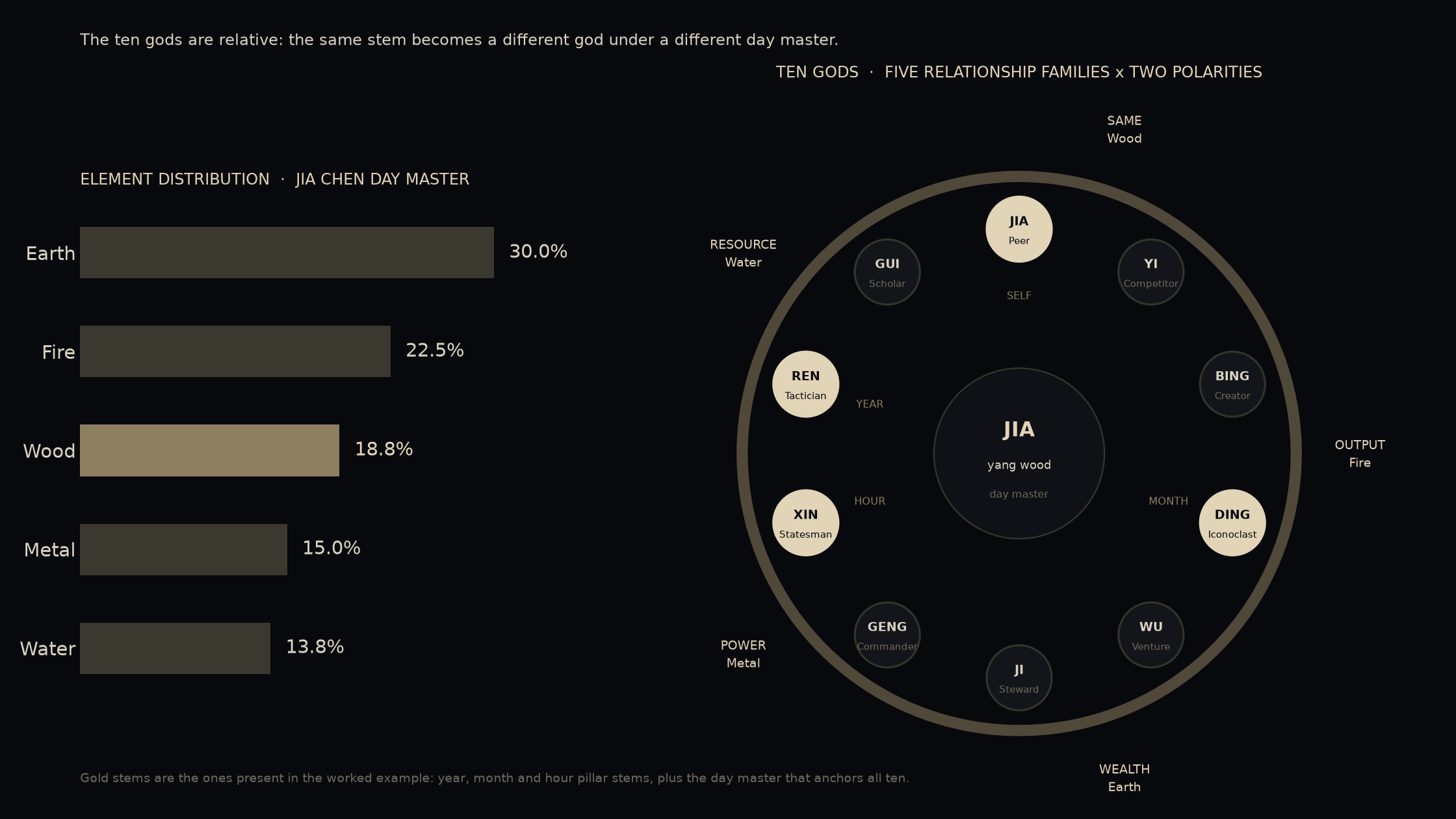
    Ten-gods ring diagram showing five relationship families and two polarities around a Jia day master, with the year, month and hour stems marked
    The ten gods as a ring: five families, two polarities each. Gold nodes are the stems present in the worked example below, with Jia as the day master that anchors all ten.

    Reading them in your own chart

    Order matters more than vocabulary here. Work through the sequence once and the labels stop being intimidating.

    1. Fix the day master. Take the day pillar’s stem and note its element and polarity.
    2. List the remaining visible stems: year, month, hour. The day stem never gets a god because it is the reference.
    3. Assign each stem its family by element relation, then its polarity by comparison with the day master.
    4. Weigh by position rather than count. Month carries professional method, year carries inherited conditions, hour carries execution and the later trajectory.
    5. Leave the luck pillars out of the first pass. They re-weight everything every ten years and blur a structural reading done too early.

    Worked example

    Our engine returns a clean case for a birth on 20 July 1982 at 13:21 in Changshu: true solar time 13:17:43, a correction of −3.28 minutes, and the pillars Ren Xu (壬戌) year, Ding Wei (丁未) month, Jia Chen (甲辰) day, Xin Wei (辛未) hour. The day master is Jia, yang wood, on a distribution of Earth 30.0, Fire 22.5, Wood 18.8, Metal 15.0, Water 13.8 per cent.

    Three visible gods follow. Ren in the year is yang water producing yang wood at matched polarity: the Visionary Tactician, the Contrarian. Ding in the month is yin fire produced by yang wood at opposed polarity: the Iconoclast. Xin in the hour is yin metal controlling yang wood at opposed polarity: the Institutional Architect, the Statesman.

    Read the positions rather than the names. Professional method sits in the month, and this month carries the Iconoclast, so the default working move is to dismantle the received method rather than perfect it. The Statesman appears only in the hour, which is where execution lives. Innovation upstream, governance downstream. That configuration reads cleanly until the organisation needs the downstream layer staffed by someone who is not the founder.

    Where this goes wrong

    The expensive failure is hiring on a label. A report that translates a stem as “seven killings” and stops there invites a reader to hear ruthlessness in what is really a description of matched-polarity power, which is the capacity to act without waiting for legitimacy. Used as a personality filter, the phrase disqualifies good operators.

    The second failure is symmetry hunting. Readers count two of one god and one of another, then conclude the chart is unbalanced. The classical method weighs position, season and support first. One month stem usually matters more than three scattered ones.

    Operating directive

    Name the day master before reading anything else. Map the three remaining visible stems to families, then to polarity, and record the balance rather than the labels. Identify which function is expensive for this person and staff it instead of training it. Read position before count, and treat every translated god name as a relationship rather than a character reference.

    For the full structural map, including element distribution, the ten gods by pillar and the luck sequence around them, the $19 BaZi Blueprint reports the arithmetic rather than the folklore. Readers who want the same profile cross-checked against the twelve-palace Ziwei topology use the $29 Master Astrological Codex Bundle, which runs both systems against one birth record.

    The month pillar above is bounded by solar terms rather than calendar months. The Wei month runs from Minor Heat to the Start of Autumn, and the Hong Kong Observatory publishes the authoritative tables for those boundaries.

    The ten gods are a discipline of relation rather than a set of titles, and a relation, unlike a title, can be redesigned.

    About the editor. Edward edits ChineseAstroCast and reviews every article against the site’s chart tables before publication. Last updated November 2026.

  • Auspicious Dates for Business: Clash Days and Launch Windows

    Auspicious Dates for Business: Clash Days and Launch Windows

    Most executives treat auspicious dates as a calendar of permissions. The classical almanac is a narrower instrument than that, and reading it precisely changes what a date can tell you about a decision.

    • An auspicious date is a day-level reading — stem, branch, duty officer, suitable/avoid columns. None of those layers knows who is signing.
    • The personal layer is a relation, not a verdict: how the candidate day’s branch sits against your own day pillar’s branch.
    • Our engine returns 甲辰 as the day pillar for a founder born 20 July 1982, 13:21 in Changshu — then 戊戌 for 20 November 2026 (opposition) and 己酉 for 1 December 2026 (harmony).
    • Dates sequence high-friction work; they do not license decisions. A clash day raises the cost of improvisation, not the right to decide.

    What an auspicious date actually measures

    The Chinese almanac (通書 in the book trade, 黃曆 in common usage) is a day calendar, not a personal reading. For each date it records three things. First, the day’s own stem-and-branch pair, one of sixty in the cycle, which advances by one every day without reference to you. Second, a duty officer (建除十二神) drawn from a twelve-day sequence: 建, 除, 滿, 平, 定, 執, 破, 危, 成, 收, 開, 閉, each naming the kind of action a day favours or resists. Third, the suitable-and-avoid columns (宜 / 忌) that most readers actually consult.

    All three are computed for the day as a public object. The same date reads “suitable for signing agreements” for a thousand people holding a thousand different charts, because nothing in the almanac’s arithmetic consults the person doing the signing. That is not a flaw; it is what a calendar can do. A day calendar answers “what kind of day is this”, and it answers it identically for everyone.

    The two layers that get merged

    The duty officer is anchored to the month branch, and the month branch changes at a solar term (節氣), not on the first of the Gregorian month. The sequence restarts with 建 on the first day whose branch matches the current month branch. So in any given month the officer list is offset from the calendar grid, and it resets in the middle of a month rather than at its start. Two almanacs that disagree about a date near a solar-term boundary are usually disagreeing about which month branch is current, not about the day. The Hong Kong Observatory publishes the solar-term tables that fix those boundaries.

    Why it matters for decision-makers

    Capital decisions cluster. A fund closes in a two-week window; a board reviews a financing round on one of four possible Fridays; a founder signs a term sheet or an executive contract in a week that also contains three other commitments. The question is never “is this a good day in general” but “which of my available days can carry the improvised part of this conversation”.

    The asymmetry matters more than the superstition. A negotiation where you must think on your feet draws on a different reserve than a negotiation where you read a prepared position. Scheduling the second kind onto a day the almanac calls closed for new business costs you nothing; scheduling the first kind there costs you the walk-away line you had not written down. Reading dates structurally is a form of load management, and load management is an executive discipline rather than a belief system.

    Where the almanac stops working

    It stops at the boundary of the person. A day’s officer describes the day’s texture; it cannot tell you whether your structure meets that texture well or badly. For that you need the one branch of your chart that moves daily in relation to the calendar: the branch of your day pillar. Everything else in the almanac is context.

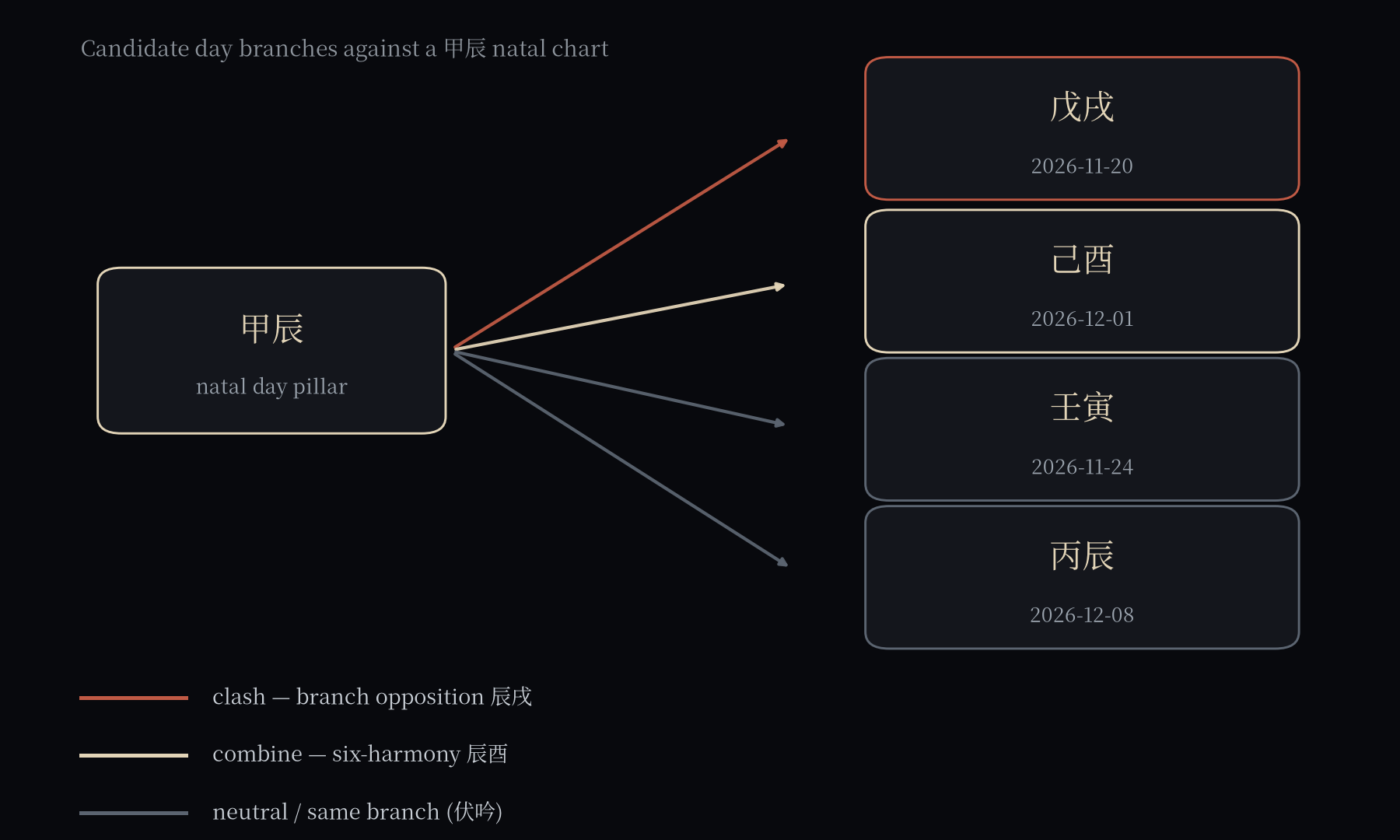
    Auspicious dates compared against a 甲辰 natal day branch: 戊戌 forms a branch opposition, 己酉 a six-harmony combination, 壬寅 and 丙辰 read as neutral.
    Four candidate 2026 dates plotted against a 甲辰 day pillar. Only the branch relation changes; the almanac’s day-level verdict is identical for every reader.

    How to read a date against your own chart

    The procedure is short and entirely mechanical, which is why it can be done before a calendar meeting rather than after.

    1. Get your day pillar. Not the year animal, not the month — the day pillar, the third of the four in a BaZi chart. Its branch is the fixed point everything else is measured against.
    2. Get the candidate date’s day pillar. Any deterministic engine returns it; our preview endpoint returns it alongside the four pillars for a birth profile, and the same call run with a candidate date returns that date’s day pillar.
    3. Compare branches. Two relations recur in practice: opposition (沖), where the branches stand opposite each other in the twelve-branch ring — 辰 against 戌, for instance — and six-harmony (合), where they pair — 辰 with 酉. A third case is duplication, where the day repeats your own branch.
    4. Assign consequence, not permission. Opposition days are where improvised commitments get expensive. Harmony days are where the conversation tends to land where you intended. Duplication days are where you tend to repeat your own default, for better and worse.

    Worked example

    Our engine returns the following for a male profile born 20 July 1982 at 13:21 in Changshu: year pillar 壬戌, month 丁未, day 甲辰, hour 辛未, with a true-solar-time correction of −3.28 minutes against civil clock time. The day master is 甲, the yang Wood stem; the element distribution comes back as Earth 30.0, Fire 22.5, Wood 18.8, Metal 15.0, Water 13.8 — an Earth-heavy late-summer chart, and the current ten-year pillar is 辛亥 for ages 36 to 45.

    Read two dates for the same person. The engine returns 戊戌 for 20 November 2026: the day branch 戌 stands in direct opposition to the natal day branch 辰, the strongest of the twelve clashes. For 1 December 2026 it returns 己酉, whose branch combines with 辰 — the six-harmony pair. Same person, same almanac columns, opposite structural readings. That difference is invisible to anyone scheduling from a public calendar.

    Where this goes wrong

    Three failure modes recur. The first is buying a date for a decision that has not been defined: no day fixes a term sheet whose walk-away price is unset. The second is using an almanac verdict as a personal one, which is the error the whole distinction above exists to prevent. The third is the expensive one: treating an opposition day as a prohibition, postponing a decision that was already ready, and signing it three weeks later in a worse market because the calendar said wait. A clash day is a day to prepare more, not a day to stop.

    Operating directive

    For this quarter: put your improvised conversations on harmony days and your rehearsed ones on opposition days. Do not reschedule a decision that is already made; reschedule the improvisation around it. Keep one written record of the day pillars you chose, so that next year’s claims can be checked against outcomes instead of memory. Read the solar-term boundary before trusting any almanac, because that is where most disagreements between published calendars actually live.

    If the reading has to be done for a counterparty (a founder, a successor, a co-investor), the structural version of that work is what the $19 The BaZi Blueprint produces: four pillars, element distribution, and the ten-year pillar sequence, without a forecast attached. Where the question is which of two systems to trust for a given date, the $29 Master Astrological Codex Bundle cross-checks the BaZi reading against the twelve-palace topology rather than doubling the same answer.

    A date is one constraint you can see before you commit anything. Treating it that way is not belief; it is one more variable in the schedule, and it is available to you whether or not you use it.

    About the editor. Edward edits ChineseAstroCast and reviews every article against the site’s chart tables before publication. Last updated November 2026.

  • BaZi vs Western Astrology: Two Readings of One Moment

    BaZi vs Western Astrology: Two Readings of One Moment

    BaZi vs Western astrology is usually framed as a contest between two forecasts of one life. It is not. Both turn a birth moment into a diagram, but they index different quantities: BaZi a sixty-step sexagenary cycle bounded by solar terms, Western astrology the angular position of bodies on the ecliptic.

    • BaZi reads element relations inside a repeating sixty-term cycle; Western astrology reads angular separation on a 360-degree ecliptic.
    • The two disagree on the year boundary: BaZi turns it at Lichun, tropical practice at the March equinox.
    • BaZi has no planets and no houses, so borrowed vocabulary produces sentences neither tradition supports.
    • Only one reduces to figures: for the profile below the engine returns Earth 30.0, Fire 22.5, Wood 18.8, Metal 15.0, Water 13.8 per cent.

    What each system actually measures

    A BaZi chart is four pillars, each written as one heavenly stem above one earthly branch: eight characters drawn from a cycle of ten stems and twelve branches that repeats every sixty steps. The year pillar turns at Lichun, the month pillar at each of the twelve major solar terms, the day pillar at the start of the Zi hour rather than at midnight. Nothing in that construction refers to a planet. The reference point is the day stem, the day master, and every other character is classified by its element relation to that one stem.

    Western astrology starts from a different instrument. It divides the ecliptic, the Sun’s apparent annual path, into twelve sectors of thirty degrees measured from the March equinox, then places each body by its ephemeris position. Interpretation reads angular separations between bodies, called aspects, and the division of the sky into houses, which depends on latitude and on the clock time of birth. The chart is a wheel of positions.

    Both traditions assign elements to their signs and branches, but only BaZi is normally read as a distribution: shares that can be printed and tracked through a decade. That is why the systems feel incommensurable side by side. They are not disagreeing about a shared variable; they are measuring different variables with similar-sounding names.

    Why the distinction matters at the decision table

    Western chart language is dispositional narrative. It describes a temperament, expressive or reserved, comfortable with conflict or not, and its natural use is self-description and coaching. BaZi is structural in a narrower sense: it names which function carries the weight, where in the chart that function sits, and how much of each element is present. A reader deciding who should hold authority over a function is served better by a component map than by a mood description.

    Timing differs the same way. BaZi supplies discrete decennial pillars plus an annual pillar, so a ten-year step can be put on a planning calendar. Western transits are continuous, which suits narrative reading but resists scheduling. A founder choosing a launch window inside a three-year build is asking a question with year-shaped boundaries, and the system with year-shaped units answers it more directly.

    Two misreadings that cost the comparison its credibility

    The first is treating the sun sign as the Western equivalent of the day master. A sun sign is one placement among many; the day master is the reference point against which every other character is classified. The second is treating the zodiac animal as a BaZi result. The animal is the year branch, one of eight characters, and a reading built on it alone discards the month, day and hour pillars entirely.

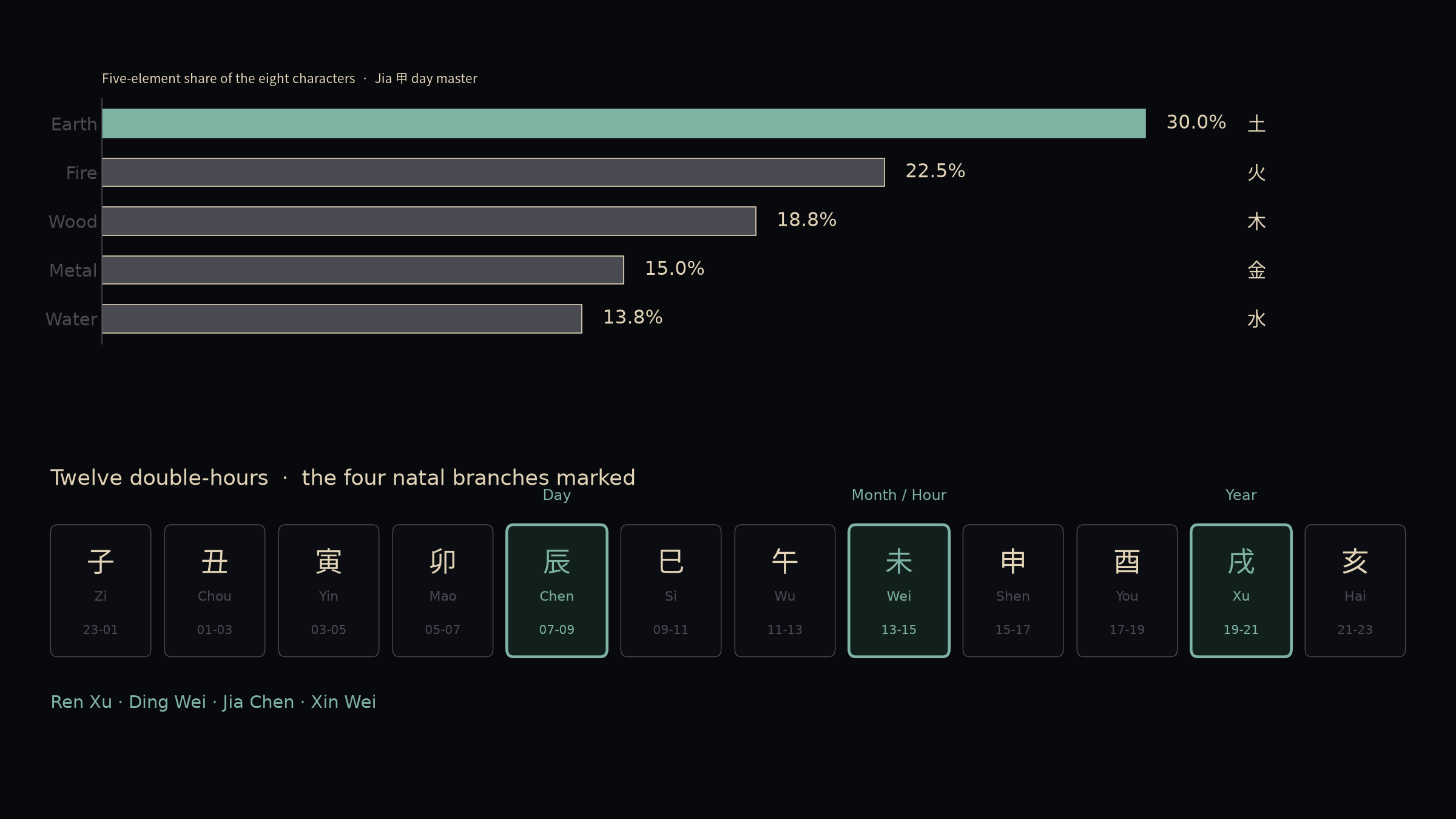
    BaZi vs Western astrology comparison diagram showing the five-element share of a Jia day master and the twelve double-hours with four natal branches marked
    Two BaZi geometries for one birth record: the element distribution (top) and the twelve double-hours with the four natal branches marked (bottom). A Western chart of the same moment would be a third geometry, a wheel of degrees.

    Reading the two side by side without confusing them

    Order matters, because the two systems disagree about the input before they disagree about the interpretation. Fix the moment first: convert clock time to true solar time for the birth longitude, then locate the moment inside the solar-term year. Our engine does both and reports the correction it applied, which is the only honest way to compare two charts of one person.

    Then read in layers. The year pillar describes inherited conditions. The month pillar describes professional method, because it is the pillar bounded by the seasonal term. The day pillar carries the day master and is the reference point for everything else. The hour pillar describes execution and the later part of life. Only after those positions are fixed does element share become meaningful, and it is read as balance rather than as a score.

    A Western chart read alongside is not a second opinion on the same layer. Its contribution is temperament language and relational pattern: how someone presents under pressure, and which conflicts recur. Keep the two readings in separate columns. The moment a report says a day master is Leo, the reader has lost both systems at once.

    Worked example: one birth record, two boundaries

    Take a birth on 20 July 1982 at 13:21 in Changshu, longitude 120.75 degrees east. Clock time becomes 13:17:43 true solar time, an adjustment of minus 3.28 minutes: the longitude term adds about three minutes against the 120-degree standard meridian, and the equation of time subtracts about six in late July. The engine returns four pillars, Ren Xu in the year, Ding Wei in the month, Jia Chen in the day and Xin Wei in the hour, with a Jia day master, yang wood, on a distribution of Earth 30.0, Fire 22.5, Wood 18.8, Metal 15.0 and Water 13.8 per cent. The decennial sequence begins at age six and runs forward; the current step, ages 36 to 45, is Xin Hai.

    Now move the boundaries, because that is where the comparison usually collapses. The same engine read at noon on 3 February 1983 returns a Ren Xu year; read at noon the next day it returns Gui Hai. The year changed on 4 February, five weeks after the Gregorian calendar did. The day boundary behaves the same way: a chart read at 23:30 civil time on 20 July had already moved to the Yi Si day, and the same Yi Si day appears after midnight. Someone comparing two apps will find one of them a day ahead, and the cause is a convention, not an error.

    Where this goes wrong

    The expensive failure is buying two reports, finding that they contradict, and using neither. The contradiction is usually a convention split inside one tradition rather than a clash between East and West. Western practice has its own version: tropical and sidereal zodiacs have drifted more than twenty degrees apart through precession, roughly one degree every seventy-two years, so two Western astrologers can disagree about a sun sign without either being careless. BaZi has the equivalent in true solar time and in the treatment of the late Zi hour.

    The second failure is vocabulary mixing, which sounds sophisticated and means nothing. A sentence that borrows relation types from one system and angular patterns from the other is not a synthesis; it is a category error with good production values.

    Operating directive

    State the question before choosing the instrument: disposition, component structure, or timing. Convert to true solar time and locate the solar-term year before comparing anything. Use Western language for temperament and relational pattern, and BaZi for element share and the pillar that carries a function. Staff the expensive function instead of training it. Never translate one vocabulary into the other, and record which convention each reading used.

    For a component-level map of one chart — element distribution, the ten gods by pillar, and the decennial sequence around them — the $19 BaZi Blueprint reports the arithmetic rather than the folklore. Readers who want the same birth record read through both systems at once use the $29 Master Astrological Codex Bundle, which runs the four pillars and the twelve-palace topology against one set of inputs.

    The year boundary used above is not a calendar convention but an astronomical one: the twelve month pillars are bounded by the major solar terms, and the Hong Kong Observatory publishes the tables that define them, alongside its notes on time conversion between clock time and solar time.

    BaZi and Western astrology are two disciplines of measurement rather than two claims about the future, and a measurement is only as good as the convention printed beside it.

    About the editor. Edward edits ChineseAstroCast and reviews every article against the site’s chart tables. Last updated November 2026.
  • Four Pillars of Destiny: A Complete Structural Reading

    Four Pillars of Destiny: A Complete Structural Reading

    • A four pillars of destiny reading is a scope document: it assigns each layer of a life to a question, and refuses the rest.
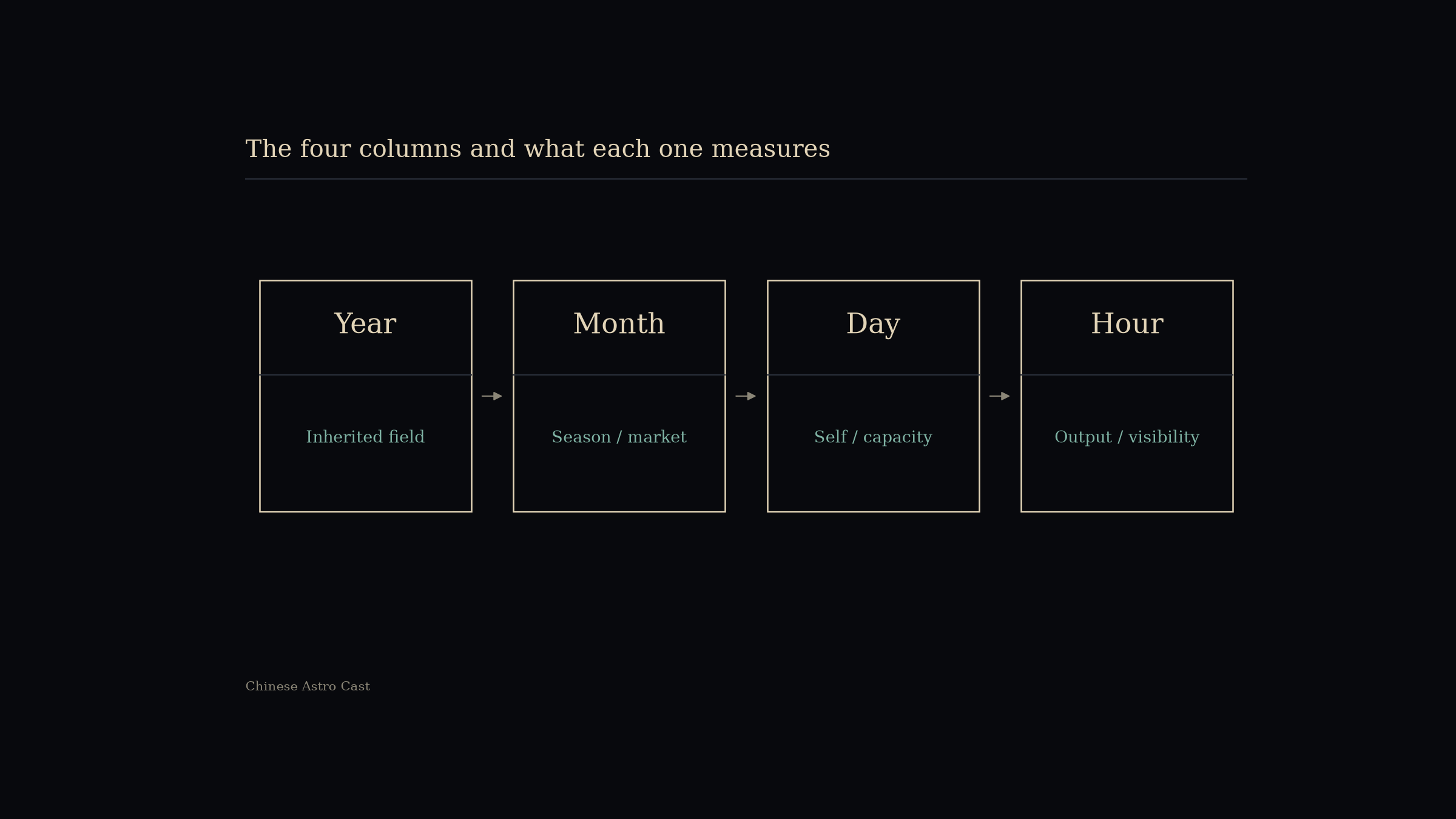
    • The eight characters are four columns — inherited field, season, self, output — and each column answers a different decision.
    • Read them in order, year to hour, because each column constrains the next one rather than restating it.
    • Read as structure, the chart describes capacity and environment; it never predicts an outcome.

    Most four pillars of destiny readings fail on scope, not on interpretation. The buyer receives four stems, four branches and eight paragraphs of adjectives, then has to guess which part applies to a decision. The term translates 四柱, four columns, and what separates a complete reading from a fragment is structural rather than poetic.

    What four pillars of destiny actually measures

    The four pillars are the birth moment written in the Chinese solar calendar: one column each for year, month, day and hour. Every column pairs a heavenly stem above an earthly branch. The stem states a function, a capability that can be deployed on request. The branch states the ground that function stands on: season, relations, and the hidden stems buried inside it. Eight characters, read as four layers of a single structure.

    The layers answer different questions. The year column describes the inherited field: generation, family baseline, the conditions nobody negotiated. The month column describes season, and it carries the most weight, because season is the market climate the person was formed inside. The day column holds the Day Master, the stem that describes the self, with the branch beneath it covering the private register: partnership, the body, what a person returns to when unobserved. The hour column describes execution, and what gets wanted after the visible career ends.

    Read that way, the system classifies conditions. It does not classify people. Jung made a similar move when he separated the self from the background of inherited material it forms against, on the observation that what looks like character is often a response to the field. Four pillars of destiny does not describe who you are. It describes the weather you were built for, then prices the cost of operating outside it.

    Why it matters for decision-makers

    Two executives with comparable track records can carry very different marginal cost for the same seat. A structure supported by strong Metal and Fire tolerates confrontation, short feedback loops and public reversals; it sharpens under friction. A structure heavy in Earth and Water does its best work across long horizons and low noise, and pays a visible price in a chaotic room. That is hiring information. It is not a verdict about the person, and it tells you where a capable one will be expensive, which is the part a reference call never surfaces.

    The columns also time. Luck pillars arrive as ten-year segments, each with its own stem and branch, and they re-weight the natal structure instead of replacing it. A decennial that reinforces the Day Master is one to expand in; a decennial that attacks it is one to consolidate and renegotiate inside. Applied to capital, the distinction turns concrete: a well-supported decade can carry an eighteen to thirty month build before returns are required, while an attacking decade argues for shorter duration, smaller cheques, more frequent checkpoints and revenue inside two quarters. The strategy stays. What moves is the term structure it can carry.

    Common misreadings

    Two errors recur. The first is reading the four columns as four personality types instead of four layers of one structure, which produces a shopping list of traits and no read on support. The second is treating the year pillar as identity. It is the least negotiable part of the chart and also the least personal: the month branch sets season, and season usually dominates inheritance. A third, subtler error is scoring the chart, counting elements as if a balanced structure were better. Balance is not an achievement. It is a different set of constraints.

    Diagram of the four pillars of destiny showing year, month, day and hour columns and the decision domain each one measures
    The four columns and the domain each one answers.

    How to read four pillars of destiny in order

    Work sequentially; the order is the method. First, fix the birth time to the minute and calibrate it to true solar time. Civil clock time is a different quantity from the solar time the calendar used, and the gap is longitude plus the equation of time, which reaches roughly a quarter of an hour in either direction. Second, state the Day Master plainly, element and polarity, and refuse to interpret anything else until you can. Third, read the month branch. It is the season, and it outranks the year column in almost every judgement.

    Fourth, map the remaining seven characters onto the ten gods by their relation to the Day Master: same element gives the Peer and the Competitor, what it produces gives the Creator and the Iconoclast, what it controls gives the Steward and the Venture Capitalist, what controls it gives the Institutional Architect and the Strategic Commander, what produces it gives the Scholar and the Visionary Tactician. Fifth, tally support against drain, meaning how much of the structure feeds the Day Master and how much extracts from it. Only then add the luck pillars as a timeline. A timeline laid over an unread structure narrates your own assumptions back to you.

    Worked example

    A finance chief runs a Fire Day Master born in the month of the Rat, the deep-winter branch where Water peaks and Water controls Fire. Nothing in the natal structure bridges the two: no Wood converts the attack into fuel. The operating record matched the structure. Cost programmes landed early and held; multi-year growth mandates stalled twice, both approved in December, when the attacking season peaked and planning optimism ran highest against the chart’s weakest quarter.

    The downstream damage was quiet because it looked like discipline. Two expansion programmes were funded, then descoped within nine months, and each was explained afterwards as a market call rather than a timing error. The procedural rule that followed was cheap: move capital commitments out of the month that duplicates the natal attack, and route them through a Wood bridge, meaning written business cases, staged gates, and an operator hired for origination instead of another analyst. The chart stayed as it was. The calendar of decisions moved.

    The year boundary is 立春, the second of the 24 solar terms tabulated by the Hong Kong Observatory, not 1 January — which is why a February birthday can carry the previous year’s pillar.

    Where the four pillars stop — the Ziwei cross-check

    Four pillars answer a question about conditions and timing: what a person is built to carry, and when the carrying cost changes. They are weaker on location, meaning which domain of a life a pressure actually lands in. That is the division of labour with Ziwei Dou Shu, whose twelve palaces partition a life into domains: Soul, Wealth, Career, Spouse, Health and the rest, each holding assigned archetypal forces. BaZi gives the climate. Ziwei gives the address.

    The value of running both is the disagreement, not the confirmation. When a BaZi structure shows an attacking decade and the Ziwei Career palace is simultaneously thin on supporting forces, two independent derivations have converged on one warning, and that convergence is what makes a reading usable in front of a board. When they diverge, the honest output is a narrower claim rather than a louder one. Anyone who wants both systems run against a single birth record, with points of agreement and friction both marked, can use the $29 Master Astrological Codex Bundle. It was built for the comparison, not for a longer single-system report.

    Operating directive

    Calibrate the birth time before you buy any reading; an hour off by one two-hour window can change the hour stem and rewrite the execution layer. Ask any practitioner which of the four columns they weight most, and treat a vague answer as a signal. Demand the support-and-drain tally in writing, as ratios rather than adjectives. Keep every reading tied to a decision you actually face this quarter, because a structure with no decision attached decays into trivia within a month. For a single-system read of your own four columns, with the ten gods and the current decennial marked, the $19 The BaZi Blueprint stays deliberately narrow: one birth record, one structure, no theatre.

    If you want the raw columns before buying anything, the free BaZi calculator returns the four pillars and the day master from a single birth record.

    Four pillars of destiny is a discipline of scope. It tells you which layer of a life answers which question, and it declines the questions it cannot reach.

    About the editor. Edward reviews every article against the site’s chart tables and the engine output quoted here. Last updated November 2026.
  • Zi Wei Dou Shu: The Twelve Palaces as a Life Topology

    Zi Wei Dou Shu: The Twelve Palaces as a Life Topology

    • Zi Wei Dou Shu is a fixed twelve-palace topology; the map is the product, not a prediction.
    • The palace order never changes — what changes is which stars land where, and the decade that reweights them.
    • The soul palace is read with its trine and opposite (wealth, career, travel), never on its own.
    • An empty palace is not a defect: it borrows its reading from the palace opposite it.

    Zi Wei Dou Shu is a twelve-palace map of a life, not a horoscope column, and most English summaries lose the map. What the system actually delivers is a fixed topology: twelve domains arranged in a ring, fourteen principal stars distributed across them, and a decade-by-decade weighting that shows where the same capability becomes expensive. Read as geometry, it belongs in a board meeting. Read as omens, it does not survive contact with a budget line.

    What Zi Wei Dou Shu actually measures

    The usual English rendering is Purple Star Astrology, and that title misleads twice. There is nothing astronomical about the purple star beyond a name for the pole star, and nothing astrological in the Western sense: no planets, no degrees, no aspects. The chart is built from the lunar date and the two-hour birth window, then twelve palaces are fixed in order around a ring, and fourteen main stars are placed into them by a deterministic rule set.

    Why the map comes before the reading

    A palace name is a slot, not a verdict. The slot says which domain of a life is being described; the stars inside it say what is happening in that domain; the decade says when. Keeping those three questions separate is what stops a palace name from being read as a personality trait, and it is the difference between a topological reading and a horoscope column.

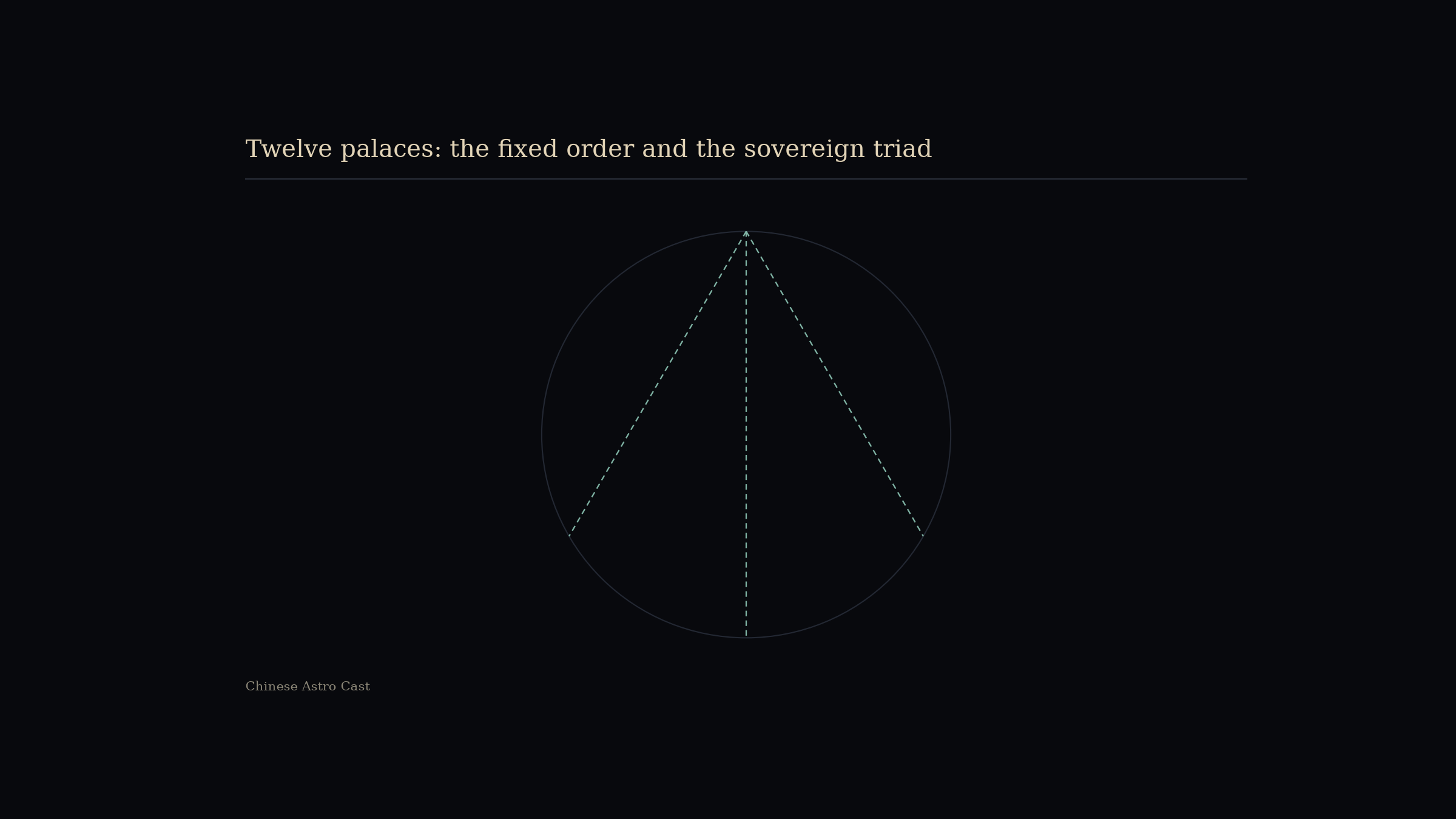
    Because the ring is fixed, every reading is relational. No palace gets judged alone. It is read with its two trine partners, four positions away on either side, and with the palace directly opposite. Practitioners call those four positions the Sovereign Triad and Axis. It is the smallest unit of meaning the system has: move one star and four domains shift at once.

    Two palaces carry the identity. The Soul Palace, ming gong, is the core conscious architecture: what the person treats as their own project, the register they default to under no instruction. The Body Palace, shen gong, is the operational instinct, and it is not a thirteenth palace. It falls on one of six existing palaces depending on the birth hour, marking where intention converts into behaviour. A person whose Body Palace lands in Wealth behaves differently under pressure from one whose Body Palace lands in Travel, even when their Soul Palaces are identical. The closest Western analogy is Jung’s split between the ego-complex and the compensatory function. One is what you claim. The other is what actually moves you.

    The twelve celestial offices the system inherits are catalogued in the 天官書 chapter of the Records of the Grand Historian, the Han-dynasty baseline for this vocabulary.

    Why it matters for decision-makers

    BaZi and Zi Wei Dou Shu answer different questions. Confuse them and you waste both. The four pillars describe capacity: how much load a structure carries, which season formed it, where it overreaches. The twelve palaces describe allocation: which domain of a life is carrying weight, and which is starved. An executive who has been told their capacity is strong still needs to know whether the load is currently sitting in Career, in Wealth, or in Property, because each has a different cost of correction.

    English summaries blur the Career Palace and the Wealth Palace more than any other pair. Career describes the arena in which the person is legible: the field where their competence reads as competence. Wealth describes how value actually arrives, including whether it arrives through salary, through equity, through partnership, or through an asset base that quietly compounds. A chart can show a strong Career field and a weak Wealth field, which is the signature of an operator who is visible, respected, and chronically underpaid. That is a structural diagnosis, and it has a remedy: move compensation out of the visible arena.

    The system also schedules. Each palace governs a decennial period, so the chart yields a sequence of ten-year activations rather than a static verdict. Practitioners call these da xian. The natal structure does not change; the weighting does. In a decade where the Wealth field is activated, expanding exposure is structurally cheaper. In a decade where the Health field is activated, the same expansion is paid for elsewhere. That is a calendar of attention, not a forecast of events, and it prices one decade against another.

    Common misreadings

    Most bad readings come from two errors. The first is treating star names as personality labels. Qi Sha is routinely rendered as the seven killings, which is a literal gloss and a poor description of a vector that mostly concerns decisive action under constraint. The second is reading a single palace in isolation. Because the ring is relational, a palace read alone will always look either flattering or alarming. Read with its triad, the same configuration usually resolves into something ordinary and specific.

    Ring diagram of the twelve Ziwei palaces in fixed order with the soul palace and its trine highlighted
    Palace order is fixed; the sovereign triad is read as one system.

    How to read it in your own chart

    Work in order. Do not skip the first step. An hour error does more damage here than in BaZi, because the hour branch decides which palace carries the Body Palace; get it wrong by one two-hour window and the operational reading moves with it.

    Read the trine before the palace

    The instinct is to open the soul palace and stop there. A trine reading runs the other way: the wealth palace shows what the structure spends on, the career palace shows where it is deployed, and the travel palace shows what it meets outside its own walls. Read those three first and the soul palace stops being a personality description and becomes a constraint at the centre of four claims.

    1. Confirm the birth moment against the correct calendar, including clock-time correction for longitude before conversion to the lunar date. Record the two-hour branch window, not just the clock hour.
    2. Locate the Soul Palace and note whether a principal star occupies it. Record the star’s element and whether it is bright or dim in that position.
    3. If the Soul Palace is empty, read the palace directly opposite as the borrowed register. Empty is not deficiency; it is a reading that depends on the opposite field, which is why empty-palace charts are usually more legible in middle age than in youth.
    4. Map the triad for the three palaces that matter commercially: Soul, Career, Wealth. Write down which stars appear in each field and which appear twice.
    5. Find where the birth-year transformation of obstruction, hua ji, lands. That palace is where friction concentrates, and friction is a budgeting question rather than a warning.
    6. Identify which palace the current decennial occupies, and read the chart through that palace first.

    Worked example

    Consider an illustrative case, not a specific client: a founder in her forties whose Soul Palace holds a single strong star and whose Body Palace falls in Career, while Wealth sits empty with its opposite palace carrying two supportive stars. Structurally, the identity is self-directed and the operational instinct pushes toward visible execution, which explains a pattern of taking the operating role personally rather than hiring it. The empty Wealth field means value arrives through the opposite register: through partners, distribution, and structures the founder does not personally run.

    The downstream consequence is quiet and expensive. A founder of this shape typically keeps improving the product, because that is where the Body Palace points, while the Wealth field stays borrowed and under-managed for years. The procedural rule that follows is blunt: when Wealth is empty and Career is occupied, the correct allocation of the founder’s attention is one quarter of what the instinct suggests, and the freed time belongs in the partner-facing register, where the actual return is booked.

    Where this goes wrong

    The costliest failure is a chart built on the wrong hour and then interpreted with full confidence. The reading looks coherent because the geometry is always coherent, and incoherence is not a signal the system gives you. Unless the practitioner asks for a birth certificate or runs an event-based rectification, assume nobody checked. The second failure is translation. Several English reports sold today are star tables rendered by machine, with the geometry dropped: star names and palace names survive, the relational reading does not. You can check this in ninety seconds by asking where the empty palace borrows from, and whether the answer names the opposite palace.

    A third failure is mistaking the report for the work. A $14 The Ziwei Astrolabe returns a correctly computed topology in English: twelve palaces, star placements, transformations, and the decennial sequence. That is the input to a decision. It is not the decision, and it will not tell you to sign a contract in March.

    Operating directive

    Verify the hour before you verify anything else, and treat an unrectified chart as provisional. Read every palace with its triad, and refuse to draw a conclusion from one palace alone. Locate the hua ji palace and convert it into a line item rather than a worry. Hold the Soul Palace and the Body Palace apart in your notes: one is what you claim, the other is what you do under pressure. If you want the two systems cross-checked rather than run separately, the $29 Master Astrological Codex Bundle pairs the four pillars with the twelve palaces, and the disagreements between them are the most useful part of the file.

    Zi Wei Dou Shu is a discipline of reading relations, not a verdict about a person. The palaces describe where attention is being spent; only the operator decides whether that allocation survives the next decade.

    About the editor. Edward reviews every article against the site’s chart tables and the engine output quoted here. Last updated November 2026.
  • Reading a BaZi Chart: A Capability Map for Executives

    Reading a BaZi Chart: A Capability Map for Executives

    • A bazi chart is eight characters of capacity data — how much load a person carries — not eight predictions.
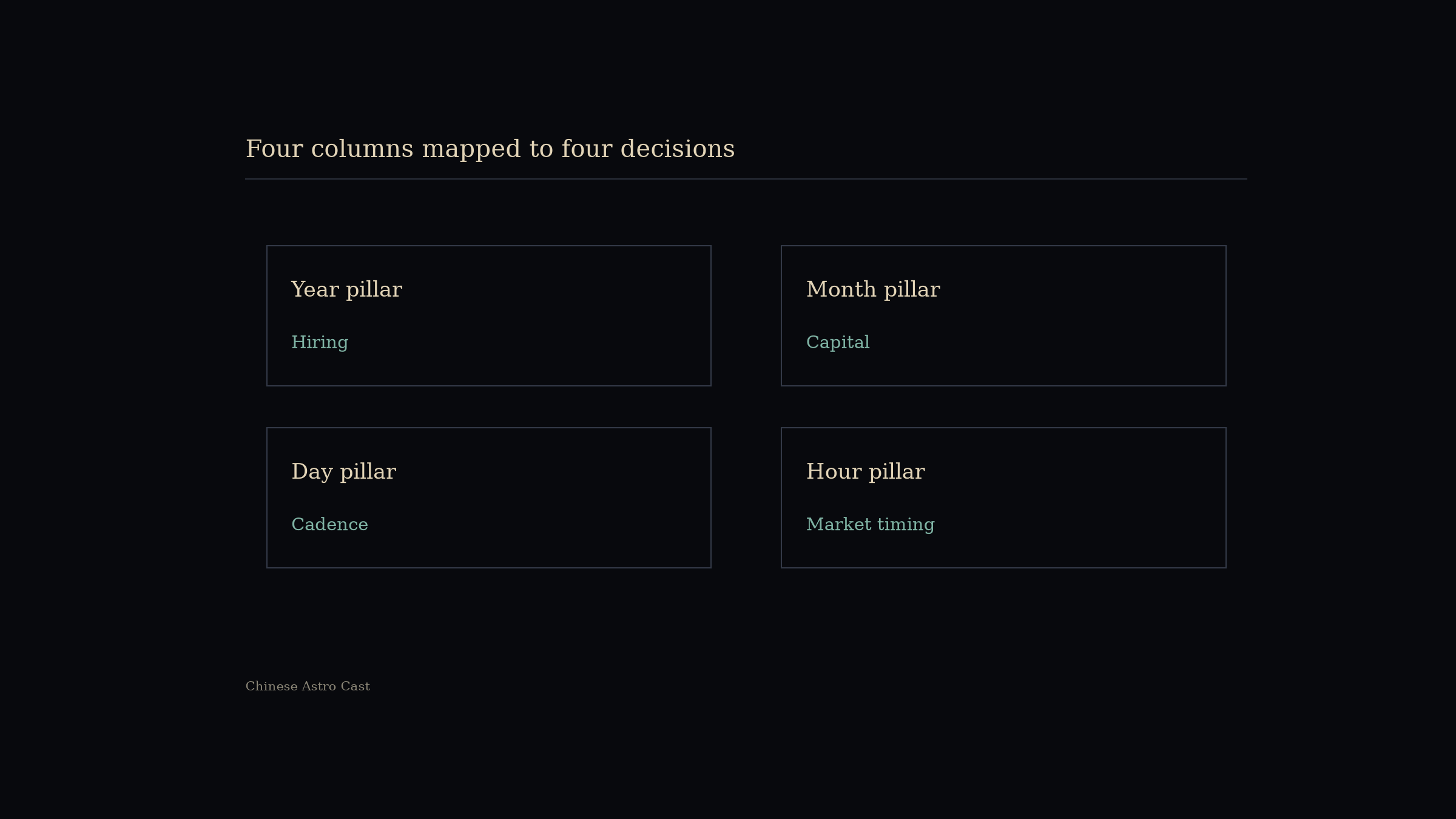
    • Four columns map to four decisions: hiring, capital, operating cadence, and market timing.
    • Which pillar carries the decision matters more than which element is ‘strong’.
    • The chart names where someone will over-apply effort; that is the part worth pricing into a role.

    A bazi chart is four pairs of characters, eight in total, and none of them is a prediction. They describe capacity: how much load a person carries, which environment suits them, and where they habitually overreach. Read as a capability map, a bazi chart belongs in the boardroom. Read as a script, it gets expensive fast.

    What a bazi chart actually measures

    The chart comes from the birth moment expressed in the Chinese solar calendar. Four pillars, each a heavenly stem above an earthly branch, for the year, month, day and hour. The year pillar describes the inherited field: generation, family baseline, the conditions nobody chose. The month pillar describes season, and it carries the most weight, because season is the industry, the market climate, the social field a person was formed inside. The day pillar holds the Day Master, the stem that describes the self. The branch beneath it describes the private register, meaning partnership, the body, and whatever a person returns to when unobserved. The hour pillar describes how output gets executed and what is wanted after the visible career ends.

    Capacity is not a score

    Eight characters do not add up to a rating. They describe where capacity is stored, what it costs to move it, and which conditions make it expensive to run. A candidate with a heavy month pillar and a thin day pillar is not weaker than the reverse — they are load-bearing in a different place, and the role has to match that place.

    What matters is never which elements are present but the ratios and the direction of flow. A chart with three Wood and no Water is not “a Wood person”. It is a system that expands without replenishment. The reading is structural: what supports the Day Master, what drains it, whether the month branch leaves it exposed. All of that describes operating conditions, and it sits closer to a balance sheet than to a forecast.

    Stems and branches do different work, a point most summaries skip. Stems describe function, the visible capability a person can deploy on demand. Branches describe context: the ground the capability stands on, including season, relationships and the hidden stems inside each branch. Two charts with identical stems can read differently because the ground beneath them is not the same. A capability is only as usable as the context holding it up, and the chart records both on one page.

    The stem-and-branch cycle the chart is built from, and the calendar it is read against, are both published in the Hong Kong Observatory’s calendar reference.

    Why it matters for decision-makers

    For an executive the value sits in cost curves, not verdicts. Two people can be equally capable and carry very different marginal cost for the same role. A structure with strong Metal and Fire tolerates confrontation, short feedback loops and public reversals; it gets sharper under friction. A structure heavy in Earth and Water does its best work across long horizons and low noise, and pays a visible price in a chaotic room. Hiring, delegation and even deal structure can be modelled against that. None of it replaces judgment. It tells you where judgment will be expensive.

    The chart also times. Luck pillars are ten-year segments, each with its own stem and branch, and they change the weighting of the natal structure rather than replacing it. A decennial that reinforces the Day Master is one to expand in. A decennial that attacks it is one to consolidate and renegotiate commitments. The structure does not choose. It prices one choice against another across a decade.

    Applied to capital, that distinction becomes concrete. A structure well supported in the current decennial can carry a longer payback period: eighteen to thirty months of build before a real return is tolerable. The same operator facing an attacking decade should shorten duration. Smaller cheques, more frequent checkpoints, and a preference for revenue that starts inside two quarters. The strategy does not change; its term structure does, because the chart says the carrying cost changed.

    Common misreadings

    Three errors recur. First, counting elements and reading the count as a score, when a balanced chart is not better than an unbalanced one, only differently constrained. Second, reading the year pillar as identity when the month branch sets the season and usually dominates it. Third, lifting one archetypal force out of the chart, the Strategic Commander or the Iconoclast, and treating it as a personality label. What matters is whether that force is supported, exposed or duplicated. A force that appears twice is rarely twice as strong; more often it is a fixed cost.

    Capability map diagram mapping the year, month, day and hour pillars to hiring, capital, cadence and market timing decisions
    Four columns, four decisions: the mapping is the reading.

    How to read it in your own chart

    Work in order and do not skip the first step. One: fix the birth time to the minute and calibrate it to true solar time. Nearly every online tool reads civil clock time, which is a different quantity. Two: locate the Day Master, the day stem, and ignore everything else until you can state its element and polarity plainly. Three: read the month branch. It is the season, and it outranks the year. Four: map the other seven characters onto the ten gods by their relationship to the Day Master. Same element gives Peer and Competitor. What it produces gives Creator and Iconoclast. What it controls gives Steward and Venture Capitalist. What controls it gives Institutional Architect and Strategic Commander. What produces it gives Scholar and Visionary Tactician. Five: tally support against drain. Six: only then add the luck pillars as a timeline.

    Which pillar carries the decision

    A board decision usually has one column behind it. Hiring a COO is a day-pillar question about load and appetite; opening a market is a month-pillar question about season and available support; pricing a launch is an hour-pillar question about output. Naming the column first keeps the reading from turning into a general description of a person, which is exactly the failure mode executives distrust.

    Worked example

    A founder in industrial distribution, born in an autumn month, runs a Wood Day Master. Autumn is Metal’s season, and Metal cuts Wood. On paper the structure reads as a person permanently under pressure, and for the first fifteen years that is what the operating record looked like: strong at winning mandates, thin on recovery. The structural correction was Water, the element that lets Metal generate Wood instead of cutting it. He moved his own role toward origination and advisory work, hired operators for delivery, and stopped taking the negotiation seat in every deal. Revenue was flat for a year. Senior-team churn was not.

    The downstream damage had been quiet for a long time. Roughly two departures a year, each explained as a bad fit, each a symptom of a role that demanded continuous exposure from a structure already under attack. The rule worth keeping: when a chart is structurally pressured, change the interface before increasing the effort. Effort against an attacking season buys endurance, and endurance has a ceiling.

    Where this goes wrong

    Two failure modes are common and one is expensive. The common ones are an uncalibrated chart, where an hour pillar off by one two-hour window changes the hour stem and sometimes the whole downstream reading, and treating the output as a fixed type, which turns a structural description into a label within a month. The expensive one is letting a chart override diligence. A favourable decennial is not evidence that a counterparty is solvent. A chart models the operator’s conditions, not the other side’s books. Where external facts exist, the chart is the last input, never the first. If you want capacity and palace topology cross-checked instead of consulted separately, the $29 Master Astrological Codex Bundle runs both systems against one birth record.

    Operating directive

    Calibrate the birth time before you read anything, because an uncalibrated hour is a different chart. Write the Day Master, the month branch and the four element ratios on a single page. If it does not fit on a page, you are reading too much. Separate capacity from timing: capacity is natal structure, timing is the decennial overlay, and confusing them produces either fatalism or overconfidence. When a decade attacks the Day Master, renegotiate scope instead of raising effort. Use the chart to ask better questions in hiring and deal review, never to close one. The $19 The BaZi Blueprint produces the structural reading described above; the interpretive judgment still belongs to you.

    The free BaZi calculator returns the same columns without interpretation — a place to practise reading before paying for one.

    A bazi chart is a discipline of reading constraints, not a label to wear. The moment it becomes an identity, it stops being information.

    About the editor. Edward reviews every article against the site’s chart tables and the engine output quoted here. Last updated November 2026.
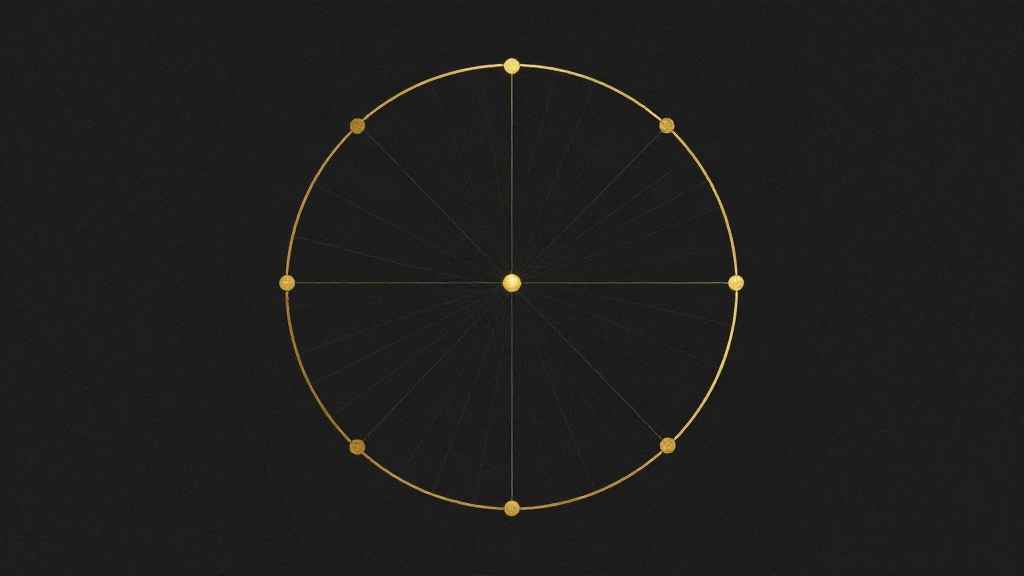
  • Chinese Zodiac Elements: Excess, Deficit and Somatic Load

    Chinese Zodiac Elements: Excess, Deficit and Somatic Load

    • Your birth-year element is a starting coordinate, not a reading of your character.
    • Balance is measured across all eight characters; the year stem is the outermost layer only.
    • Excess and deficit are different problems: excess over-spends, deficit borrows against something else.
    • Element load shows up as a somatic pattern — a recovery question, not a virtue question.

    Most people meet their Chinese zodiac element as a single word printed under their birth year: Wood, Fire, Earth, Metal or Water. A Chinese zodiac element is a starting coordinate, not a reading. It describes how a person takes in information and where they spend capacity. On its own, it says almost nothing about what they will do with either.

    What a Chinese zodiac element actually measures

    Classical Chinese astrology assigns one of five elements to each of the eight characters in a birth chart: the four pillars, each built from a heavenly stem and an earthly branch. The element you see under your birth year comes from the year stem, the most public layer of the chart. It is roughly how institutions, markets and strangers read you. Your day stem, the character most practitioners treat as the self, sits four positions later and often carries a different element entirely.

    The year stem is one layer of eight

    Reading an element off a birth year is reading the outermost layer of a chart that has four. The year pillar describes inherited conditions; the month describes the season the rest of the structure works in. That is why two people born in the same year can carry the same element word and still have opposite balances once the other six characters are counted.

    The five elements work better as psychological drivers than as substances. Wood is the growth and vision driver: curiosity, expansion, ethical ambition. Fire is the passion and charisma driver, meaning visibility, expression, and the willingness to be seen while the outcome is still uncertain. Earth is the foundation driver, which shows up as reliability, patience, and systems that keep holding after attention moves elsewhere. Metal is the precision driver: discernment, structure, the capacity to decline cleanly. Water is the intuition driver, which reads as adaptability, depth and strategic fluidity under pressure.

    Counts matter more than any single label. A chart with three Water characters and no visible Fire describes surplus adaptability and a deficit of public claim. That pattern shows up in how someone negotiates, not in what they believe about themselves. Traditional Chinese medicine makes the same move with constitutional typing. The useful question is never which type you are. It is where load accumulates when the system is stressed.

    The five-element scheme itself is set out in the Great Plan chapter of the Book of Documents, where 五行 first appears as a list of five capacities rather than five substances.

    Why element balance matters for decision-makers

    Executives usually reach this material at the moment their habitual style stops producing results. A founder whose chart is Wood-dominant builds quickly and consolidates badly, because the instinct that turns a prototype into a company also resists the operational patience a second stage requires. A Metal-dominant operator sets standards that hold, then cannot delegate, because delegated work arrives below the standard. Neither pattern is a character flaw. Both are predictable, and predictability is the whole of the value.

    The practical consequence is allocation. Element excess tells you where a leader will overspend attention without noticing. Element deficit tells you where they will under-invest until the gap surfaces as an incident. Read before a hiring round, this changes the brief. A Water-heavy leadership team does not need another strategist. It needs someone constitutionally willing to commit to a single number and defend it in a room. The same reading applies to risk appetite, to delegation depth, and to how a quarter gets laid out.

    There is a somatic layer here too, which is why the framework travels well with people who already track their own physiology. Excess tends to appear as a specific, repeatable form of strain rather than a vague malaise. Fire-dominant operators commonly run a sympathetic pattern: late sleep, early waking, a nervous system that will not stand down after the meeting ends. Water-dominant operators report the opposite failure mode. They can absorb an unreasonable load for months and then stop, with no gradient in between. Neither observation is a diagnosis. Both are load patterns worth scheduling around.

    Common misreadings

    Two mistakes account for most of what goes wrong. The first is reading the birth-year animal as the whole chart. The animal belongs to the year branch and describes a social register, not a constitution. Two people born in the same year share an animal and may hold opposite day stems, which is why the year label predicts so little. The second is treating a missing element as a permanent deficit. Absence from the visible eight characters does not mean absence from the structure. The month branch governs seasonal strength, and hidden stems inside the branches often supply what the surface appears to lack. A chart with no visible Fire can still hold Fire in the month branch, dormant until a Fire luck pillar arrives.

    Diagram of the five elements with the generating cycle in solid arrows and the controlling cycle in dashed lines
    Generating and controlling cycles: excess moves along one, deficit along the other.

    How to read your own elements

    Work in order, and do not skip the first step. Fix the birth data first: date, clock time, birthplace. Convert clock time to true solar time, because a two-hour pillar boundary is easy to cross by accident and an hour-pillar error changes the element count. Then list all eight characters and mark the element of every stem and every branch. Weight them: the day stem carries the most, the month branch governs how strong every other element is, and the year and hour pillars describe the public and the private register respectively. Note any excess above three characters of one element, and note absence entirely. Finally read the demand the structure makes, which is what it asks a person to build rather than what it hands them.

    The visible metal-wood clash and the structural version behave differently. Metal is boundary and Wood is expansion. When both are strong and adjacent, decisions stall at the point of commitment, because the same person argues for the opening and then argues against the terms. When the clash is only apparent, with Metal thin in the visible characters and Wood supplied by the month, there is no stall. There is a preference for movement that occasionally costs precision.

    Worked example

    A chief operating officer, born in the late 1970s, presents a chart with Water in the year, month and hour stems, a Yang Wood day stem, and no visible Fire. Three channels of adaptation feed one growth axis, and the visibility driver sits absent from the surface.

    The downstream consequence is consistent and expensive. She reads rooms faster than anyone else in the company and still loses the internal argument for her own budget, because she waits for a consensus her chart never required. The pattern is not indecision. It is surplus intake with insufficient claim. The rule that follows is a calendar rule: one visible commitment per week, meaning a decision announced, a number owned, a position staked in writing, scheduled the way a board meeting gets scheduled. Fire becomes an operational item rather than a personality transplant, and success is measured by whether the commitments land on the record, not by whether she feels more assertive afterwards.

    Where this goes wrong

    The expensive failure is buying a regimen keyed to one element: supplements, colours, direction-based seating charts, a diet built from a reading of one character out of eight. Cost without evidence, plus a false sense that the structure has been addressed. The second failure is using the chart as a licence. “I am Wood, so detail is not my strength” converts a description of load into an exemption from the work. The third, and the one that quietly damages careers, is reading the element in isolation from the role. A deficit only exists relative to a demand. Metal-thin is a liability in audit, a relief in a turnaround, and irrelevant in a research function nobody is measuring.

    Operating directive

    Get the birth data right before interpreting anything, and verify the hour pillar against true solar time. Count elements across all eight characters, recording excess and not only absence. Name the one place your dominant element overspends attention, then cap it with a rule rather than a resolution. Name the one place your deficit shows up under load, and put a procedure there. Re-read the chart in twelve months and compare it against what actually happened, because the only honest test of a structural reading is its hit rate on decisions. $19 The BaZi Blueprint does the counting and weighting for you and returns the demand rather than a label. If you want a second map of the same structure, the $29 Master Astrological Codex Bundle sets the twelve-palace topology alongside it.

    The free five elements chart renders that balance as a weighted map, which is worth looking at before you read any interpretation of it.

    Treat an element as a description of how capacity moves. Capacity can be scheduled; identity cannot.

    About the editor. Edward reviews every article against the site’s chart tables and the engine output quoted here. Last updated November 2026.