Executive Astrology

  • BaZi Compatibility: Reading Two Charts for Fit

    BaZi Compatibility: Reading Two Charts for Fit

    BaZi compatibility is a structural comparison of two charts, not a verdict on a relationship. The classical method weighs the day pillar first — the position that describes how a person meets the world — and then the balance of the five elements across both charts. What comes out is a description of where two operating styles will grate and where one chart supplies what the other lacks.

    • Compatibility is read on the day pillar of each chart, not on the birth-year animal; the animal is a twelve-year unit shared by roughly one person in twelve.
    • The fixed tables that pair the twelve branches — six harmonies, six clashes, six harms — describe process friction, not affection. A harmony does not promise a happy partnership and a clash does not forbid one.
    • Element percentages are the second axis: a chart carrying 0% Metal and a chart carrying 15% Metal are describing a supply relationship, not a personality match.
    • For a co-founder or a key hire, the useful output is a list of decisions that should not be shared, not a score out of ten.

    What compatibility actually compares

    Two people born in the same year share an animal and almost nothing else. The year pillar is the outermost ring of a BaZi chart — it describes the environment a person was born into, not the person. Compatibility readings that stop at the animal are comparing two twelve-year cohorts, which is why they produce the same answer for millions of people and no useful answer for any one of them.

    The classical method (合婚, the reading of a pair) works on the day pillar instead. The day stem is the Day Master, the reference point the whole chart is interpreted around; the day branch is the position that classical texts assign to the spouse palace. Whatever else a chart says, that branch is where a practitioner starts when two charts are laid beside each other.

    The day branch is the hinge

    The twelve branches have three fixed relation tables, each a lookup rather than a judgement. Six pairs form a harmony (子丑, 寅亥, 卯戌, 辰酉, 巳申, 午未). Six pairs clash, sitting directly opposite each other on the ring (子午, 丑未, 寅申, 卯酉, 辰戌, 巳亥). Six pairs harm (子未, 丑午, 寅巳, 卯辰, 申亥, 酉戌).

    Most readings skip the third table; it matters most in working relationships. A clash is loud. Two positions pull in opposite directions and the first meeting shows it. A harm is quiet — classically the least dramatic of the conflict pairs, describing friction in routine coordination rather than open opposition. Two people who agree on strategy and cannot agree on sequencing are usually looking at a harm, not a clash.

    Why the hour pillar is worth the trouble

    The hour pillar is where clock time becomes a problem. Our engine calibrates every birth to local apparent solar time before it assigns a branch; a birth recorded at 13:21 civil time in Changshu on 20 July 1982 resolves to 13:17:44 after a −3.27 minute correction. That shift is small enough to leave the hour unchanged. In Singapore the same correction runs to −74 minutes, and a 09:45 birth lands in the previous branch entirely. The Hong Kong Observatory’s conversion tables make that adjustment auditable.

    Two charts, side by side

    Take a worked pair from the engine. Chart A: 20 July 1982, 13:21, Changshu — 壬戌 year, 丁未 month, 甲辰 day, 辛未 hour, Day Master 甲 (Wood). Chart B: 17 February 1979, 07:40, New York — day pillar 乙卯, Day Master 乙 (Wood).

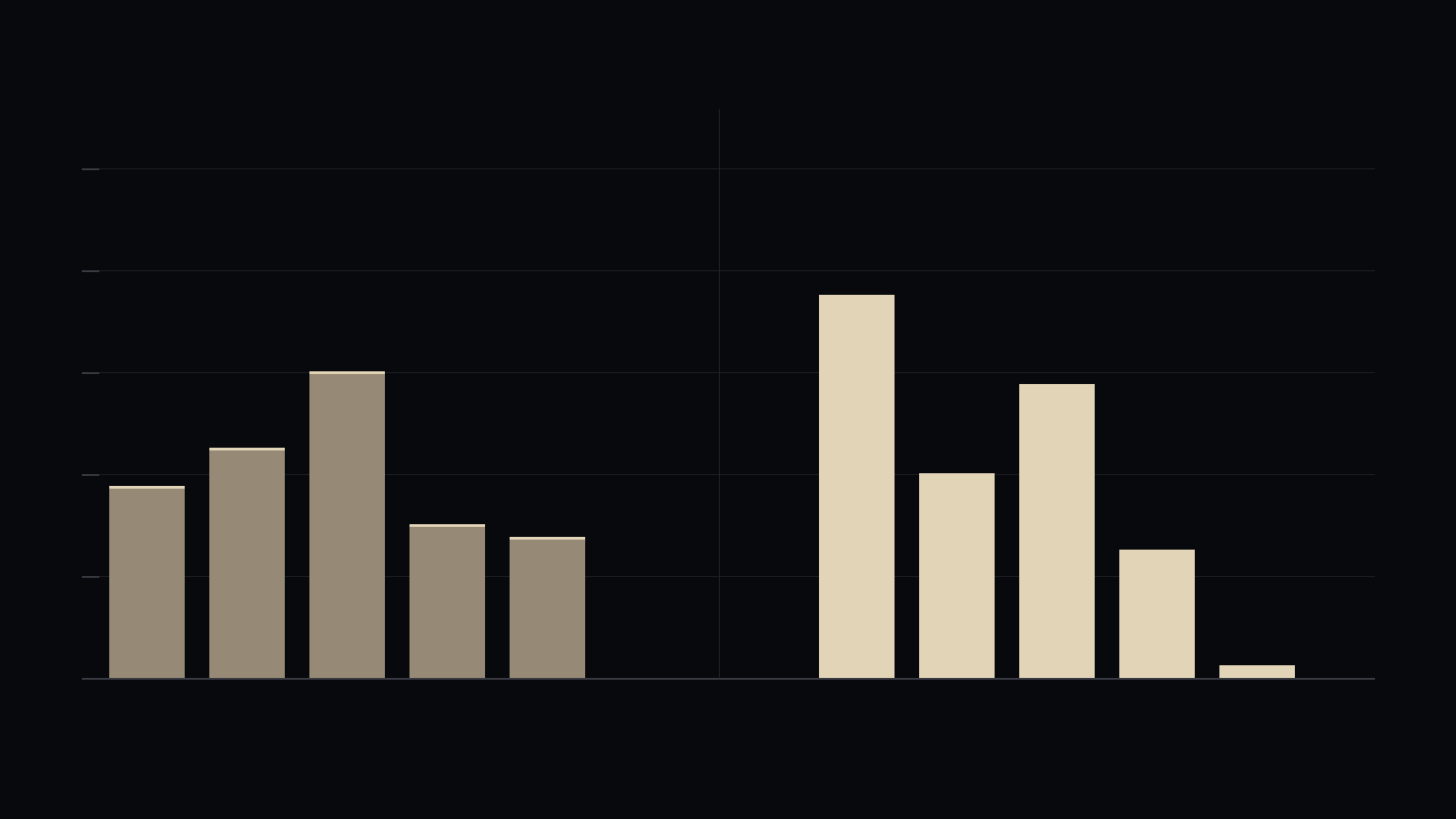
    They look similar on the element axis. A carries Wood 18.8%, Fire 22.5%, Earth 30.0%, Metal 15.0%, Water 13.8%. B carries Wood 37.5%, Fire 20.0%, Earth 28.8%, Metal 12.5%, Water 1.2%. Fire and Earth sit within two points of each other; Metal within three. A reading that scored element similarity would call this a strong match.

    The day branches disagree. A’s day branch is 辰; B’s is 卯. On the harm table, 卯 and 辰 are a pair. Two charts elementally close and relationally awkward are the combination every founder recognises: “we get along until we have to run something together”.
    BaZi compatibility comparison of five-element distribution in two charts, gold bars on charcoal, chart A against chart B
    Five-element distribution for the two charts compared in this article, in the fixed order Wood, Fire, Earth, Metal, Water. Chart A (left group) carries a balanced spread with Earth at 30.0%; chart B (right group) is Wood-dominant at 37.5% with Water at 1.2%. Drawn from the engine’s own weighting, not from raw character counts.

    Reading the second axis

    B’s Water sits at 1.2%. A supplies 13.8%. In the classical frame that is a supply relationship: the position B is thinnest in is the position A carries most comfortably. It does not make the pair harmonious, since the harm stands, but it does explain why the pairing feels useful in one direction and tiring in the other. B’s chart absorbs from A what it does not generate; A receives very little in return on the Wood axis, where B is nearly double.

    We ran the same comparison against a third chart as a control: 14 March 1988, 09:45, Singapore — 戊辰 day, Earth 47.5%, Metal 0.0%. Same day branch as A, which the tables treat as the weakest conflict class, a self-punishment that stays internal. On elements it is the more interesting pairing: a chart with no Metal meeting one carrying 15.0%. Similar structure, complementary material — the opposite arrangement to A and B.

    What the comparison cannot say

    It cannot rank people. No arithmetic in these tables produces a score, and any product handing you 87% has invented a scale and then attributed it to the tradition. The relation tables are categorical: a pair either sits on a listed pair or it does not.

    What a clash is not

    A clash between day branches is not a prohibition. It is a description of how two people handle the same decision: one moves first and refines later, the other refines first and moves late. Durable partnerships are often built on exactly that tension: the pair covers both failure modes. The clash becomes expensive only when both parties are asked to do the same job at the same moment.

    Putting it to work: the co-founder case

    This reading earns its place in an executive context because it produces constraints, not comfort. When a harm sits between two day branches, the practical translation is that routine coordination — scheduling, sequencing, who signs first — is the friction point, while strategic direction may be perfectly aligned. That is a governance finding, and it has cheap fixes.

    • Separate the calendars. A harm pair usually coordinates badly on shared timelines; give each partner their own operating cadence and one shared decision log rather than a joint sprint.
    • Do not co-sign. Split signature authority by domain, so a sequencing disagreement cannot stall a transaction.
    • Use the element gap deliberately. If one chart is the Metal supply and the other carries none, make the Metal-carrying partner the one who owns standards and review, and say so in the operating agreement.

    For a hire rather than a partner, the logic runs one direction: does the candidate’s day branch and element profile add a capability the team lacks? That question is answered by the second axis far more often than the first — and it is the kind of structural read a full BaZi Blueprint sets out position by position, day and hour pillars included.

    A three-step reading order

    Step one: fix both birth times

    Before anyone consults a table, both charts have to be cast from calibrated times. A 74-minute solar correction moves an hour pillar; a birth near a branch boundary without that correction produces a different chart, and two different charts cannot be compared. This is the most common way a compatibility reading goes wrong before it starts.

    Step two: read the day branches, then the elements

    Look up the pair on the three relation tables. Then — and only then — compare element percentages, looking for the position one chart supplies and the other lacks. Report both; they routinely disagree, and the disagreement is the finding.

    Step three: translate into decisions

    Convert each finding into one operating constraint. A harmony needs no action. A clash needs a decision-right split. A harm needs separate cadences and a written escalation path. If the pair of charts is going to govern money or a company, the Master Codex Bundle adds the twelve-palace topology that shows which domain each person’s chart concentrates authority in — the palace layer that a day-branch comparison alone cannot reach.

    About the editor. Edward edits ChineseAstroCast and reviews every article against the site’s chart tables. Last updated November 2026.
  • Four Pillars of Destiny: A Complete Structural Reading

    Four Pillars of Destiny: A Complete Structural Reading

    • A four pillars of destiny reading is a scope document: it assigns each layer of a life to a question, and refuses the rest.
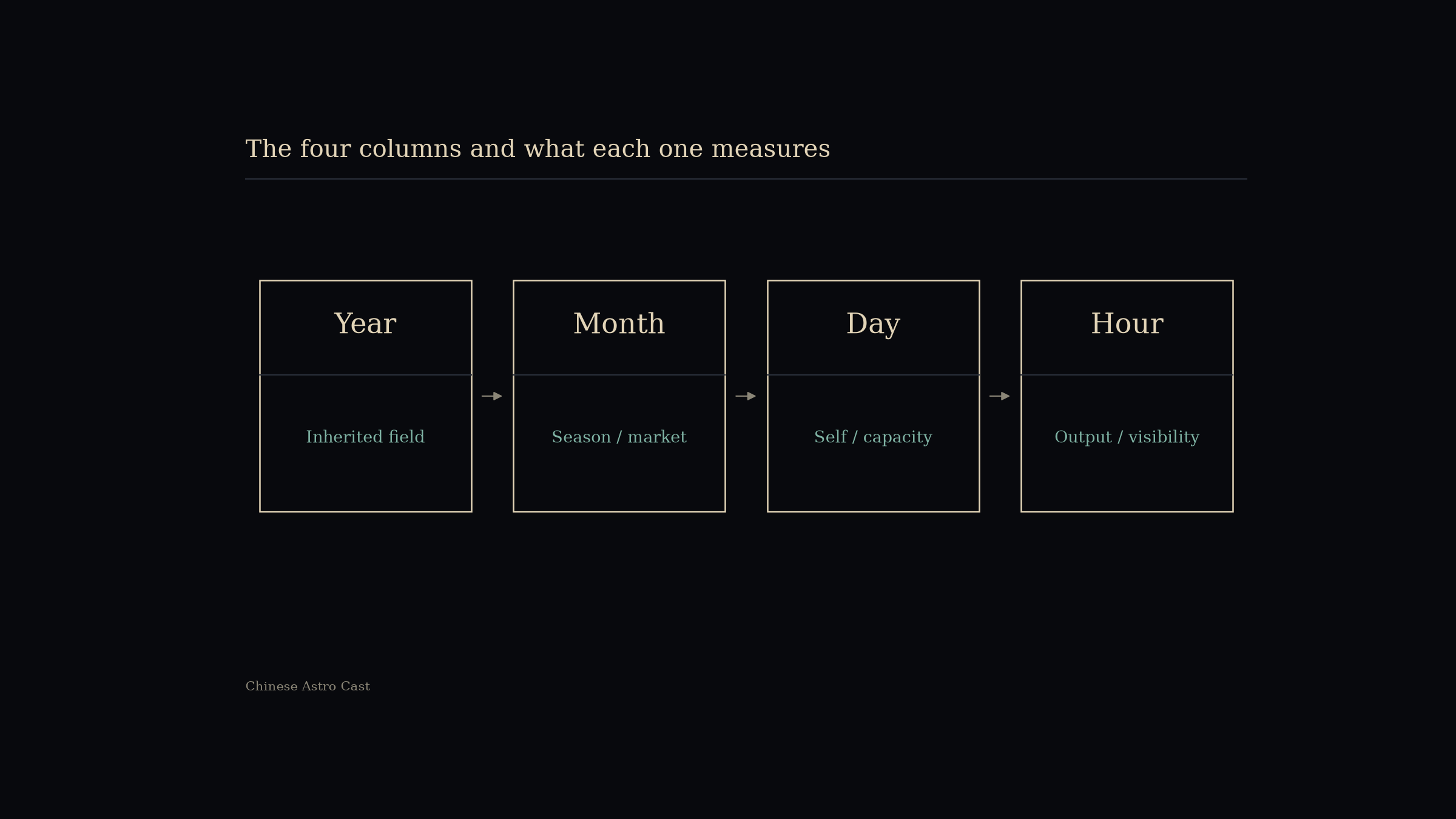
    • The eight characters are four columns — inherited field, season, self, output — and each column answers a different decision.
    • Read them in order, year to hour, because each column constrains the next one rather than restating it.
    • Read as structure, the chart describes capacity and environment; it never predicts an outcome.

    Most four pillars of destiny readings fail on scope, not on interpretation. The buyer receives four stems, four branches and eight paragraphs of adjectives, then has to guess which part applies to a decision. The term translates 四柱, four columns, and what separates a complete reading from a fragment is structural rather than poetic.

    What four pillars of destiny actually measures

    The four pillars are the birth moment written in the Chinese solar calendar: one column each for year, month, day and hour. Every column pairs a heavenly stem above an earthly branch. The stem states a function, a capability that can be deployed on request. The branch states the ground that function stands on: season, relations, and the hidden stems buried inside it. Eight characters, read as four layers of a single structure.

    The layers answer different questions. The year column describes the inherited field: generation, family baseline, the conditions nobody negotiated. The month column describes season, and it carries the most weight, because season is the market climate the person was formed inside. The day column holds the Day Master, the stem that describes the self, with the branch beneath it covering the private register: partnership, the body, what a person returns to when unobserved. The hour column describes execution, and what gets wanted after the visible career ends.

    Read that way, the system classifies conditions. It does not classify people. Jung made a similar move when he separated the self from the background of inherited material it forms against, on the observation that what looks like character is often a response to the field. Four pillars of destiny does not describe who you are. It describes the weather you were built for, then prices the cost of operating outside it.

    Why it matters for decision-makers

    Two executives with comparable track records can carry very different marginal cost for the same seat. A structure supported by strong Metal and Fire tolerates confrontation, short feedback loops and public reversals; it sharpens under friction. A structure heavy in Earth and Water does its best work across long horizons and low noise, and pays a visible price in a chaotic room. That is hiring information. It is not a verdict about the person, and it tells you where a capable one will be expensive, which is the part a reference call never surfaces.

    The columns also time. Luck pillars arrive as ten-year segments, each with its own stem and branch, and they re-weight the natal structure instead of replacing it. A decennial that reinforces the Day Master is one to expand in; a decennial that attacks it is one to consolidate and renegotiate inside. Applied to capital, the distinction turns concrete: a well-supported decade can carry an eighteen to thirty month build before returns are required, while an attacking decade argues for shorter duration, smaller cheques, more frequent checkpoints and revenue inside two quarters. The strategy stays. What moves is the term structure it can carry.

    Common misreadings

    Two errors recur. The first is reading the four columns as four personality types instead of four layers of one structure, which produces a shopping list of traits and no read on support. The second is treating the year pillar as identity. It is the least negotiable part of the chart and also the least personal: the month branch sets season, and season usually dominates inheritance. A third, subtler error is scoring the chart, counting elements as if a balanced structure were better. Balance is not an achievement. It is a different set of constraints.

    Diagram of the four pillars of destiny showing year, month, day and hour columns and the decision domain each one measures
    The four columns and the domain each one answers.

    How to read four pillars of destiny in order

    Work sequentially; the order is the method. First, fix the birth time to the minute and calibrate it to true solar time. Civil clock time is a different quantity from the solar time the calendar used, and the gap is longitude plus the equation of time, which reaches roughly a quarter of an hour in either direction. Second, state the Day Master plainly, element and polarity, and refuse to interpret anything else until you can. Third, read the month branch. It is the season, and it outranks the year column in almost every judgement.

    Fourth, map the remaining seven characters onto the ten gods by their relation to the Day Master: same element gives the Peer and the Competitor, what it produces gives the Creator and the Iconoclast, what it controls gives the Steward and the Venture Capitalist, what controls it gives the Institutional Architect and the Strategic Commander, what produces it gives the Scholar and the Visionary Tactician. Fifth, tally support against drain, meaning how much of the structure feeds the Day Master and how much extracts from it. Only then add the luck pillars as a timeline. A timeline laid over an unread structure narrates your own assumptions back to you.

    Worked example

    A finance chief runs a Fire Day Master born in the month of the Rat, the deep-winter branch where Water peaks and Water controls Fire. Nothing in the natal structure bridges the two: no Wood converts the attack into fuel. The operating record matched the structure. Cost programmes landed early and held; multi-year growth mandates stalled twice, both approved in December, when the attacking season peaked and planning optimism ran highest against the chart’s weakest quarter.

    The downstream damage was quiet because it looked like discipline. Two expansion programmes were funded, then descoped within nine months, and each was explained afterwards as a market call rather than a timing error. The procedural rule that followed was cheap: move capital commitments out of the month that duplicates the natal attack, and route them through a Wood bridge, meaning written business cases, staged gates, and an operator hired for origination instead of another analyst. The chart stayed as it was. The calendar of decisions moved.

    The year boundary is 立春, the second of the 24 solar terms tabulated by the Hong Kong Observatory, not 1 January — which is why a February birthday can carry the previous year’s pillar.

    Where the four pillars stop — the Ziwei cross-check

    Four pillars answer a question about conditions and timing: what a person is built to carry, and when the carrying cost changes. They are weaker on location, meaning which domain of a life a pressure actually lands in. That is the division of labour with Ziwei Dou Shu, whose twelve palaces partition a life into domains: Soul, Wealth, Career, Spouse, Health and the rest, each holding assigned archetypal forces. BaZi gives the climate. Ziwei gives the address.

    The value of running both is the disagreement, not the confirmation. When a BaZi structure shows an attacking decade and the Ziwei Career palace is simultaneously thin on supporting forces, two independent derivations have converged on one warning, and that convergence is what makes a reading usable in front of a board. When they diverge, the honest output is a narrower claim rather than a louder one. Anyone who wants both systems run against a single birth record, with points of agreement and friction both marked, can use the $29 Master Astrological Codex Bundle. It was built for the comparison, not for a longer single-system report.

    Operating directive

    Calibrate the birth time before you buy any reading; an hour off by one two-hour window can change the hour stem and rewrite the execution layer. Ask any practitioner which of the four columns they weight most, and treat a vague answer as a signal. Demand the support-and-drain tally in writing, as ratios rather than adjectives. Keep every reading tied to a decision you actually face this quarter, because a structure with no decision attached decays into trivia within a month. For a single-system read of your own four columns, with the ten gods and the current decennial marked, the $19 The BaZi Blueprint stays deliberately narrow: one birth record, one structure, no theatre.

    If you want the raw columns before buying anything, the free BaZi calculator returns the four pillars and the day master from a single birth record.

    Four pillars of destiny is a discipline of scope. It tells you which layer of a life answers which question, and it declines the questions it cannot reach.

    About the editor. Edward reviews every article against the site’s chart tables and the engine output quoted here. Last updated November 2026.

  • Reading a BaZi Chart: A Capability Map for Executives

    Reading a BaZi Chart: A Capability Map for Executives

    • A bazi chart is eight characters of capacity data — how much load a person carries — not eight predictions.
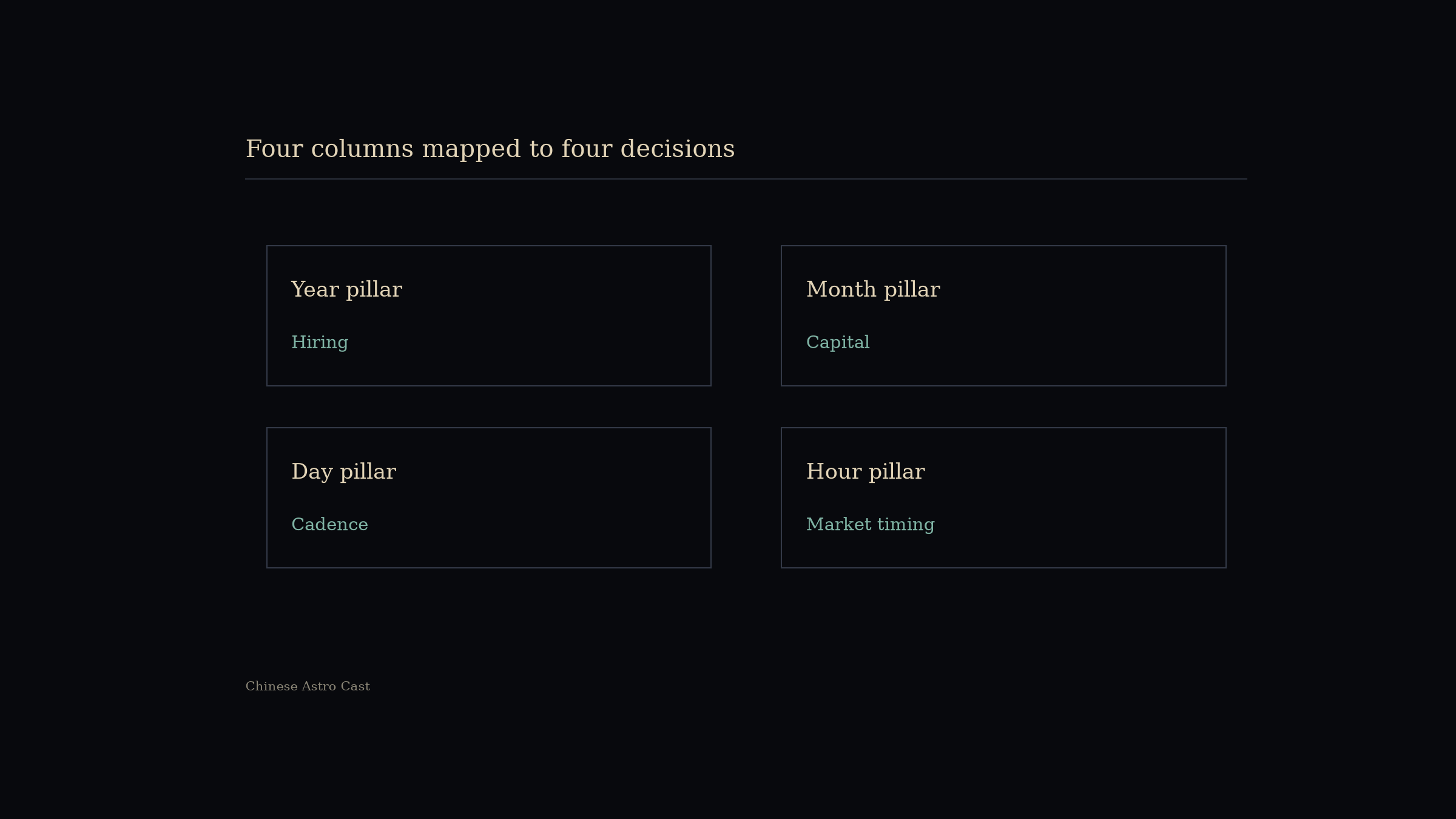
    • Four columns map to four decisions: hiring, capital, operating cadence, and market timing.
    • Which pillar carries the decision matters more than which element is ‘strong’.
    • The chart names where someone will over-apply effort; that is the part worth pricing into a role.

    A bazi chart is four pairs of characters, eight in total, and none of them is a prediction. They describe capacity: how much load a person carries, which environment suits them, and where they habitually overreach. Read as a capability map, a bazi chart belongs in the boardroom. Read as a script, it gets expensive fast.

    What a bazi chart actually measures

    The chart comes from the birth moment expressed in the Chinese solar calendar. Four pillars, each a heavenly stem above an earthly branch, for the year, month, day and hour. The year pillar describes the inherited field: generation, family baseline, the conditions nobody chose. The month pillar describes season, and it carries the most weight, because season is the industry, the market climate, the social field a person was formed inside. The day pillar holds the Day Master, the stem that describes the self. The branch beneath it describes the private register, meaning partnership, the body, and whatever a person returns to when unobserved. The hour pillar describes how output gets executed and what is wanted after the visible career ends.

    Capacity is not a score

    Eight characters do not add up to a rating. They describe where capacity is stored, what it costs to move it, and which conditions make it expensive to run. A candidate with a heavy month pillar and a thin day pillar is not weaker than the reverse — they are load-bearing in a different place, and the role has to match that place.

    What matters is never which elements are present but the ratios and the direction of flow. A chart with three Wood and no Water is not “a Wood person”. It is a system that expands without replenishment. The reading is structural: what supports the Day Master, what drains it, whether the month branch leaves it exposed. All of that describes operating conditions, and it sits closer to a balance sheet than to a forecast.

    Stems and branches do different work, a point most summaries skip. Stems describe function, the visible capability a person can deploy on demand. Branches describe context: the ground the capability stands on, including season, relationships and the hidden stems inside each branch. Two charts with identical stems can read differently because the ground beneath them is not the same. A capability is only as usable as the context holding it up, and the chart records both on one page.

    The stem-and-branch cycle the chart is built from, and the calendar it is read against, are both published in the Hong Kong Observatory’s calendar reference.

    Why it matters for decision-makers

    For an executive the value sits in cost curves, not verdicts. Two people can be equally capable and carry very different marginal cost for the same role. A structure with strong Metal and Fire tolerates confrontation, short feedback loops and public reversals; it gets sharper under friction. A structure heavy in Earth and Water does its best work across long horizons and low noise, and pays a visible price in a chaotic room. Hiring, delegation and even deal structure can be modelled against that. None of it replaces judgment. It tells you where judgment will be expensive.

    The chart also times. Luck pillars are ten-year segments, each with its own stem and branch, and they change the weighting of the natal structure rather than replacing it. A decennial that reinforces the Day Master is one to expand in. A decennial that attacks it is one to consolidate and renegotiate commitments. The structure does not choose. It prices one choice against another across a decade.

    Applied to capital, that distinction becomes concrete. A structure well supported in the current decennial can carry a longer payback period: eighteen to thirty months of build before a real return is tolerable. The same operator facing an attacking decade should shorten duration. Smaller cheques, more frequent checkpoints, and a preference for revenue that starts inside two quarters. The strategy does not change; its term structure does, because the chart says the carrying cost changed.

    Common misreadings

    Three errors recur. First, counting elements and reading the count as a score, when a balanced chart is not better than an unbalanced one, only differently constrained. Second, reading the year pillar as identity when the month branch sets the season and usually dominates it. Third, lifting one archetypal force out of the chart, the Strategic Commander or the Iconoclast, and treating it as a personality label. What matters is whether that force is supported, exposed or duplicated. A force that appears twice is rarely twice as strong; more often it is a fixed cost.

    Capability map diagram mapping the year, month, day and hour pillars to hiring, capital, cadence and market timing decisions
    Four columns, four decisions: the mapping is the reading.

    How to read it in your own chart

    Work in order and do not skip the first step. One: fix the birth time to the minute and calibrate it to true solar time. Nearly every online tool reads civil clock time, which is a different quantity. Two: locate the Day Master, the day stem, and ignore everything else until you can state its element and polarity plainly. Three: read the month branch. It is the season, and it outranks the year. Four: map the other seven characters onto the ten gods by their relationship to the Day Master. Same element gives Peer and Competitor. What it produces gives Creator and Iconoclast. What it controls gives Steward and Venture Capitalist. What controls it gives Institutional Architect and Strategic Commander. What produces it gives Scholar and Visionary Tactician. Five: tally support against drain. Six: only then add the luck pillars as a timeline.

    Which pillar carries the decision

    A board decision usually has one column behind it. Hiring a COO is a day-pillar question about load and appetite; opening a market is a month-pillar question about season and available support; pricing a launch is an hour-pillar question about output. Naming the column first keeps the reading from turning into a general description of a person, which is exactly the failure mode executives distrust.

    Worked example

    A founder in industrial distribution, born in an autumn month, runs a Wood Day Master. Autumn is Metal’s season, and Metal cuts Wood. On paper the structure reads as a person permanently under pressure, and for the first fifteen years that is what the operating record looked like: strong at winning mandates, thin on recovery. The structural correction was Water, the element that lets Metal generate Wood instead of cutting it. He moved his own role toward origination and advisory work, hired operators for delivery, and stopped taking the negotiation seat in every deal. Revenue was flat for a year. Senior-team churn was not.

    The downstream damage had been quiet for a long time. Roughly two departures a year, each explained as a bad fit, each a symptom of a role that demanded continuous exposure from a structure already under attack. The rule worth keeping: when a chart is structurally pressured, change the interface before increasing the effort. Effort against an attacking season buys endurance, and endurance has a ceiling.

    Where this goes wrong

    Two failure modes are common and one is expensive. The common ones are an uncalibrated chart, where an hour pillar off by one two-hour window changes the hour stem and sometimes the whole downstream reading, and treating the output as a fixed type, which turns a structural description into a label within a month. The expensive one is letting a chart override diligence. A favourable decennial is not evidence that a counterparty is solvent. A chart models the operator’s conditions, not the other side’s books. Where external facts exist, the chart is the last input, never the first. If you want capacity and palace topology cross-checked instead of consulted separately, the $29 Master Astrological Codex Bundle runs both systems against one birth record.

    Operating directive

    Calibrate the birth time before you read anything, because an uncalibrated hour is a different chart. Write the Day Master, the month branch and the four element ratios on a single page. If it does not fit on a page, you are reading too much. Separate capacity from timing: capacity is natal structure, timing is the decennial overlay, and confusing them produces either fatalism or overconfidence. When a decade attacks the Day Master, renegotiate scope instead of raising effort. Use the chart to ask better questions in hiring and deal review, never to close one. The $19 The BaZi Blueprint produces the structural reading described above; the interpretive judgment still belongs to you.

    The free BaZi calculator returns the same columns without interpretation — a place to practise reading before paying for one.

    A bazi chart is a discipline of reading constraints, not a label to wear. The moment it becomes an identity, it stops being information.

    About the editor. Edward reviews every article against the site’s chart tables and the engine output quoted here. Last updated November 2026.

  • Why BaZi Calculators Disagree: True Solar Time Explained

    Why BaZi Calculators Disagree: True Solar Time Explained

    • Three calculators return three hour pillars because each one defines noon differently.
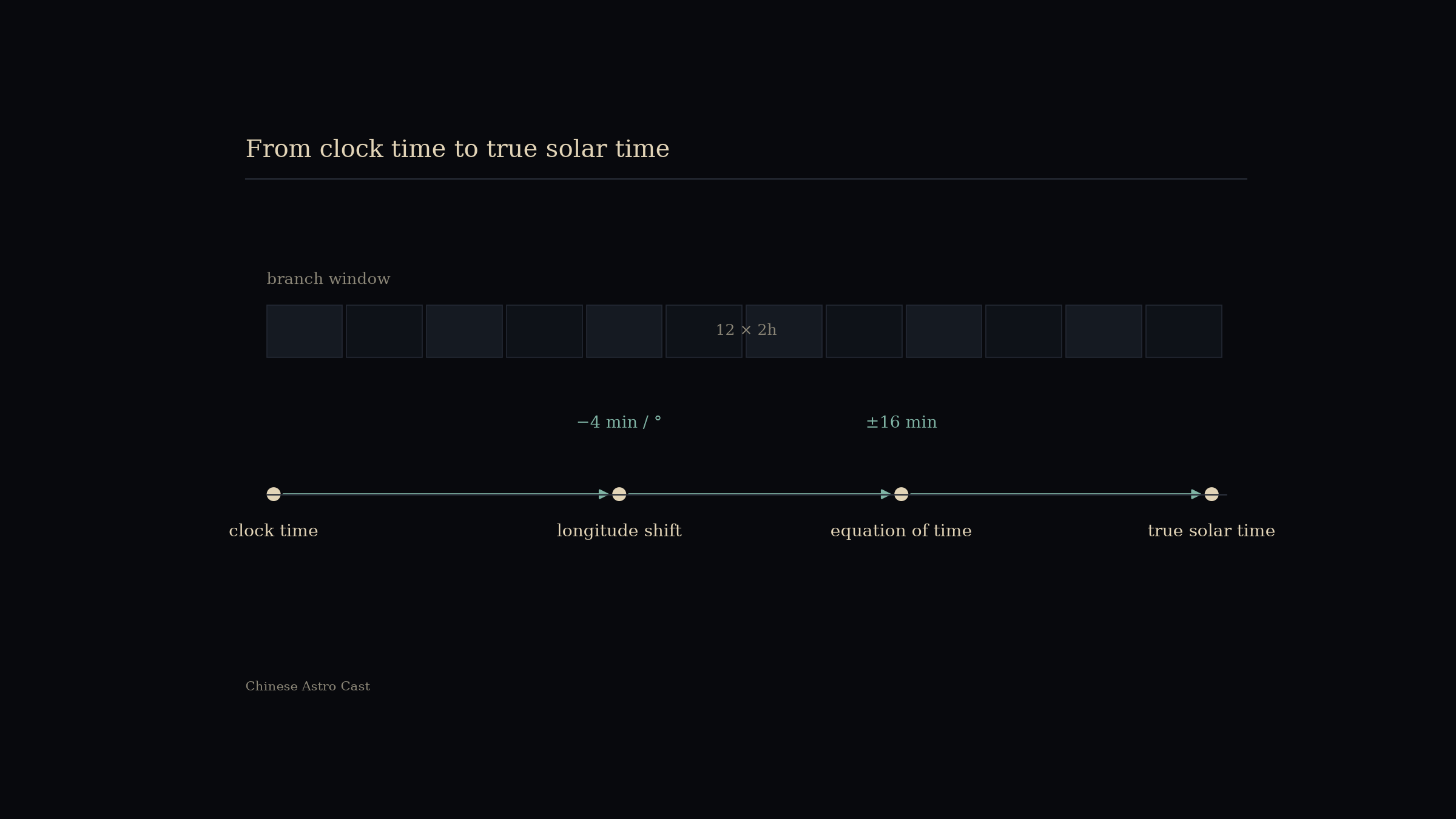
    • True solar time = clock time + longitude correction + equation of time; both corrections are something an honest tool can show you.
    • A two-degree longitude error moves the reading by about eight minutes — enough to cross a two-hour boundary and change the pillar.
    • Calibrate before interpreting: an uncalibrated chart is simply a different chart.

    Run the same birth data through three BaZi calculators and you will often get three different hour pillars. Each engine picks a clock and most never say which one. What reads as sloppy arithmetic is usually a disagreement about the definition of noon.

    What a BaZi calculator actually measures

    A BaZi chart is a timestamp written in four pairs of characters. Each pair, or pillar, carries one Heavenly Stem and one Earthly Branch drawn from a sexagenary cycle that advances with the solar calendar rather than the Gregorian one. The year pillar turns at the Start of Spring solar term in early February, not on January the first. The month pillar turns at each of the twelve major solar terms. The day pillar advances one step per day, without gaps.

    Three of those four layers survive translation between engines intact, because they depend only on the date. The fourth depends on something no clock records: where the sun stood above the birth location at that moment. A calendar hands you civil time. A chart needs apparent solar time. The two quantities differ, and the difference is large enough to move a boundary.

    Engines also differ in how they handle the solar term edges. One rounds the Start of Spring to the nearest minute, another to the nearest hour. For a birth two days away from the term this is irrelevant. For a birth inside the boundary hour it changes the year pillar, and with it the entire frame of the reading. Precision claims on a marketing page rarely specify which of these choices the engine made.

    Why the hour pillar is the fragile layer

    The hour pillar splits the day into twelve windows of two hours each, and those windows are anchored to the sun rather than to the wrist. The noon window is centred on local solar noon. The midnight window opens at 23:00 apparent time and closes at 01:00, which is also the point where most schools roll the day pillar forward. Anything measured from that boundary inherits its precision, or its error.

    Three corrections separate clock time from solar time. Longitude comes first. Every degree east or west of the standard meridian shifts local noon by four minutes. China is the extreme case: a single zone built on 120 degrees east, while Chengdu sits near 104 degrees. That gap is 64 minutes. A birth recorded at 00:40 in Chengdu happened, in solar terms, during the previous evening’s window, so the day pillar belongs to the day before.

    The second correction is the equation of time, the gap between mean and apparent solar time created by the tilt of Earth’s axis and the eccentricity of its orbit. It runs from roughly minus 14 minutes in mid-February to plus 16 minutes in early November. The third is daylight saving, a clean 60 minutes that no birth certificate ever annotates. Add all three and a chart can drift by ninety minutes before anyone has made a mistake.

    Common misreadings

    Two errors produce most of the confusion. The first is deciding the engine is broken when two sites disagree. Usually both are internally consistent and calibrated to different conventions, and neither publishes its convention. The second is treating the hour pillar as decoration because the day master feels more personal. The hour layer governs the operational style, the later palaces and the internal balance of the ten gods. Shift it one window sideways and the reading still sounds plausible, which is precisely the problem.

    Timeline showing clock time, longitude correction and equation of time combining into true solar time, above the twelve two-hour branch windows
    Two corrections sit between the clock on the wall and the branch window.

    How to calibrate before you read anything

    Do the arithmetic in a fixed order and write the result down before you open the chart. The sequence matters more than the precision.

    1. Strip daylight saving from the recorded time if the birth fell inside a summer-time window.
    2. Convert longitude to minutes: subtract or add four minutes for each degree between the birthplace and the zone’s standard meridian.
    3. Apply the equation of time for that date, which you can look up to the nearest half minute.
    4. Compare the result against the twelve window boundaries and note the margin.
    5. Flag any birth within twenty minutes of a boundary and run the reading twice, once in each adjacent window.

    The fifth step is where most of the value sits. A drift of six minutes changes nothing. A drift of six minutes across a boundary changes the hour stem, and with it the relationship between the hour and the day master. When the margin is thin, the honest move is to test both readings against lived behaviour rather than to pick the tidier one.

    There is one convention question the arithmetic cannot settle. A minority of schools keep the day pillar on the civil midnight, so a birth at 23:30 belongs to the same day as 22:00 and 00:30 alike. The older reckoning opens the new day at 23:00. Both are defensible, and the choice matters most for births inside that single hour. What is not defensible is switching convention between charts without saying so.

    A worked example

    A founder born in Boston in mid-July, recorded at 07:20 on the certificate during daylight saving. Strip the hour: 06:20 standard clock. Boston sits at 71.06 degrees west against a 75 degree meridian, so add 15.8 minutes for longitude and the result is 06:36 local mean time.

    The equation of time in mid-July is about minus 6 minutes, which gives 06:30 apparent solar time. That lands inside the 05:00 to 07:00 window. The uncalibrated 07:20 would have landed in the next window, with a different branch, a different hour stem and a different relationship to the day master. Fifty minutes of bookkeeping separates two different readings of the same person.

    The downstream damage is quiet. A different hour stem changes the ten god attached to the hour pillar, which changes the stated relationship between a person’s output and their authority, and it shifts the hour branch that anchors the Ziwei palaces. Nothing in the report announces the swap; the prose simply describes a neighbouring configuration with the same confidence.

    The practical fix is procedural rather than technical. Ask every chart you inherit one question — which clock produced this hour pillar. Certificate time, hospital record time and the time a parent remembers are three different inputs, and only one of them has been calibrated.

    The apparent-solar-time calculation behind both corrections is documented in NOAA’s solar calculator, with the equation-of-time curve published as a table.

    Where this goes wrong

    The expensive failure is not a wrong chart. It is a chart that is right about the wrong person. A consultant reads an hour stem that belongs to the neighbouring window and describes a decision style the client does not have. The client recognises enough of the description to accept the rest, and a strategy gets built on a mislabelled strength.

    The same error propagates into Ziwei Dou Shu, where the birth hour determines the position of the Soul Palace. One uncorrected clock reading displaces an entire twelve-palace topology, and the resulting advice can be coherent, detailed and aimed at somebody else. The cheaper failure is inconsistency: calibrate one chart and not the next, and you can no longer compare two people, which is most of what an advisory practice does with a system like this.

    Operating directive

    Record the birthplace coordinates before you record anything else, because longitude is the correction people skip. State the convention your chart uses, in writing, so a second reader can reproduce it. Run every boundary case twice and keep both versions in the file.

    Treat calibration as part of the reading rather than an IT chore. The $19 The BaZi Blueprint applies true solar time before any interpretation begins, so the hour pillar you read is the one the sky actually produced. Where the stakes justify a cross-check, the $29 Master Astrological Codex Bundle pairs the same calibrated birth data with a twelve-palace Ziwei chart, which makes a displaced hour visible rather than silently absorbed.

    The free BaZi calculator shows the true solar time it used, so the displacement is visible rather than absorbed into the result.

    A BaZi calculator is a measurement instrument, and the hour pillar is the reading that tells you whether it was calibrated.

    About the editor. Edward reviews every article against the site’s chart tables and the engine output quoted here. Last updated November 2026.