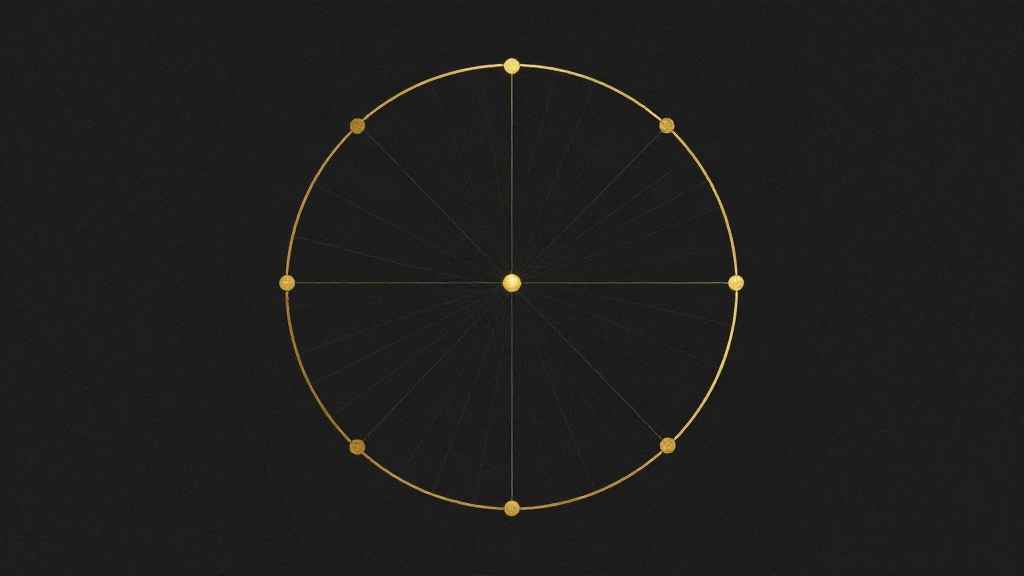
- Zi Wei Dou Shu is a fixed twelve-palace topology; the map is the product, not a prediction.
- The palace order never changes — what changes is which stars land where, and the decade that reweights them.
- The soul palace is read with its trine and opposite (wealth, career, travel), never on its own.
- An empty palace is not a defect: it borrows its reading from the palace opposite it.
Zi Wei Dou Shu is a twelve-palace map of a life, not a horoscope column, and most English summaries lose the map. What the system actually delivers is a fixed topology: twelve domains arranged in a ring, fourteen principal stars distributed across them, and a decade-by-decade weighting that shows where the same capability becomes expensive. Read as geometry, it belongs in a board meeting. Read as omens, it does not survive contact with a budget line.
What Zi Wei Dou Shu actually measures
The usual English rendering is Purple Star Astrology, and that title misleads twice. There is nothing astronomical about the purple star beyond a name for the pole star, and nothing astrological in the Western sense: no planets, no degrees, no aspects. The chart is built from the lunar date and the two-hour birth window, then twelve palaces are fixed in order around a ring, and fourteen main stars are placed into them by a deterministic rule set.
Why the map comes before the reading
A palace name is a slot, not a verdict. The slot says which domain of a life is being described; the stars inside it say what is happening in that domain; the decade says when. Keeping those three questions separate is what stops a palace name from being read as a personality trait, and it is the difference between a topological reading and a horoscope column.
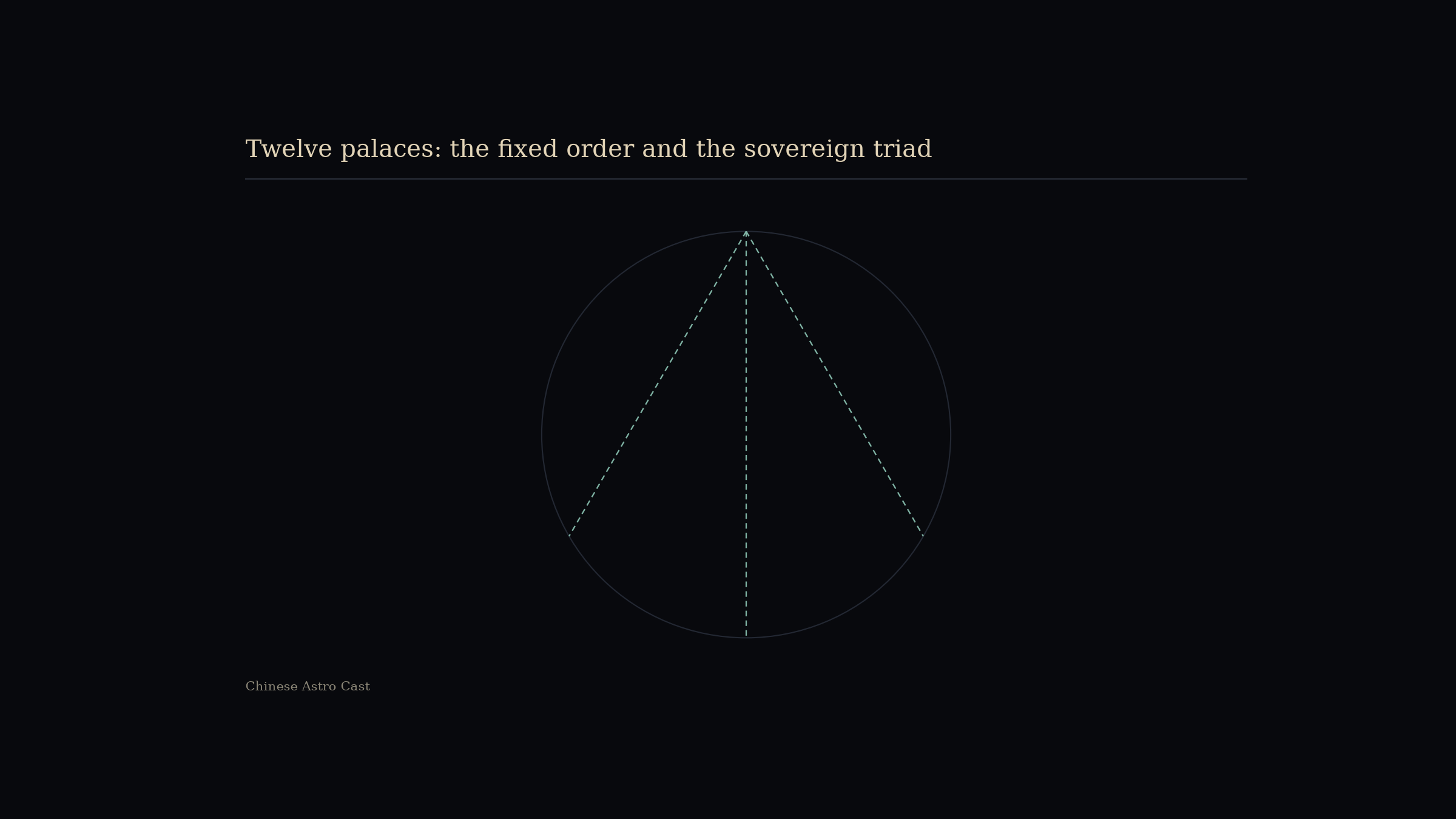
Because the ring is fixed, every reading is relational. No palace gets judged alone. It is read with its two trine partners, four positions away on either side, and with the palace directly opposite. Practitioners call those four positions the Sovereign Triad and Axis. It is the smallest unit of meaning the system has: move one star and four domains shift at once.
Two palaces carry the identity. The Soul Palace, ming gong, is the core conscious architecture: what the person treats as their own project, the register they default to under no instruction. The Body Palace, shen gong, is the operational instinct, and it is not a thirteenth palace. It falls on one of six existing palaces depending on the birth hour, marking where intention converts into behaviour. A person whose Body Palace lands in Wealth behaves differently under pressure from one whose Body Palace lands in Travel, even when their Soul Palaces are identical. The closest Western analogy is Jung’s split between the ego-complex and the compensatory function. One is what you claim. The other is what actually moves you.
The twelve celestial offices the system inherits are catalogued in the 天官書 chapter of the Records of the Grand Historian, the Han-dynasty baseline for this vocabulary.
Why it matters for decision-makers
BaZi and Zi Wei Dou Shu answer different questions. Confuse them and you waste both. The four pillars describe capacity: how much load a structure carries, which season formed it, where it overreaches. The twelve palaces describe allocation: which domain of a life is carrying weight, and which is starved. An executive who has been told their capacity is strong still needs to know whether the load is currently sitting in Career, in Wealth, or in Property, because each has a different cost of correction.
English summaries blur the Career Palace and the Wealth Palace more than any other pair. Career describes the arena in which the person is legible: the field where their competence reads as competence. Wealth describes how value actually arrives, including whether it arrives through salary, through equity, through partnership, or through an asset base that quietly compounds. A chart can show a strong Career field and a weak Wealth field, which is the signature of an operator who is visible, respected, and chronically underpaid. That is a structural diagnosis, and it has a remedy: move compensation out of the visible arena.
The system also schedules. Each palace governs a decennial period, so the chart yields a sequence of ten-year activations rather than a static verdict. Practitioners call these da xian. The natal structure does not change; the weighting does. In a decade where the Wealth field is activated, expanding exposure is structurally cheaper. In a decade where the Health field is activated, the same expansion is paid for elsewhere. That is a calendar of attention, not a forecast of events, and it prices one decade against another.
Common misreadings
Most bad readings come from two errors. The first is treating star names as personality labels. Qi Sha is routinely rendered as the seven killings, which is a literal gloss and a poor description of a vector that mostly concerns decisive action under constraint. The second is reading a single palace in isolation. Because the ring is relational, a palace read alone will always look either flattering or alarming. Read with its triad, the same configuration usually resolves into something ordinary and specific.
How to read it in your own chart
Work in order. Do not skip the first step. An hour error does more damage here than in BaZi, because the hour branch decides which palace carries the Body Palace; get it wrong by one two-hour window and the operational reading moves with it.
Read the trine before the palace
The instinct is to open the soul palace and stop there. A trine reading runs the other way: the wealth palace shows what the structure spends on, the career palace shows where it is deployed, and the travel palace shows what it meets outside its own walls. Read those three first and the soul palace stops being a personality description and becomes a constraint at the centre of four claims.
- Confirm the birth moment against the correct calendar, including clock-time correction for longitude before conversion to the lunar date. Record the two-hour branch window, not just the clock hour.
- Locate the Soul Palace and note whether a principal star occupies it. Record the star’s element and whether it is bright or dim in that position.
- If the Soul Palace is empty, read the palace directly opposite as the borrowed register. Empty is not deficiency; it is a reading that depends on the opposite field, which is why empty-palace charts are usually more legible in middle age than in youth.
- Map the triad for the three palaces that matter commercially: Soul, Career, Wealth. Write down which stars appear in each field and which appear twice.
- Find where the birth-year transformation of obstruction, hua ji, lands. That palace is where friction concentrates, and friction is a budgeting question rather than a warning.
- Identify which palace the current decennial occupies, and read the chart through that palace first.
Worked example
Consider an illustrative case, not a specific client: a founder in her forties whose Soul Palace holds a single strong star and whose Body Palace falls in Career, while Wealth sits empty with its opposite palace carrying two supportive stars. Structurally, the identity is self-directed and the operational instinct pushes toward visible execution, which explains a pattern of taking the operating role personally rather than hiring it. The empty Wealth field means value arrives through the opposite register: through partners, distribution, and structures the founder does not personally run.
The downstream consequence is quiet and expensive. A founder of this shape typically keeps improving the product, because that is where the Body Palace points, while the Wealth field stays borrowed and under-managed for years. The procedural rule that follows is blunt: when Wealth is empty and Career is occupied, the correct allocation of the founder’s attention is one quarter of what the instinct suggests, and the freed time belongs in the partner-facing register, where the actual return is booked.
Where this goes wrong
The costliest failure is a chart built on the wrong hour and then interpreted with full confidence. The reading looks coherent because the geometry is always coherent, and incoherence is not a signal the system gives you. Unless the practitioner asks for a birth certificate or runs an event-based rectification, assume nobody checked. The second failure is translation. Several English reports sold today are star tables rendered by machine, with the geometry dropped: star names and palace names survive, the relational reading does not. You can check this in ninety seconds by asking where the empty palace borrows from, and whether the answer names the opposite palace.
A third failure is mistaking the report for the work. A $14 The Ziwei Astrolabe returns a correctly computed topology in English: twelve palaces, star placements, transformations, and the decennial sequence. That is the input to a decision. It is not the decision, and it will not tell you to sign a contract in March.
Operating directive
Verify the hour before you verify anything else, and treat an unrectified chart as provisional. Read every palace with its triad, and refuse to draw a conclusion from one palace alone. Locate the hua ji palace and convert it into a line item rather than a worry. Hold the Soul Palace and the Body Palace apart in your notes: one is what you claim, the other is what you do under pressure. If you want the two systems cross-checked rather than run separately, the $29 Master Astrological Codex Bundle pairs the four pillars with the twelve palaces, and the disagreements between them are the most useful part of the file.
Zi Wei Dou Shu is a discipline of reading relations, not a verdict about a person. The palaces describe where attention is being spent; only the operator decides whether that allocation survives the next decade.
About the editor. Edward reviews every article against the site’s chart tables and the engine output quoted here. Last updated November 2026.
Leave a Reply