Psychological Archetypes

  • Reading an Astrology Chart: What Positions Actually Measure

    Reading an Astrology Chart: What Positions Actually Measure

    An astrology chart is a coordinate reading of one moment, not a description of a person. Every wheel and every set of pillars fixes a time and a place inside a repeating cycle, and the interpretation comes afterwards.

    • A chart records where a moment sits in a coordinate system. Interpretation is downstream of that recording step.
    • The wheel measures ecliptic geometry; the four pillars measure a sixty-step cycle. Vocabulary does not transfer between them.
    • Both need the clock: the wheel for house cusps, the pillars for the local apparent Sun.
    • Our engine returns 32.5% Earth at 06:44 and 52.5% at 07:00 on the same London morning.

    What an astrology chart actually measures

    Strip the symbolism and a chart is a timestamp with an address. It takes one moment of local time, one latitude and one longitude, and converts them into positions on a ruler that repeats: the ecliptic divided into signs, or the sexagenary cycle divided into stems and branches. Nothing in the diagram is about character until a reader assigns meaning to a position.

    Two rulers over one snapshot

    The Western wheel divides the ecliptic into twelve sectors of thirty degrees measured from the March equinox, then plots each body by its ephemeris position. Aspects are angular separations. Houses are the local sky split by a system that depends on latitude and clock time. Reading it is geometry.

    The four pillars take four slices of the same moment, year through hour, and write each as one heavenly stem over one earthly branch, drawn from a cycle that repeats every sixty steps. The year turns at Lichun rather than on 1 January. The month turns at each major solar term rather than on the first of the month. There are no planets in it and no houses. Reading is relational: every other character is classified by its elemental relation to the day stem.

    The psychological parallel holds if you keep it precise. A chart behaves like a well-normed instrument, constraining what can be said before interpretation begins. Jung treated such systems as structured projective surfaces, useful because they force a reader to account for the parts of a life he would rather skip. The instrument is not the error. The error is a reader who takes the scale for the object being measured.

    Why chart structure matters at a decision table

    Executives reach for chart language because it is compact and non-accusatory. Saying that a chart carries no output channel lands differently from saying a founder never says what he thinks, and it invites a different reply. That is a fair use of the vocabulary: a short way to hold a hard conversation about functions and costs.

    The use turns bad when the diagram becomes evidence about a candidate. A chart can name an over-supplied function and an absent one. For a 己 Earth day master, Wood is the officer element, the authority imposed from outside, and Metal is the output element, what the person makes and says. A profile with Wood at 42.5 per cent and Metal at 0.0 describes a heavy external mandate and a thin expressive channel. That is a structural claim, and it converts into a staffing question rather than a judgement.

    Three questions a chart cannot answer

    • Whether a person will perform. No distribution of elements predicts competence at a specific job.
    • Which of two candidates is better. A chart reads one profile; selection compares profiles against a role specification.
    • When an event will happen. Timing layers describe pressure and receptivity, and the class of event is not specified.
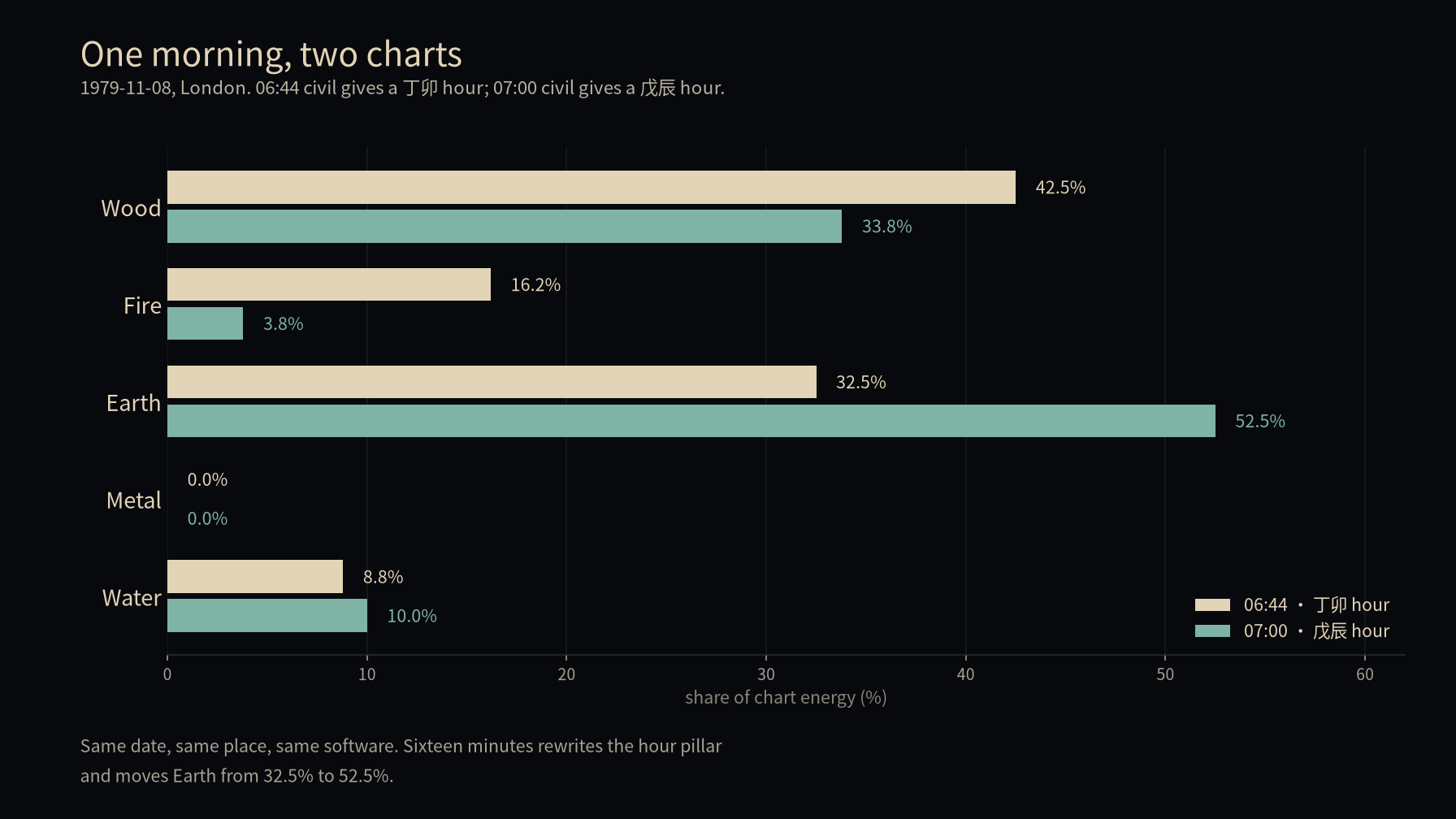
    Bar chart comparing the five-element shares of one astrology chart at 06:44 and 07:00, where the hour pillar changes from Ding Mao to Wu Chen
    One birth record, sixteen minutes apart. The hour pillar changes, and so does the whole element distribution.

    How to read a chart in the right order

    Most bad readings are sequencing errors rather than symbol errors. The order below is the one our own tools follow, and skipping a step is what produces confident nonsense.

    1. Fix the record. Civil date, civil time, city. A chart without a birth time cannot place houses or an hour pillar, and no later step repairs that.
    2. Convert the clock. Move civil time to local apparent solar time. In London on 8 November 1979 the correction is +15.57 minutes; in Shanghai in July it runs the other way.
    3. Place the axes. Houses and ascendant for the wheel, year through hour pillars for the Chinese chart. This is where two apps first disagree.
    4. Locate the reference point. The day stem in a BaZi chart, the ascendant and its ruler in a Western one. Everything else is classified relative to it.
    5. Read the distribution, not the keywords. Shares across five elements carry more information than any single term in a glossary.
    6. Attach one decision. A reading that changes nothing you were going to do this quarter was entertainment.

    Worked example: one morning, sixteen minutes apart

    Our engine returns four pillars for a London birth on 8 November 1979 at 06:40: 己未 year, 乙亥 month, 己卯 day, 丁卯 hour, with a day master of 己 Earth and Wood at 42.5, Earth at 32.5, Fire at 16.2, Water at 8.8 and Metal at 0.0 per cent. The month stem 乙 classifies as the Strategic Commander, the hour stem 丁 as the Visionary Tactician, the year stem 己 as the Peer.

    Move the clock to 07:00 and the hour pillar becomes 戊辰. Earth rises to 52.5 per cent and Fire falls to 3.8. The reading changes from a chart with a working resource channel to one crowded with peers, and nothing about the person changed except the minute on the certificate. That is the argument for treating the fixing step as data and the interpretation as argument. The day master calculator prints the first half of that record with no interpretation attached, which is the right place to start, and we set out the boundary rules in more detail in the BaZi versus Western astrology comparison.

    Where this goes wrong

    Three failure modes cover most of the damage. The first is a chart built on a guessed birth time: rectification by anecdote produces an hour pillar that is fiction, and fiction at the hour layer propagates into every timing claim after it. The second is vocabulary transfer, reading a 冲 as an opposition aspect or a palace as a house, which yields sentences no tradition would defend. The third, and the expensive one, is treating a distribution as a verdict in a hiring or equity conversation, where a compact metaphor should have stayed a metaphor.

    Operating directive

    Confirm the birth record before you accept any chart of your own, and keep the civil time, the true solar time and the correction in one document. Read the reference point first and the glossary last. Ask of every reading which decision it would change, then discard the ones that change nothing. When a chart enters a room, say plainly that it describes a structure and not a performance record.

    The full structural reading, including the ten-god classification of all four pillars, is what $19 The BaZi Blueprint produces for one profile. The $29 Master Codex Bundle adds the twelve-palace layer for readers who want the second geometry beside the first.

    Hong Kong Observatory publishes the solar-term tables that fix the month and year boundaries used above.

    An astrology chart rewards fixing before it rewards meaning, which is why the checkable half of it belongs first.

    About the editor. Edward edits ChineseAstroCast and reviews every article against the site’s chart tables before publication. Last updated November 2026.
  • The Ten Gods in BaZi as Ten Psychological Archetypes

    The Ten Gods in BaZi as Ten Psychological Archetypes

    The ten gods in a BaZi chart are the layer Western readers abandon first, because the standard English labels read like a crime report. “Seven killings”, “hurting officer”, “rob wealth”: none of those phrases describes a behaviour. Each describes a relationship.

    • They are neither deities nor events: ten relationship types between the day-master stem and every other stem.
    • The label is relative, so the same stem is a different god under a different day master and literalism explains nothing.
    • Ten collapse into five families (same, output, wealth, power, resource) split by polarity: two axes, not ten mysteries.
    • Read by pillar: year for inherited conditions, month for professional method, hour for execution.

    What the ten gods actually measure

    A BaZi chart is four pillars, each written as one heavenly stem above one earthly branch. Eight characters in total, and the day stem is the only one that refers to the person. Call it the day master. One element, one polarity, yang wood for instance, and it becomes the origin point for everything else in the chart.

    The ten gods classify every other visible stem with two questions. What is the element relation between that stem and the day master: identical, produced by it, controlled by it, controlling it, or producing it. Then, does the stem share the day master’s polarity or oppose it. Five relations times two polarities gives ten labels. None of that arithmetic predicts anything. It is grammar.

    The closest Western analogue is a function-attitude typology, not a horoscope. Jung’s eight types describe a mode of functioning relative to the ego, and the same function behaves differently when it is introverted rather than extraverted. The ten gods work the same way. They name the relation, then the polarity, and leave the behaviour to be inferred from the whole chart.

    Five families, ten archetypes

    Because five families crossed with two polarities generate the ten, they hold in the mind as a map rather than a list. Each family answers a different question about what a person does with capacity: replicate it, express it, monetise it, govern it, or absorb it.

    • In the same-element family sit the Peer and the Competitor: colleagues, siblings, rivals, and the instinct to solve alone.
    • The output family holds the Creator and the Iconoclast, which is what the self produces. The Creator refines the craft. The Iconoclast dismantles the received method.
    • Wealth covers what the self controls. The Steward builds systems that hold assets. The Venture Capitalist finds the asymmetric bet.
    • Power covers what controls the self. The Institutional Architect works through legitimate structure, the Strategic Commander through force and tempo.
    • Resource is what produces the self. The Scholar absorbs codified knowledge, the Visionary Tactician reads patterns nobody has written down.

    Polarity is not virtue

    Classical Chinese marks one of each pair 正, proper, and the other 偏, lopsided. Those words describe the alignment of the pairing rather than a grade. A Direct Officer and a Seven Killings are the same metal meeting the same day master from two directions, one with polarity opposed, one with polarity matched. The matched pair tends to be frictionless and repetitive. The opposed pair tends to differentiate, and it is harder to regulate. Neither one is the better employee.

    Why it matters for decision-makers

    The practical value sits in the balance between families, not in any single label, because the five describe five different drains and supplies on the person. Output and wealth consume the day master. Resource and peers support it. A chart whose two largest shares sit on the consuming side and whose two smallest sit on the supporting side belongs to someone who can generate a great deal and replenish very little. That constraint surfaces in calendar design long before it shows up in any forecast.

    It also reframes the executive question. Instead of asking what kind of person this is, the chart asks which function is expensive for this person and which one is free. Free functions get delegated toward. Expensive ones get staffed. A founder whose professional method is production and critique should not be the person governing the institution, however capable the founder is. That is an org-design answer, not a prediction.

    Common misreadings

    Two errors recur. The first is reading a god as a trait: calling someone a Seven Killings personality fixes a relation into an identity, and then the hiring decision runs on the label. The second is reading absence as deficit. No visible stem of a family does not mean the function is missing. Classical readings also weigh the hidden stems inside the branches, and daily expression shifts with the luck pillars regardless.

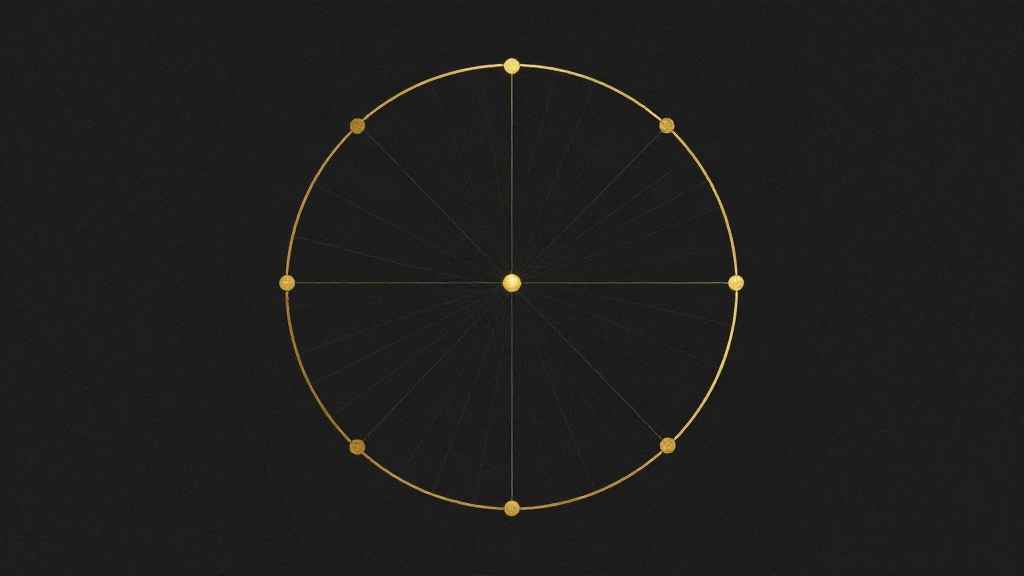
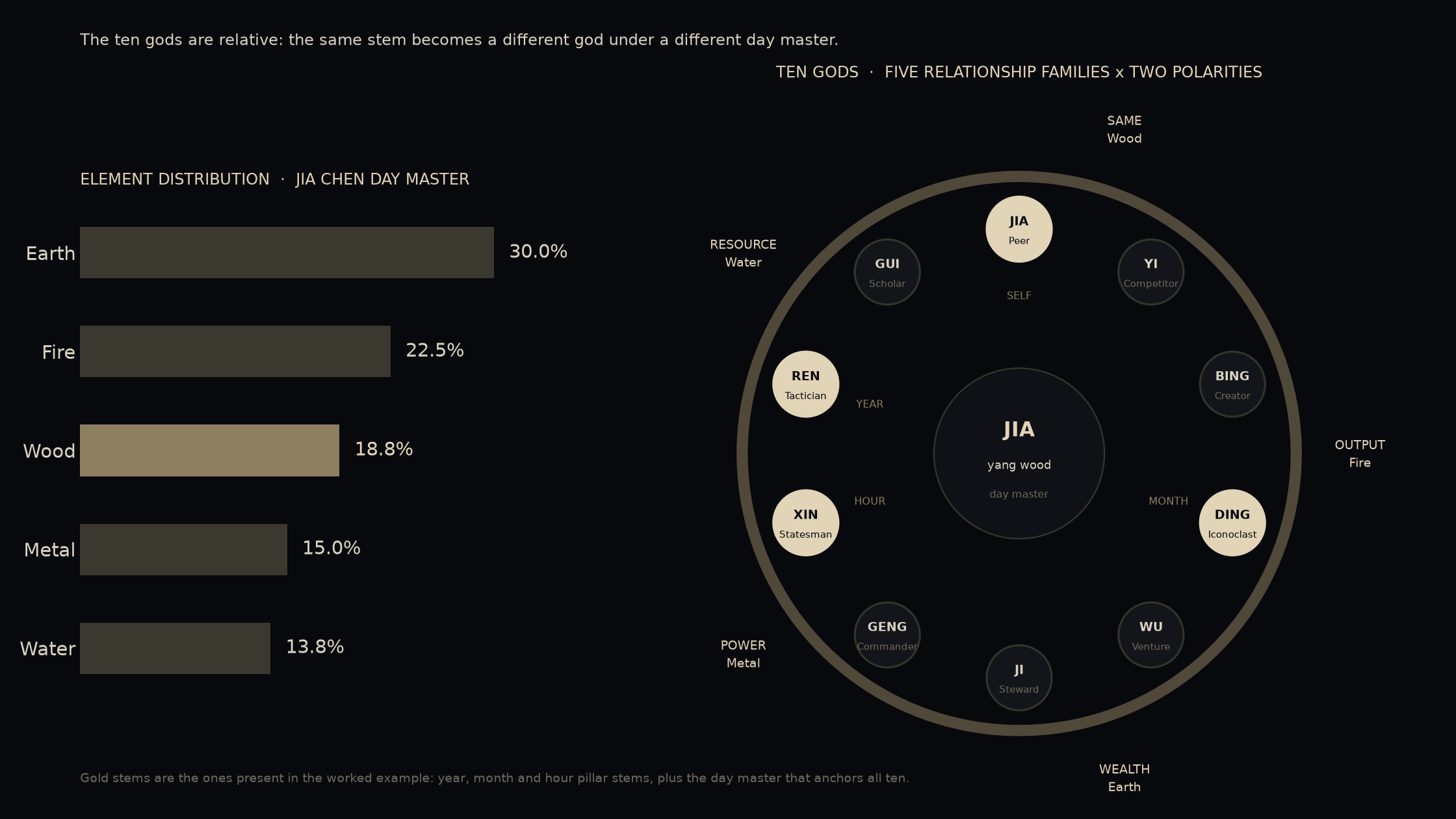
    Ten-gods ring diagram showing five relationship families and two polarities around a Jia day master, with the year, month and hour stems marked
    The ten gods as a ring: five families, two polarities each. Gold nodes are the stems present in the worked example below, with Jia as the day master that anchors all ten.

    Reading them in your own chart

    Order matters more than vocabulary here. Work through the sequence once and the labels stop being intimidating.

    1. Fix the day master. Take the day pillar’s stem and note its element and polarity.
    2. List the remaining visible stems: year, month, hour. The day stem never gets a god because it is the reference.
    3. Assign each stem its family by element relation, then its polarity by comparison with the day master.
    4. Weigh by position rather than count. Month carries professional method, year carries inherited conditions, hour carries execution and the later trajectory.
    5. Leave the luck pillars out of the first pass. They re-weight everything every ten years and blur a structural reading done too early.

    Worked example

    Our engine returns a clean case for a birth on 20 July 1982 at 13:21 in Changshu: true solar time 13:17:43, a correction of −3.28 minutes, and the pillars Ren Xu (壬戌) year, Ding Wei (丁未) month, Jia Chen (甲辰) day, Xin Wei (辛未) hour. The day master is Jia, yang wood, on a distribution of Earth 30.0, Fire 22.5, Wood 18.8, Metal 15.0, Water 13.8 per cent.

    Three visible gods follow. Ren in the year is yang water producing yang wood at matched polarity: the Visionary Tactician, the Contrarian. Ding in the month is yin fire produced by yang wood at opposed polarity: the Iconoclast. Xin in the hour is yin metal controlling yang wood at opposed polarity: the Institutional Architect, the Statesman.

    Read the positions rather than the names. Professional method sits in the month, and this month carries the Iconoclast, so the default working move is to dismantle the received method rather than perfect it. The Statesman appears only in the hour, which is where execution lives. Innovation upstream, governance downstream. That configuration reads cleanly until the organisation needs the downstream layer staffed by someone who is not the founder.

    Where this goes wrong

    The expensive failure is hiring on a label. A report that translates a stem as “seven killings” and stops there invites a reader to hear ruthlessness in what is really a description of matched-polarity power, which is the capacity to act without waiting for legitimacy. Used as a personality filter, the phrase disqualifies good operators.

    The second failure is symmetry hunting. Readers count two of one god and one of another, then conclude the chart is unbalanced. The classical method weighs position, season and support first. One month stem usually matters more than three scattered ones.

    Operating directive

    Name the day master before reading anything else. Map the three remaining visible stems to families, then to polarity, and record the balance rather than the labels. Identify which function is expensive for this person and staff it instead of training it. Read position before count, and treat every translated god name as a relationship rather than a character reference.

    For the full structural map, including element distribution, the ten gods by pillar and the luck sequence around them, the $19 BaZi Blueprint reports the arithmetic rather than the folklore. Readers who want the same profile cross-checked against the twelve-palace Ziwei topology use the $29 Master Astrological Codex Bundle, which runs both systems against one birth record.

    The month pillar above is bounded by solar terms rather than calendar months. The Wei month runs from Minor Heat to the Start of Autumn, and the Hong Kong Observatory publishes the authoritative tables for those boundaries.

    The ten gods are a discipline of relation rather than a set of titles, and a relation, unlike a title, can be redesigned.

    About the editor. Edward edits ChineseAstroCast and reviews every article against the site’s chart tables before publication. Last updated November 2026.
  • BaZi vs Western Astrology: Two Readings of One Moment

    BaZi vs Western Astrology: Two Readings of One Moment

    BaZi vs Western astrology is usually framed as a contest between two forecasts of one life. It is not. Both turn a birth moment into a diagram, but they index different quantities: BaZi a sixty-step sexagenary cycle bounded by solar terms, Western astrology the angular position of bodies on the ecliptic.

    • BaZi reads element relations inside a repeating sixty-term cycle; Western astrology reads angular separation on a 360-degree ecliptic.
    • The two disagree on the year boundary: BaZi turns it at Lichun, tropical practice at the March equinox.
    • BaZi has no planets and no houses, so borrowed vocabulary produces sentences neither tradition supports.
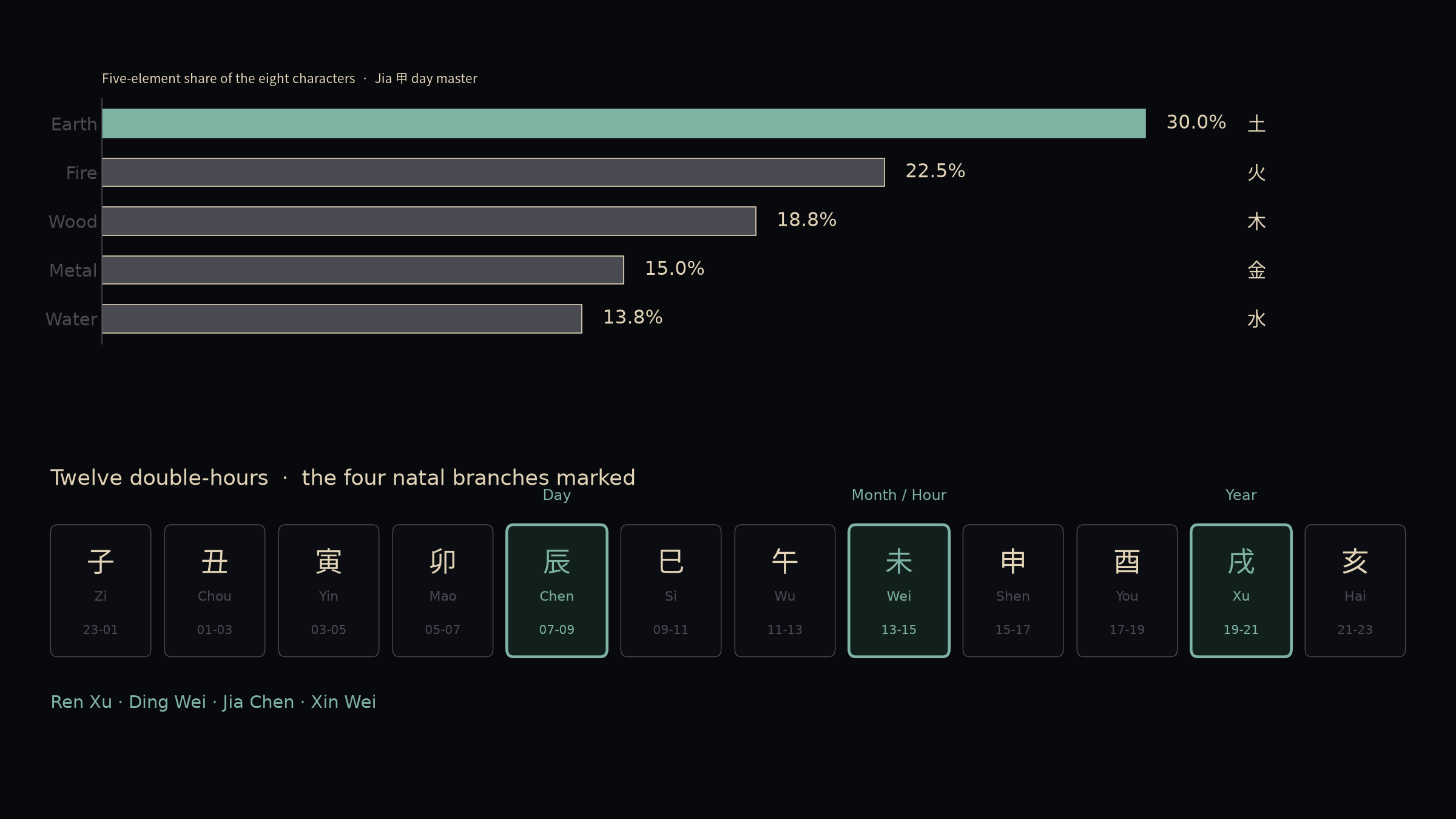
    • Only one reduces to figures: for the profile below the engine returns Earth 30.0, Fire 22.5, Wood 18.8, Metal 15.0, Water 13.8 per cent.

    What each system actually measures

    A BaZi chart is four pillars, each written as one heavenly stem above one earthly branch: eight characters drawn from a cycle of ten stems and twelve branches that repeats every sixty steps. The year pillar turns at Lichun, the month pillar at each of the twelve major solar terms, the day pillar at the start of the Zi hour rather than at midnight. Nothing in that construction refers to a planet. The reference point is the day stem, the day master, and every other character is classified by its element relation to that one stem.

    Western astrology starts from a different instrument. It divides the ecliptic, the Sun’s apparent annual path, into twelve sectors of thirty degrees measured from the March equinox, then places each body by its ephemeris position. Interpretation reads angular separations between bodies, called aspects, and the division of the sky into houses, which depends on latitude and on the clock time of birth. The chart is a wheel of positions.

    Both traditions assign elements to their signs and branches, but only BaZi is normally read as a distribution: shares that can be printed and tracked through a decade. That is why the systems feel incommensurable side by side. They are not disagreeing about a shared variable; they are measuring different variables with similar-sounding names.

    Why the distinction matters at the decision table

    Western chart language is dispositional narrative. It describes a temperament, expressive or reserved, comfortable with conflict or not, and its natural use is self-description and coaching. BaZi is structural in a narrower sense: it names which function carries the weight, where in the chart that function sits, and how much of each element is present. A reader deciding who should hold authority over a function is served better by a component map than by a mood description.

    Timing differs the same way. BaZi supplies discrete decennial pillars plus an annual pillar, so a ten-year step can be put on a planning calendar. Western transits are continuous, which suits narrative reading but resists scheduling. A founder choosing a launch window inside a three-year build is asking a question with year-shaped boundaries, and the system with year-shaped units answers it more directly.

    Two misreadings that cost the comparison its credibility

    The first is treating the sun sign as the Western equivalent of the day master. A sun sign is one placement among many; the day master is the reference point against which every other character is classified. The second is treating the zodiac animal as a BaZi result. The animal is the year branch, one of eight characters, and a reading built on it alone discards the month, day and hour pillars entirely.

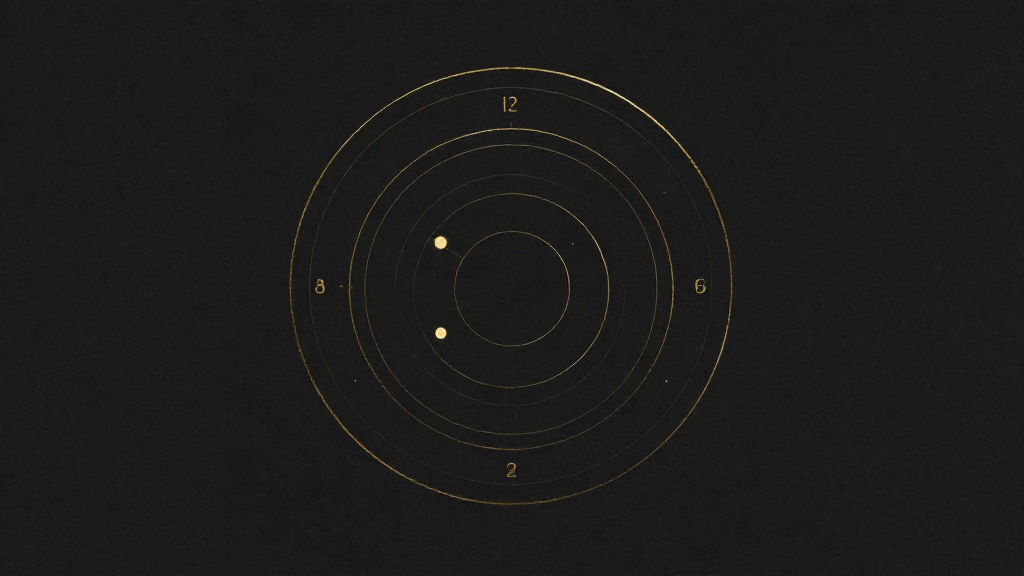
    BaZi vs Western astrology comparison diagram showing the five-element share of a Jia day master and the twelve double-hours with four natal branches marked
    Two BaZi geometries for one birth record: the element distribution (top) and the twelve double-hours with the four natal branches marked (bottom). A Western chart of the same moment would be a third geometry, a wheel of degrees.

    Reading the two side by side without confusing them

    Order matters, because the two systems disagree about the input before they disagree about the interpretation. Fix the moment first: convert clock time to true solar time for the birth longitude, then locate the moment inside the solar-term year. Our engine does both and reports the correction it applied, which is the only honest way to compare two charts of one person.

    Then read in layers. The year pillar describes inherited conditions. The month pillar describes professional method, because it is the pillar bounded by the seasonal term. The day pillar carries the day master and is the reference point for everything else. The hour pillar describes execution and the later part of life. Only after those positions are fixed does element share become meaningful, and it is read as balance rather than as a score.

    A Western chart read alongside is not a second opinion on the same layer. Its contribution is temperament language and relational pattern: how someone presents under pressure, and which conflicts recur. Keep the two readings in separate columns. The moment a report says a day master is Leo, the reader has lost both systems at once.

    Worked example: one birth record, two boundaries

    Take a birth on 20 July 1982 at 13:21 in Changshu, longitude 120.75 degrees east. Clock time becomes 13:17:43 true solar time, an adjustment of minus 3.28 minutes: the longitude term adds about three minutes against the 120-degree standard meridian, and the equation of time subtracts about six in late July. The engine returns four pillars, Ren Xu in the year, Ding Wei in the month, Jia Chen in the day and Xin Wei in the hour, with a Jia day master, yang wood, on a distribution of Earth 30.0, Fire 22.5, Wood 18.8, Metal 15.0 and Water 13.8 per cent. The decennial sequence begins at age six and runs forward; the current step, ages 36 to 45, is Xin Hai.

    Now move the boundaries, because that is where the comparison usually collapses. The same engine read at noon on 3 February 1983 returns a Ren Xu year; read at noon the next day it returns Gui Hai. The year changed on 4 February, five weeks after the Gregorian calendar did. The day boundary behaves the same way: a chart read at 23:30 civil time on 20 July had already moved to the Yi Si day, and the same Yi Si day appears after midnight. Someone comparing two apps will find one of them a day ahead, and the cause is a convention, not an error.

    Where this goes wrong

    The expensive failure is buying two reports, finding that they contradict, and using neither. The contradiction is usually a convention split inside one tradition rather than a clash between East and West. Western practice has its own version: tropical and sidereal zodiacs have drifted more than twenty degrees apart through precession, roughly one degree every seventy-two years, so two Western astrologers can disagree about a sun sign without either being careless. BaZi has the equivalent in true solar time and in the treatment of the late Zi hour.

    The second failure is vocabulary mixing, which sounds sophisticated and means nothing. A sentence that borrows relation types from one system and angular patterns from the other is not a synthesis; it is a category error with good production values.

    Operating directive

    State the question before choosing the instrument: disposition, component structure, or timing. Convert to true solar time and locate the solar-term year before comparing anything. Use Western language for temperament and relational pattern, and BaZi for element share and the pillar that carries a function. Staff the expensive function instead of training it. Never translate one vocabulary into the other, and record which convention each reading used.

    For a component-level map of one chart — element distribution, the ten gods by pillar, and the decennial sequence around them — the $19 BaZi Blueprint reports the arithmetic rather than the folklore. Readers who want the same birth record read through both systems at once use the $29 Master Astrological Codex Bundle, which runs the four pillars and the twelve-palace topology against one set of inputs.

    The year boundary used above is not a calendar convention but an astronomical one: the twelve month pillars are bounded by the major solar terms, and the Hong Kong Observatory publishes the tables that define them, alongside its notes on time conversion between clock time and solar time.

    BaZi and Western astrology are two disciplines of measurement rather than two claims about the future, and a measurement is only as good as the convention printed beside it.

    About the editor. Edward edits ChineseAstroCast and reviews every article against the site’s chart tables. Last updated November 2026.

  • Zi Wei Dou Shu: The Twelve Palaces as a Life Topology

    Zi Wei Dou Shu: The Twelve Palaces as a Life Topology

    • Zi Wei Dou Shu is a fixed twelve-palace topology; the map is the product, not a prediction.
    • The palace order never changes — what changes is which stars land where, and the decade that reweights them.
    • The soul palace is read with its trine and opposite (wealth, career, travel), never on its own.
    • An empty palace is not a defect: it borrows its reading from the palace opposite it.

    Zi Wei Dou Shu is a twelve-palace map of a life, not a horoscope column, and most English summaries lose the map. What the system actually delivers is a fixed topology: twelve domains arranged in a ring, fourteen principal stars distributed across them, and a decade-by-decade weighting that shows where the same capability becomes expensive. Read as geometry, it belongs in a board meeting. Read as omens, it does not survive contact with a budget line.

    What Zi Wei Dou Shu actually measures

    The usual English rendering is Purple Star Astrology, and that title misleads twice. There is nothing astronomical about the purple star beyond a name for the pole star, and nothing astrological in the Western sense: no planets, no degrees, no aspects. The chart is built from the lunar date and the two-hour birth window, then twelve palaces are fixed in order around a ring, and fourteen main stars are placed into them by a deterministic rule set.

    Why the map comes before the reading

    A palace name is a slot, not a verdict. The slot says which domain of a life is being described; the stars inside it say what is happening in that domain; the decade says when. Keeping those three questions separate is what stops a palace name from being read as a personality trait, and it is the difference between a topological reading and a horoscope column.

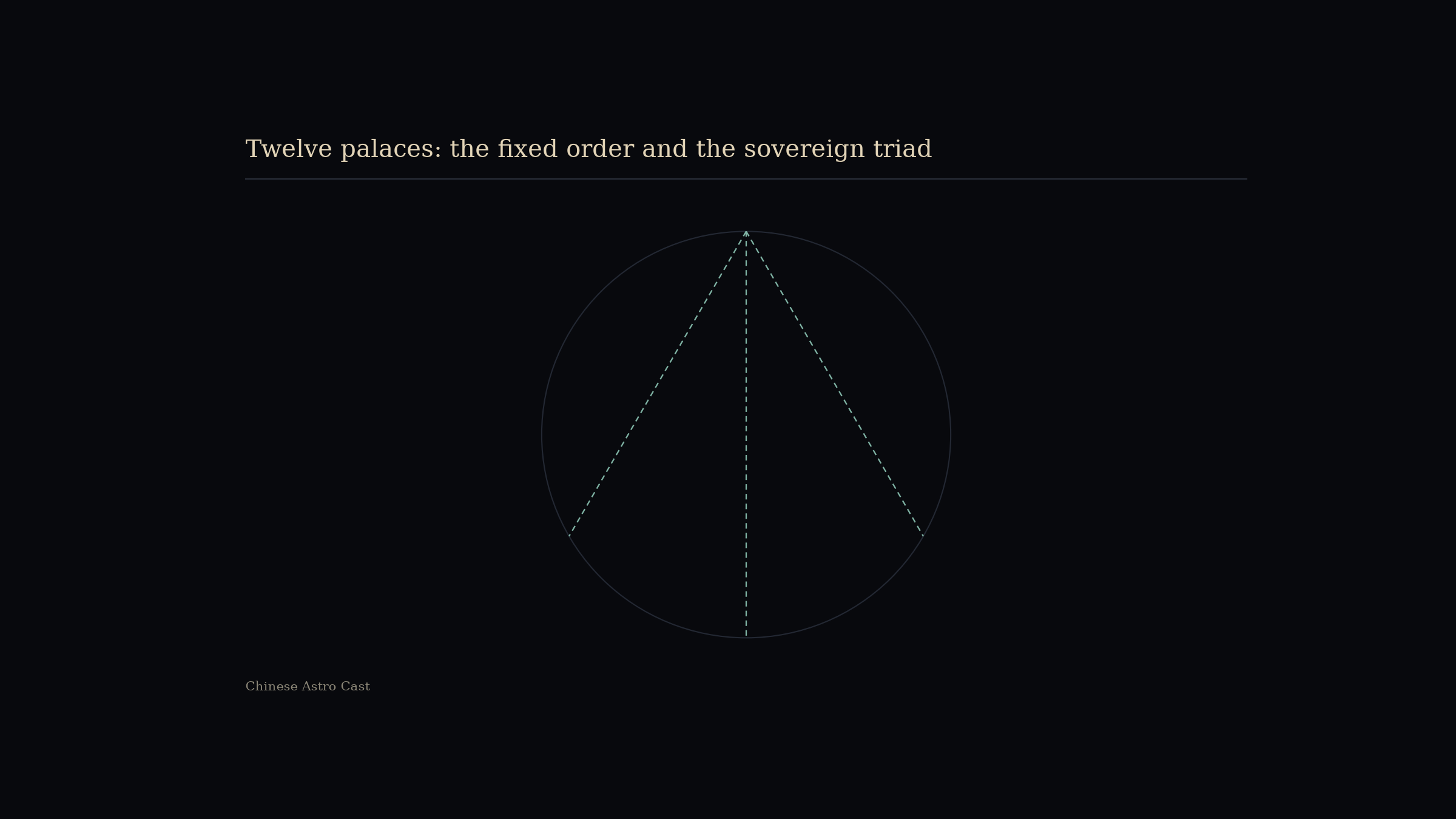
    Because the ring is fixed, every reading is relational. No palace gets judged alone. It is read with its two trine partners, four positions away on either side, and with the palace directly opposite. Practitioners call those four positions the Sovereign Triad and Axis. It is the smallest unit of meaning the system has: move one star and four domains shift at once.

    Two palaces carry the identity. The Soul Palace, ming gong, is the core conscious architecture: what the person treats as their own project, the register they default to under no instruction. The Body Palace, shen gong, is the operational instinct, and it is not a thirteenth palace. It falls on one of six existing palaces depending on the birth hour, marking where intention converts into behaviour. A person whose Body Palace lands in Wealth behaves differently under pressure from one whose Body Palace lands in Travel, even when their Soul Palaces are identical. The closest Western analogy is Jung’s split between the ego-complex and the compensatory function. One is what you claim. The other is what actually moves you.

    The twelve celestial offices the system inherits are catalogued in the 天官書 chapter of the Records of the Grand Historian, the Han-dynasty baseline for this vocabulary.

    Why it matters for decision-makers

    BaZi and Zi Wei Dou Shu answer different questions. Confuse them and you waste both. The four pillars describe capacity: how much load a structure carries, which season formed it, where it overreaches. The twelve palaces describe allocation: which domain of a life is carrying weight, and which is starved. An executive who has been told their capacity is strong still needs to know whether the load is currently sitting in Career, in Wealth, or in Property, because each has a different cost of correction.

    English summaries blur the Career Palace and the Wealth Palace more than any other pair. Career describes the arena in which the person is legible: the field where their competence reads as competence. Wealth describes how value actually arrives, including whether it arrives through salary, through equity, through partnership, or through an asset base that quietly compounds. A chart can show a strong Career field and a weak Wealth field, which is the signature of an operator who is visible, respected, and chronically underpaid. That is a structural diagnosis, and it has a remedy: move compensation out of the visible arena.

    The system also schedules. Each palace governs a decennial period, so the chart yields a sequence of ten-year activations rather than a static verdict. Practitioners call these da xian. The natal structure does not change; the weighting does. In a decade where the Wealth field is activated, expanding exposure is structurally cheaper. In a decade where the Health field is activated, the same expansion is paid for elsewhere. That is a calendar of attention, not a forecast of events, and it prices one decade against another.

    Common misreadings

    Most bad readings come from two errors. The first is treating star names as personality labels. Qi Sha is routinely rendered as the seven killings, which is a literal gloss and a poor description of a vector that mostly concerns decisive action under constraint. The second is reading a single palace in isolation. Because the ring is relational, a palace read alone will always look either flattering or alarming. Read with its triad, the same configuration usually resolves into something ordinary and specific.

    Ring diagram of the twelve Ziwei palaces in fixed order with the soul palace and its trine highlighted
    Palace order is fixed; the sovereign triad is read as one system.

    How to read it in your own chart

    Work in order. Do not skip the first step. An hour error does more damage here than in BaZi, because the hour branch decides which palace carries the Body Palace; get it wrong by one two-hour window and the operational reading moves with it.

    Read the trine before the palace

    The instinct is to open the soul palace and stop there. A trine reading runs the other way: the wealth palace shows what the structure spends on, the career palace shows where it is deployed, and the travel palace shows what it meets outside its own walls. Read those three first and the soul palace stops being a personality description and becomes a constraint at the centre of four claims.

    1. Confirm the birth moment against the correct calendar, including clock-time correction for longitude before conversion to the lunar date. Record the two-hour branch window, not just the clock hour.
    2. Locate the Soul Palace and note whether a principal star occupies it. Record the star’s element and whether it is bright or dim in that position.
    3. If the Soul Palace is empty, read the palace directly opposite as the borrowed register. Empty is not deficiency; it is a reading that depends on the opposite field, which is why empty-palace charts are usually more legible in middle age than in youth.
    4. Map the triad for the three palaces that matter commercially: Soul, Career, Wealth. Write down which stars appear in each field and which appear twice.
    5. Find where the birth-year transformation of obstruction, hua ji, lands. That palace is where friction concentrates, and friction is a budgeting question rather than a warning.
    6. Identify which palace the current decennial occupies, and read the chart through that palace first.

    Worked example

    Consider an illustrative case, not a specific client: a founder in her forties whose Soul Palace holds a single strong star and whose Body Palace falls in Career, while Wealth sits empty with its opposite palace carrying two supportive stars. Structurally, the identity is self-directed and the operational instinct pushes toward visible execution, which explains a pattern of taking the operating role personally rather than hiring it. The empty Wealth field means value arrives through the opposite register: through partners, distribution, and structures the founder does not personally run.

    The downstream consequence is quiet and expensive. A founder of this shape typically keeps improving the product, because that is where the Body Palace points, while the Wealth field stays borrowed and under-managed for years. The procedural rule that follows is blunt: when Wealth is empty and Career is occupied, the correct allocation of the founder’s attention is one quarter of what the instinct suggests, and the freed time belongs in the partner-facing register, where the actual return is booked.

    Where this goes wrong

    The costliest failure is a chart built on the wrong hour and then interpreted with full confidence. The reading looks coherent because the geometry is always coherent, and incoherence is not a signal the system gives you. Unless the practitioner asks for a birth certificate or runs an event-based rectification, assume nobody checked. The second failure is translation. Several English reports sold today are star tables rendered by machine, with the geometry dropped: star names and palace names survive, the relational reading does not. You can check this in ninety seconds by asking where the empty palace borrows from, and whether the answer names the opposite palace.

    A third failure is mistaking the report for the work. A $14 The Ziwei Astrolabe returns a correctly computed topology in English: twelve palaces, star placements, transformations, and the decennial sequence. That is the input to a decision. It is not the decision, and it will not tell you to sign a contract in March.

    Operating directive

    Verify the hour before you verify anything else, and treat an unrectified chart as provisional. Read every palace with its triad, and refuse to draw a conclusion from one palace alone. Locate the hua ji palace and convert it into a line item rather than a worry. Hold the Soul Palace and the Body Palace apart in your notes: one is what you claim, the other is what you do under pressure. If you want the two systems cross-checked rather than run separately, the $29 Master Astrological Codex Bundle pairs the four pillars with the twelve palaces, and the disagreements between them are the most useful part of the file.

    Zi Wei Dou Shu is a discipline of reading relations, not a verdict about a person. The palaces describe where attention is being spent; only the operator decides whether that allocation survives the next decade.

    About the editor. Edward reviews every article against the site’s chart tables and the engine output quoted here. Last updated November 2026.

  • Chinese Zodiac Elements: Excess, Deficit and Somatic Load

    Chinese Zodiac Elements: Excess, Deficit and Somatic Load

    • Your birth-year element is a starting coordinate, not a reading of your character.
    • Balance is measured across all eight characters; the year stem is the outermost layer only.
    • Excess and deficit are different problems: excess over-spends, deficit borrows against something else.
    • Element load shows up as a somatic pattern — a recovery question, not a virtue question.

    Most people meet their Chinese zodiac element as a single word printed under their birth year: Wood, Fire, Earth, Metal or Water. A Chinese zodiac element is a starting coordinate, not a reading. It describes how a person takes in information and where they spend capacity. On its own, it says almost nothing about what they will do with either.

    What a Chinese zodiac element actually measures

    Classical Chinese astrology assigns one of five elements to each of the eight characters in a birth chart: the four pillars, each built from a heavenly stem and an earthly branch. The element you see under your birth year comes from the year stem, the most public layer of the chart. It is roughly how institutions, markets and strangers read you. Your day stem, the character most practitioners treat as the self, sits four positions later and often carries a different element entirely.

    The year stem is one layer of eight

    Reading an element off a birth year is reading the outermost layer of a chart that has four. The year pillar describes inherited conditions; the month describes the season the rest of the structure works in. That is why two people born in the same year can carry the same element word and still have opposite balances once the other six characters are counted.

    The five elements work better as psychological drivers than as substances. Wood is the growth and vision driver: curiosity, expansion, ethical ambition. Fire is the passion and charisma driver, meaning visibility, expression, and the willingness to be seen while the outcome is still uncertain. Earth is the foundation driver, which shows up as reliability, patience, and systems that keep holding after attention moves elsewhere. Metal is the precision driver: discernment, structure, the capacity to decline cleanly. Water is the intuition driver, which reads as adaptability, depth and strategic fluidity under pressure.

    Counts matter more than any single label. A chart with three Water characters and no visible Fire describes surplus adaptability and a deficit of public claim. That pattern shows up in how someone negotiates, not in what they believe about themselves. Traditional Chinese medicine makes the same move with constitutional typing. The useful question is never which type you are. It is where load accumulates when the system is stressed.

    The five-element scheme itself is set out in the Great Plan chapter of the Book of Documents, where 五行 first appears as a list of five capacities rather than five substances.

    Why element balance matters for decision-makers

    Executives usually reach this material at the moment their habitual style stops producing results. A founder whose chart is Wood-dominant builds quickly and consolidates badly, because the instinct that turns a prototype into a company also resists the operational patience a second stage requires. A Metal-dominant operator sets standards that hold, then cannot delegate, because delegated work arrives below the standard. Neither pattern is a character flaw. Both are predictable, and predictability is the whole of the value.

    The practical consequence is allocation. Element excess tells you where a leader will overspend attention without noticing. Element deficit tells you where they will under-invest until the gap surfaces as an incident. Read before a hiring round, this changes the brief. A Water-heavy leadership team does not need another strategist. It needs someone constitutionally willing to commit to a single number and defend it in a room. The same reading applies to risk appetite, to delegation depth, and to how a quarter gets laid out.

    There is a somatic layer here too, which is why the framework travels well with people who already track their own physiology. Excess tends to appear as a specific, repeatable form of strain rather than a vague malaise. Fire-dominant operators commonly run a sympathetic pattern: late sleep, early waking, a nervous system that will not stand down after the meeting ends. Water-dominant operators report the opposite failure mode. They can absorb an unreasonable load for months and then stop, with no gradient in between. Neither observation is a diagnosis. Both are load patterns worth scheduling around.

    Common misreadings

    Two mistakes account for most of what goes wrong. The first is reading the birth-year animal as the whole chart. The animal belongs to the year branch and describes a social register, not a constitution. Two people born in the same year share an animal and may hold opposite day stems, which is why the year label predicts so little. The second is treating a missing element as a permanent deficit. Absence from the visible eight characters does not mean absence from the structure. The month branch governs seasonal strength, and hidden stems inside the branches often supply what the surface appears to lack. A chart with no visible Fire can still hold Fire in the month branch, dormant until a Fire luck pillar arrives.

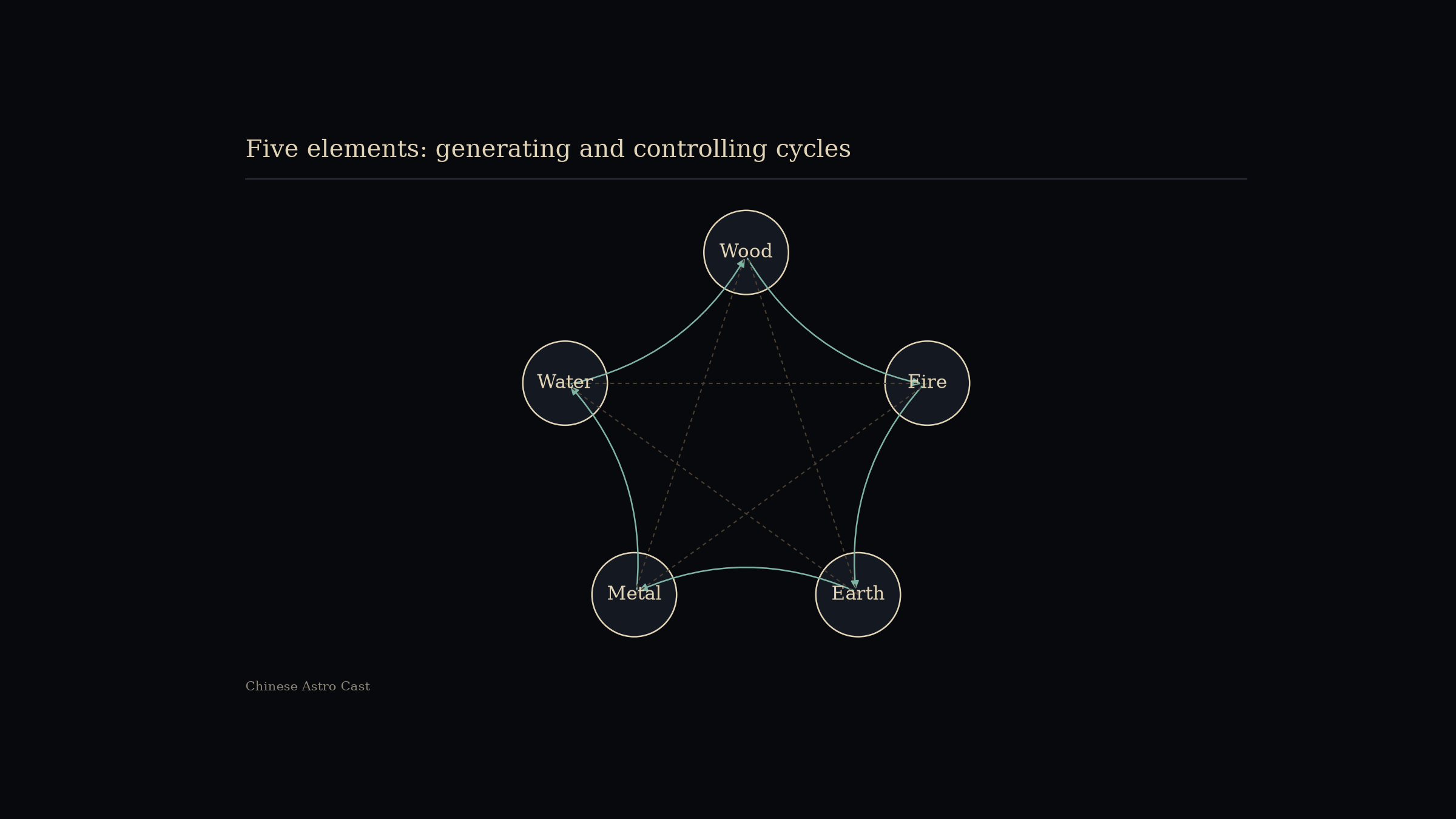
    Diagram of the five elements with the generating cycle in solid arrows and the controlling cycle in dashed lines
    Generating and controlling cycles: excess moves along one, deficit along the other.

    How to read your own elements

    Work in order, and do not skip the first step. Fix the birth data first: date, clock time, birthplace. Convert clock time to true solar time, because a two-hour pillar boundary is easy to cross by accident and an hour-pillar error changes the element count. Then list all eight characters and mark the element of every stem and every branch. Weight them: the day stem carries the most, the month branch governs how strong every other element is, and the year and hour pillars describe the public and the private register respectively. Note any excess above three characters of one element, and note absence entirely. Finally read the demand the structure makes, which is what it asks a person to build rather than what it hands them.

    The visible metal-wood clash and the structural version behave differently. Metal is boundary and Wood is expansion. When both are strong and adjacent, decisions stall at the point of commitment, because the same person argues for the opening and then argues against the terms. When the clash is only apparent, with Metal thin in the visible characters and Wood supplied by the month, there is no stall. There is a preference for movement that occasionally costs precision.

    Worked example

    A chief operating officer, born in the late 1970s, presents a chart with Water in the year, month and hour stems, a Yang Wood day stem, and no visible Fire. Three channels of adaptation feed one growth axis, and the visibility driver sits absent from the surface.

    The downstream consequence is consistent and expensive. She reads rooms faster than anyone else in the company and still loses the internal argument for her own budget, because she waits for a consensus her chart never required. The pattern is not indecision. It is surplus intake with insufficient claim. The rule that follows is a calendar rule: one visible commitment per week, meaning a decision announced, a number owned, a position staked in writing, scheduled the way a board meeting gets scheduled. Fire becomes an operational item rather than a personality transplant, and success is measured by whether the commitments land on the record, not by whether she feels more assertive afterwards.

    Where this goes wrong

    The expensive failure is buying a regimen keyed to one element: supplements, colours, direction-based seating charts, a diet built from a reading of one character out of eight. Cost without evidence, plus a false sense that the structure has been addressed. The second failure is using the chart as a licence. “I am Wood, so detail is not my strength” converts a description of load into an exemption from the work. The third, and the one that quietly damages careers, is reading the element in isolation from the role. A deficit only exists relative to a demand. Metal-thin is a liability in audit, a relief in a turnaround, and irrelevant in a research function nobody is measuring.

    Operating directive

    Get the birth data right before interpreting anything, and verify the hour pillar against true solar time. Count elements across all eight characters, recording excess and not only absence. Name the one place your dominant element overspends attention, then cap it with a rule rather than a resolution. Name the one place your deficit shows up under load, and put a procedure there. Re-read the chart in twelve months and compare it against what actually happened, because the only honest test of a structural reading is its hit rate on decisions. $19 The BaZi Blueprint does the counting and weighting for you and returns the demand rather than a label. If you want a second map of the same structure, the $29 Master Astrological Codex Bundle sets the twelve-palace topology alongside it.

    The free five elements chart renders that balance as a weighted map, which is worth looking at before you read any interpretation of it.

    Treat an element as a description of how capacity moves. Capacity can be scheduled; identity cannot.

    About the editor. Edward reviews every article against the site’s chart tables and the engine output quoted here. Last updated November 2026.

  • The Day Master in BaZi: Reading Constitutional Capacity

    The Day Master in BaZi: Reading Constitutional Capacity

    • The day master is the one character describing you; the other seven describe the field you operate in.
    • It is a default operating mode under pressure — what the system spends first — not a personality label.
    • Ten stems, five elements, two polarities: the reading is the relation between that stem and the other seven characters.
    • Constitution tells you whether someone under load borrows support, burns output, or absorbs the hit.

    A Day Master is the one character in a BaZi chart that describes you rather than your circumstances. The other seven characters describe the field you are operating in — the season, the available support, the competition, the exposure. Read the day master first and most of the vocabulary in a Chinese astrology report stops being decorative and starts behaving like instrumentation.

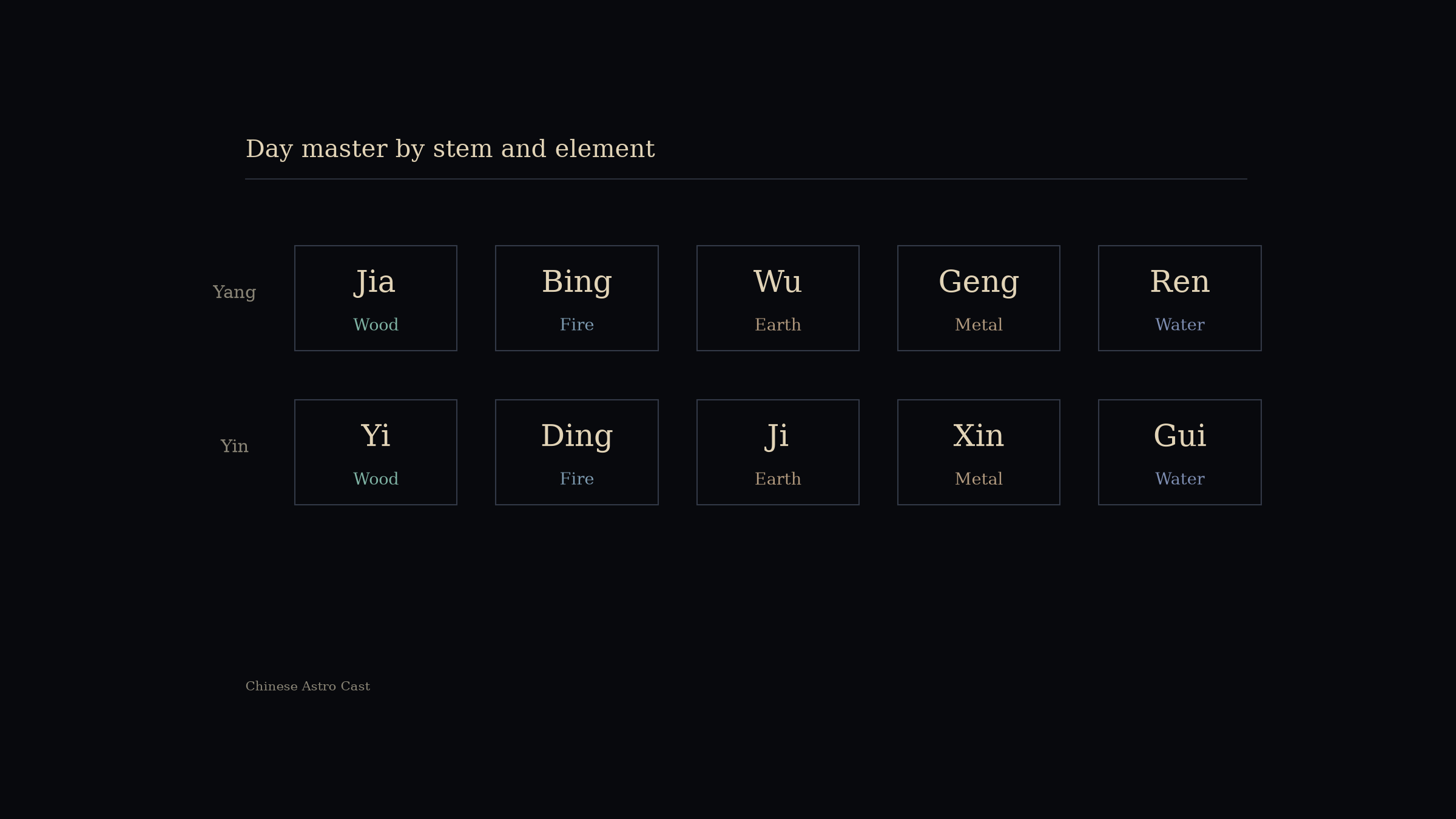
    In the four pillars, the day master is the upper character of the day pillar: one of ten stems, produced by combining the five elements with yin and yang polarity. Jia and Yi are wood; Bing and Ding fire; Wu and Ji earth; Geng and Xin metal; Ren and Gui water. Ten possible defaults, and every other character in the chart is interpreted as a relationship to that one.

    What the day master actually measures

    The day master is a reference point, not a verdict. Once it is fixed, the remaining stems and branches are translated into the Ten Gods — Resource, Output, Wealth, Officer, Peer — each of which is simply a statement about how that character stands in relation to you. Resource supports the day master; Output drains it into expression; Wealth is what the day master can control; Officer constrains it; Peer competes with it.

    That makes the day master closer to a capitalization structure than to a personality label. It describes the default mode in which you metabolize pressure: whether you absorb it and convert it into structure, export it immediately as output, or borrow capacity from allies until the season turns. A strong day master can carry weight without support and will often be restless without an outlet. A weak day master with abundant Resource has depth but can drown in preparation; the same day master with Output has speed but burns reserves.

    The Jungian parallel is deliberate and imperfect. The day master behaves like a typological baseline — the function you default to before you have decided anything. It does not predict what you will do. It predicts what the first move costs you, and which moves are cheap.

    The ten stems and their element assignments are fixed in the stem-and-branch reference published by the Hong Kong Observatory, not a matter of interpretation.

    Why it matters for decision-makers

    Because it prices your options. Two founders can hold the same strategy and face wildly different execution costs depending on whether their day master is reinforced by the month branch or isolated in it. The one with seasonal support can hold a position through a bad quarter without restructuring. The one without it will interpret the same quarter as a signal to change course, and will often be wrong about which variable moved.

    It also governs how support should arrive. Resource-type support — advice, capital, mentorship, credentials — feeds a day master that is structurally thin. The same support smothers a day master that is already strong and needs Output instead: shipping, hiring operators, and putting decisions into the world where they can be tested. Executive coaching that ignores this distinction produces highly polished people who still cannot commit.

    There is a second-order effect on visibility. Charts with prominent Officer structures tend to carry public exposure at low internal cost; charts dominated by Output carry it at high cost, because the same visibility that looks like authority to the market registers internally as exposure. Knowing which one you are is the difference between a keynote and three weeks of recovery.

    Common misreadings

    Strong is not good and weak is not bad. Strength is a structural statement about how much support the day master receives from the season and the branches. It says nothing about competence, character, or outcomes. Plenty of high-functioning operators run thin day masters and build systems precisely because they cannot rely on raw capacity.

    Element is not temperament cliché. Metal is not cold, Fire is not charismatic, Water is not emotional. The element describes a mode of transformation — refinement, expansion, consolidation, crystallization, circulation — and the same element behaves differently depending on whether it is rooted, exposed, or clashed.

    A missing element is not a deficiency. Charts do not owe you five elements. What matters is whether the structure functions: whether the day master has a route to output, whether wealth has a container, whether authority has a check.

    How to read it in your own chart

    Five steps, in order, and the order matters more than the vocabulary.

    1. Fix the day stem. Not the year, not the animal — the upper character of the day pillar. Everything downstream is relative to it.
    2. Read the month branch. This is the season, and in classical practice it carries more weight than any other single character. It tells you whether the day master is in its own season, in a supportive one, or in a hostile one.
    3. Count the Ten Gods. Not to score them, but to see distribution: is the chart dominated by Resource, by Wealth, by Officer? The dominant category is where the person spends attention by default.
    4. Check rooting. A stem with a hidden counterpart in a branch is anchored; the same stem without one is a preference rather than a capacity.
    5. Only then read the luck pillars. The decennial sequence tells you when the structure is subsidized and when it is taxed. Reading luck pillars before the natal structure is the most common inversion in commercial astrology.

    One methodological note that separates a usable chart from a decorative one: the hour pillar requires true solar time, not civil clock time. A birth at 23:40 civil time can fall into the preceding solar day, which changes the day pillar and therefore the day master itself. Calculators that skip the calibration produce a different chart, not a slightly less accurate one.

    Worked example

    An anonymised case: a founder born into a Wu (戊) earth day master in a Zi (子) month — earth in the depth of winter, structurally cold and thin. The chart carries three water characters and no fire at all. Read naively, this is a “weak” chart that should pursue support. Read structurally, it is a chart whose wealth is abundant and whose container is thin: the person can generate opportunity faster than they can hold it, and the correct intervention is not more opportunity but a container — contracts, operators, and a shorter list of active commitments. Every attempt to grow revenue before fixing retention reproduced the same failure at a larger scale.

    Diagram of the ten heavenly stems arranged by polarity and mapped to the five elements for day master reading
    Ten stems, five elements: the day master is one cell in this table.

    Where this goes wrong

    The first failure mode is moralizing strength. Clients who learn they are “strong” stop asking for help; clients who learn they are “weak” start treating every setback as confirmation of a defect. Both readings are lazy, and both are expensive.

    The second is single-variable diagnosis. The day master alone cannot tell you whether a business will work; it can tell you where the person will run out of energy first. Practitioners who stop at the day master produce horoscopes with better vocabulary.

    The third is timing. Structure without timing produces correct analysis that arrives late. The decennial luck pillars and the annual interactions are what convert a static reading into a schedule, and they require the full chart to be computed correctly — true solar time, late-zi handling, and consistent polarity throughout.

    Operating directive

    Identify your day master and its season this week, not this year. Write down the one category — Resource, Output, Wealth, Officer, Peer — that dominates your last twelve months of decisions. Then name the corrective: if Resource dominates, ship something unfinished; if Output dominates, build one container; if Wealth dominates, hire the person who says no.

    If you want the full structure rather than the single stem, the $19 The BaZi Blueprint computes the four pillars under true solar time, distributes the five elements quantitatively, and reads the Ten Gods as behavioral vectors rather than epithets. For a dual-system read that cross-checks the BaZi day master against the Ziwei soul palace, the $29 Master Astrological Codex Bundle runs both engines on the same birth data.

    The free day master calculator returns your day master and the elements that support or drain it, without an email address.

    The day master is not a description of who you are. It is the price list for how you operate — and price lists are only useful when read before the transaction.

    About the editor. Edward reviews every article against the site’s chart tables and the engine output quoted here. Last updated November 2026.