
- The day master is the one character describing you; the other seven describe the field you operate in.
- It is a default operating mode under pressure — what the system spends first — not a personality label.
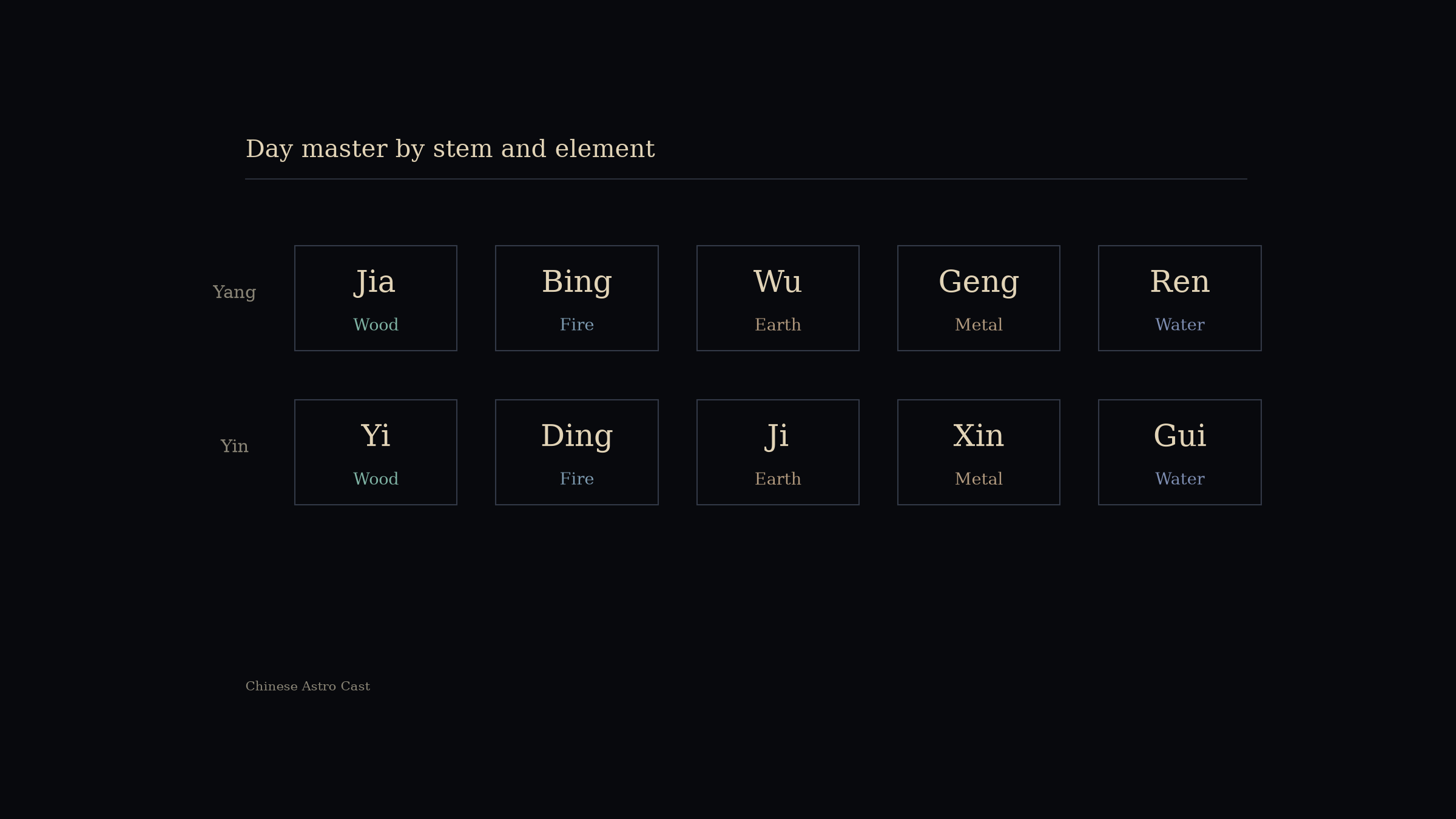
- Ten stems, five elements, two polarities: the reading is the relation between that stem and the other seven characters.
- Constitution tells you whether someone under load borrows support, burns output, or absorbs the hit.
A Day Master is the one character in a BaZi chart that describes you rather than your circumstances. The other seven characters describe the field you are operating in — the season, the available support, the competition, the exposure. Read the day master first and most of the vocabulary in a Chinese astrology report stops being decorative and starts behaving like instrumentation.
In the four pillars, the day master is the upper character of the day pillar: one of ten stems, produced by combining the five elements with yin and yang polarity. Jia and Yi are wood; Bing and Ding fire; Wu and Ji earth; Geng and Xin metal; Ren and Gui water. Ten possible defaults, and every other character in the chart is interpreted as a relationship to that one.
What the day master actually measures
The day master is a reference point, not a verdict. Once it is fixed, the remaining stems and branches are translated into the Ten Gods — Resource, Output, Wealth, Officer, Peer — each of which is simply a statement about how that character stands in relation to you. Resource supports the day master; Output drains it into expression; Wealth is what the day master can control; Officer constrains it; Peer competes with it.
That makes the day master closer to a capitalization structure than to a personality label. It describes the default mode in which you metabolize pressure: whether you absorb it and convert it into structure, export it immediately as output, or borrow capacity from allies until the season turns. A strong day master can carry weight without support and will often be restless without an outlet. A weak day master with abundant Resource has depth but can drown in preparation; the same day master with Output has speed but burns reserves.
The Jungian parallel is deliberate and imperfect. The day master behaves like a typological baseline — the function you default to before you have decided anything. It does not predict what you will do. It predicts what the first move costs you, and which moves are cheap.
The ten stems and their element assignments are fixed in the stem-and-branch reference published by the Hong Kong Observatory, not a matter of interpretation.
Why it matters for decision-makers
Because it prices your options. Two founders can hold the same strategy and face wildly different execution costs depending on whether their day master is reinforced by the month branch or isolated in it. The one with seasonal support can hold a position through a bad quarter without restructuring. The one without it will interpret the same quarter as a signal to change course, and will often be wrong about which variable moved.
It also governs how support should arrive. Resource-type support — advice, capital, mentorship, credentials — feeds a day master that is structurally thin. The same support smothers a day master that is already strong and needs Output instead: shipping, hiring operators, and putting decisions into the world where they can be tested. Executive coaching that ignores this distinction produces highly polished people who still cannot commit.
There is a second-order effect on visibility. Charts with prominent Officer structures tend to carry public exposure at low internal cost; charts dominated by Output carry it at high cost, because the same visibility that looks like authority to the market registers internally as exposure. Knowing which one you are is the difference between a keynote and three weeks of recovery.
Common misreadings
Strong is not good and weak is not bad. Strength is a structural statement about how much support the day master receives from the season and the branches. It says nothing about competence, character, or outcomes. Plenty of high-functioning operators run thin day masters and build systems precisely because they cannot rely on raw capacity.
Element is not temperament cliché. Metal is not cold, Fire is not charismatic, Water is not emotional. The element describes a mode of transformation — refinement, expansion, consolidation, crystallization, circulation — and the same element behaves differently depending on whether it is rooted, exposed, or clashed.
A missing element is not a deficiency. Charts do not owe you five elements. What matters is whether the structure functions: whether the day master has a route to output, whether wealth has a container, whether authority has a check.
How to read it in your own chart
Five steps, in order, and the order matters more than the vocabulary.
- Fix the day stem. Not the year, not the animal — the upper character of the day pillar. Everything downstream is relative to it.
- Read the month branch. This is the season, and in classical practice it carries more weight than any other single character. It tells you whether the day master is in its own season, in a supportive one, or in a hostile one.
- Count the Ten Gods. Not to score them, but to see distribution: is the chart dominated by Resource, by Wealth, by Officer? The dominant category is where the person spends attention by default.
- Check rooting. A stem with a hidden counterpart in a branch is anchored; the same stem without one is a preference rather than a capacity.
- Only then read the luck pillars. The decennial sequence tells you when the structure is subsidized and when it is taxed. Reading luck pillars before the natal structure is the most common inversion in commercial astrology.
One methodological note that separates a usable chart from a decorative one: the hour pillar requires true solar time, not civil clock time. A birth at 23:40 civil time can fall into the preceding solar day, which changes the day pillar and therefore the day master itself. Calculators that skip the calibration produce a different chart, not a slightly less accurate one.
Worked example
An anonymised case: a founder born into a Wu (戊) earth day master in a Zi (子) month — earth in the depth of winter, structurally cold and thin. The chart carries three water characters and no fire at all. Read naively, this is a “weak” chart that should pursue support. Read structurally, it is a chart whose wealth is abundant and whose container is thin: the person can generate opportunity faster than they can hold it, and the correct intervention is not more opportunity but a container — contracts, operators, and a shorter list of active commitments. Every attempt to grow revenue before fixing retention reproduced the same failure at a larger scale.
Where this goes wrong
The first failure mode is moralizing strength. Clients who learn they are “strong” stop asking for help; clients who learn they are “weak” start treating every setback as confirmation of a defect. Both readings are lazy, and both are expensive.
The second is single-variable diagnosis. The day master alone cannot tell you whether a business will work; it can tell you where the person will run out of energy first. Practitioners who stop at the day master produce horoscopes with better vocabulary.
The third is timing. Structure without timing produces correct analysis that arrives late. The decennial luck pillars and the annual interactions are what convert a static reading into a schedule, and they require the full chart to be computed correctly — true solar time, late-zi handling, and consistent polarity throughout.
Operating directive
Identify your day master and its season this week, not this year. Write down the one category — Resource, Output, Wealth, Officer, Peer — that dominates your last twelve months of decisions. Then name the corrective: if Resource dominates, ship something unfinished; if Output dominates, build one container; if Wealth dominates, hire the person who says no.
If you want the full structure rather than the single stem, the $19 The BaZi Blueprint computes the four pillars under true solar time, distributes the five elements quantitatively, and reads the Ten Gods as behavioral vectors rather than epithets. For a dual-system read that cross-checks the BaZi day master against the Ziwei soul palace, the $29 Master Astrological Codex Bundle runs both engines on the same birth data.
The free day master calculator returns your day master and the elements that support or drain it, without an email address.
The day master is not a description of who you are. It is the price list for how you operate — and price lists are only useful when read before the transaction.
About the editor. Edward reviews every article against the site’s chart tables and the engine output quoted here. Last updated November 2026.
Leave a Reply