Ten Gods

  • The Ten Gods in BaZi as Ten Psychological Archetypes

    The Ten Gods in BaZi as Ten Psychological Archetypes

    The ten gods in a BaZi chart are the layer Western readers abandon first, because the standard English labels read like a crime report. “Seven killings”, “hurting officer”, “rob wealth”: none of those phrases describes a behaviour. Each describes a relationship.

    • They are neither deities nor events: ten relationship types between the day-master stem and every other stem.
    • The label is relative, so the same stem is a different god under a different day master and literalism explains nothing.
    • Ten collapse into five families (same, output, wealth, power, resource) split by polarity: two axes, not ten mysteries.
    • Read by pillar: year for inherited conditions, month for professional method, hour for execution.

    What the ten gods actually measure

    A BaZi chart is four pillars, each written as one heavenly stem above one earthly branch. Eight characters in total, and the day stem is the only one that refers to the person. Call it the day master. One element, one polarity, yang wood for instance, and it becomes the origin point for everything else in the chart.

    The ten gods classify every other visible stem with two questions. What is the element relation between that stem and the day master: identical, produced by it, controlled by it, controlling it, or producing it. Then, does the stem share the day master’s polarity or oppose it. Five relations times two polarities gives ten labels. None of that arithmetic predicts anything. It is grammar.

    The closest Western analogue is a function-attitude typology, not a horoscope. Jung’s eight types describe a mode of functioning relative to the ego, and the same function behaves differently when it is introverted rather than extraverted. The ten gods work the same way. They name the relation, then the polarity, and leave the behaviour to be inferred from the whole chart.

    Five families, ten archetypes

    Because five families crossed with two polarities generate the ten, they hold in the mind as a map rather than a list. Each family answers a different question about what a person does with capacity: replicate it, express it, monetise it, govern it, or absorb it.

    • In the same-element family sit the Peer and the Competitor: colleagues, siblings, rivals, and the instinct to solve alone.
    • The output family holds the Creator and the Iconoclast, which is what the self produces. The Creator refines the craft. The Iconoclast dismantles the received method.
    • Wealth covers what the self controls. The Steward builds systems that hold assets. The Venture Capitalist finds the asymmetric bet.
    • Power covers what controls the self. The Institutional Architect works through legitimate structure, the Strategic Commander through force and tempo.
    • Resource is what produces the self. The Scholar absorbs codified knowledge, the Visionary Tactician reads patterns nobody has written down.

    Polarity is not virtue

    Classical Chinese marks one of each pair 正, proper, and the other 偏, lopsided. Those words describe the alignment of the pairing rather than a grade. A Direct Officer and a Seven Killings are the same metal meeting the same day master from two directions, one with polarity opposed, one with polarity matched. The matched pair tends to be frictionless and repetitive. The opposed pair tends to differentiate, and it is harder to regulate. Neither one is the better employee.

    Why it matters for decision-makers

    The practical value sits in the balance between families, not in any single label, because the five describe five different drains and supplies on the person. Output and wealth consume the day master. Resource and peers support it. A chart whose two largest shares sit on the consuming side and whose two smallest sit on the supporting side belongs to someone who can generate a great deal and replenish very little. That constraint surfaces in calendar design long before it shows up in any forecast.

    It also reframes the executive question. Instead of asking what kind of person this is, the chart asks which function is expensive for this person and which one is free. Free functions get delegated toward. Expensive ones get staffed. A founder whose professional method is production and critique should not be the person governing the institution, however capable the founder is. That is an org-design answer, not a prediction.

    Common misreadings

    Two errors recur. The first is reading a god as a trait: calling someone a Seven Killings personality fixes a relation into an identity, and then the hiring decision runs on the label. The second is reading absence as deficit. No visible stem of a family does not mean the function is missing. Classical readings also weigh the hidden stems inside the branches, and daily expression shifts with the luck pillars regardless.
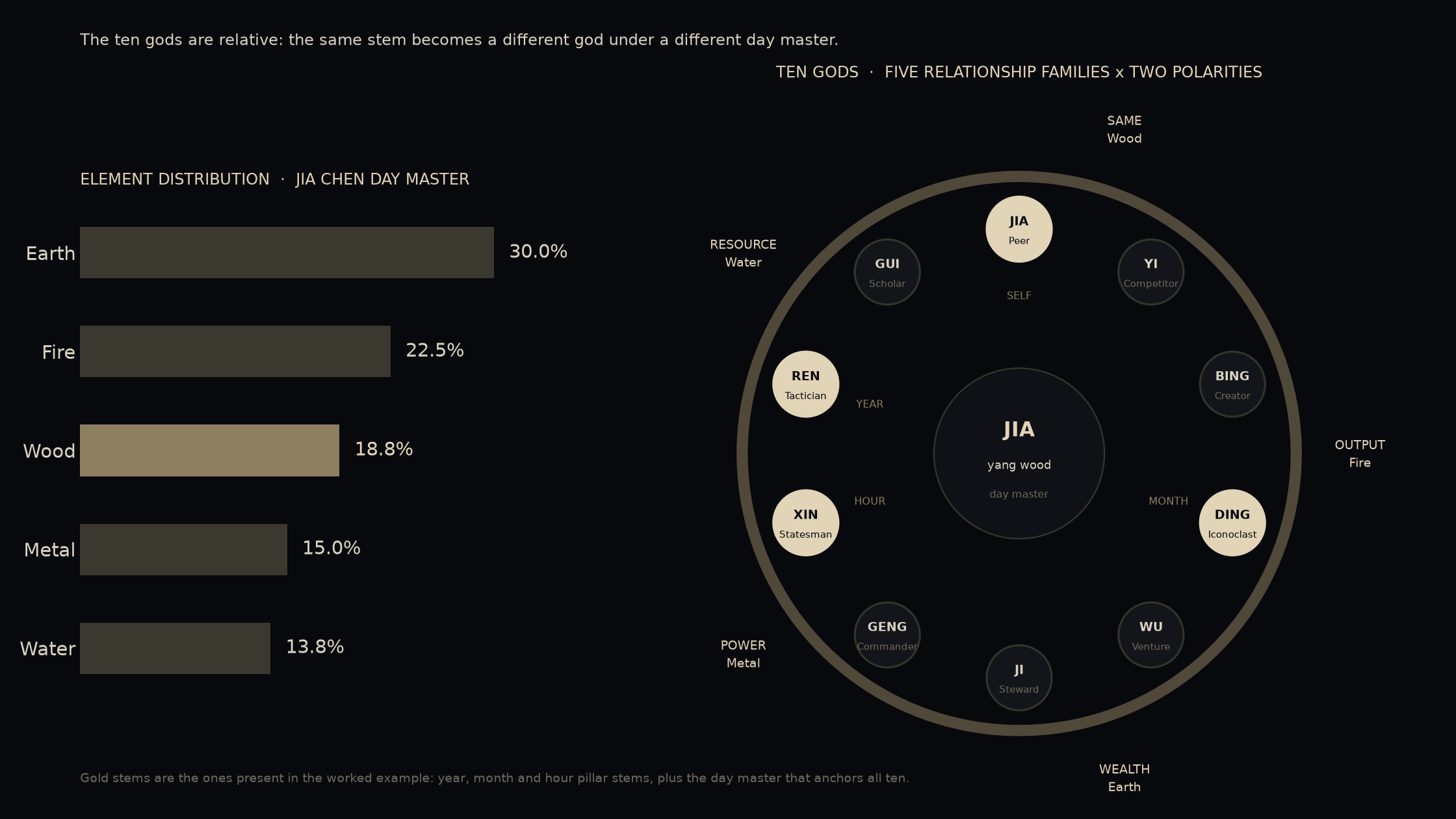
    Ten-gods ring diagram showing five relationship families and two polarities around a Jia day master, with the year, month and hour stems marked
    The ten gods as a ring: five families, two polarities each. Gold nodes are the stems present in the worked example below, with Jia as the day master that anchors all ten.

    Reading them in your own chart

    Order matters more than vocabulary here. Work through the sequence once and the labels stop being intimidating.

    1. Fix the day master. Take the day pillar’s stem and note its element and polarity.
    2. List the remaining visible stems: year, month, hour. The day stem never gets a god because it is the reference.
    3. Assign each stem its family by element relation, then its polarity by comparison with the day master.
    4. Weigh by position rather than count. Month carries professional method, year carries inherited conditions, hour carries execution and the later trajectory.
    5. Leave the luck pillars out of the first pass. They re-weight everything every ten years and blur a structural reading done too early.

    Worked example

    Our engine returns a clean case for a birth on 20 July 1982 at 13:21 in Changshu: true solar time 13:17:43, a correction of −3.28 minutes, and the pillars Ren Xu (壬戌) year, Ding Wei (丁未) month, Jia Chen (甲辰) day, Xin Wei (辛未) hour. The day master is Jia, yang wood, on a distribution of Earth 30.0, Fire 22.5, Wood 18.8, Metal 15.0, Water 13.8 per cent.

    Three visible gods follow. Ren in the year is yang water producing yang wood at matched polarity: the Visionary Tactician, the Contrarian. Ding in the month is yin fire produced by yang wood at opposed polarity: the Iconoclast. Xin in the hour is yin metal controlling yang wood at opposed polarity: the Institutional Architect, the Statesman.

    Read the positions rather than the names. Professional method sits in the month, and this month carries the Iconoclast, so the default working move is to dismantle the received method rather than perfect it. The Statesman appears only in the hour, which is where execution lives. Innovation upstream, governance downstream. That configuration reads cleanly until the organisation needs the downstream layer staffed by someone who is not the founder.

    Where this goes wrong

    The expensive failure is hiring on a label. A report that translates a stem as “seven killings” and stops there invites a reader to hear ruthlessness in what is really a description of matched-polarity power, which is the capacity to act without waiting for legitimacy. Used as a personality filter, the phrase disqualifies good operators.

    The second failure is symmetry hunting. Readers count two of one god and one of another, then conclude the chart is unbalanced. The classical method weighs position, season and support first. One month stem usually matters more than three scattered ones.

    Operating directive

    Name the day master before reading anything else. Map the three remaining visible stems to families, then to polarity, and record the balance rather than the labels. Identify which function is expensive for this person and staff it instead of training it. Read position before count, and treat every translated god name as a relationship rather than a character reference.

    For the full structural map, including element distribution, the ten gods by pillar and the luck sequence around them, the $19 BaZi Blueprint reports the arithmetic rather than the folklore. Readers who want the same profile cross-checked against the twelve-palace Ziwei topology use the $29 Master Astrological Codex Bundle, which runs both systems against one birth record.

    The month pillar above is bounded by solar terms rather than calendar months. The Wei month runs from Minor Heat to the Start of Autumn, and the Hong Kong Observatory publishes the authoritative tables for those boundaries.

    The ten gods are a discipline of relation rather than a set of titles, and a relation, unlike a title, can be redesigned.

    About the editor. Edward edits ChineseAstroCast and reviews every article against the site’s chart tables before publication. Last updated November 2026.

  • Reading a BaZi Chart: A Capability Map for Executives

    Reading a BaZi Chart: A Capability Map for Executives

    • A bazi chart is eight characters of capacity data — how much load a person carries — not eight predictions.
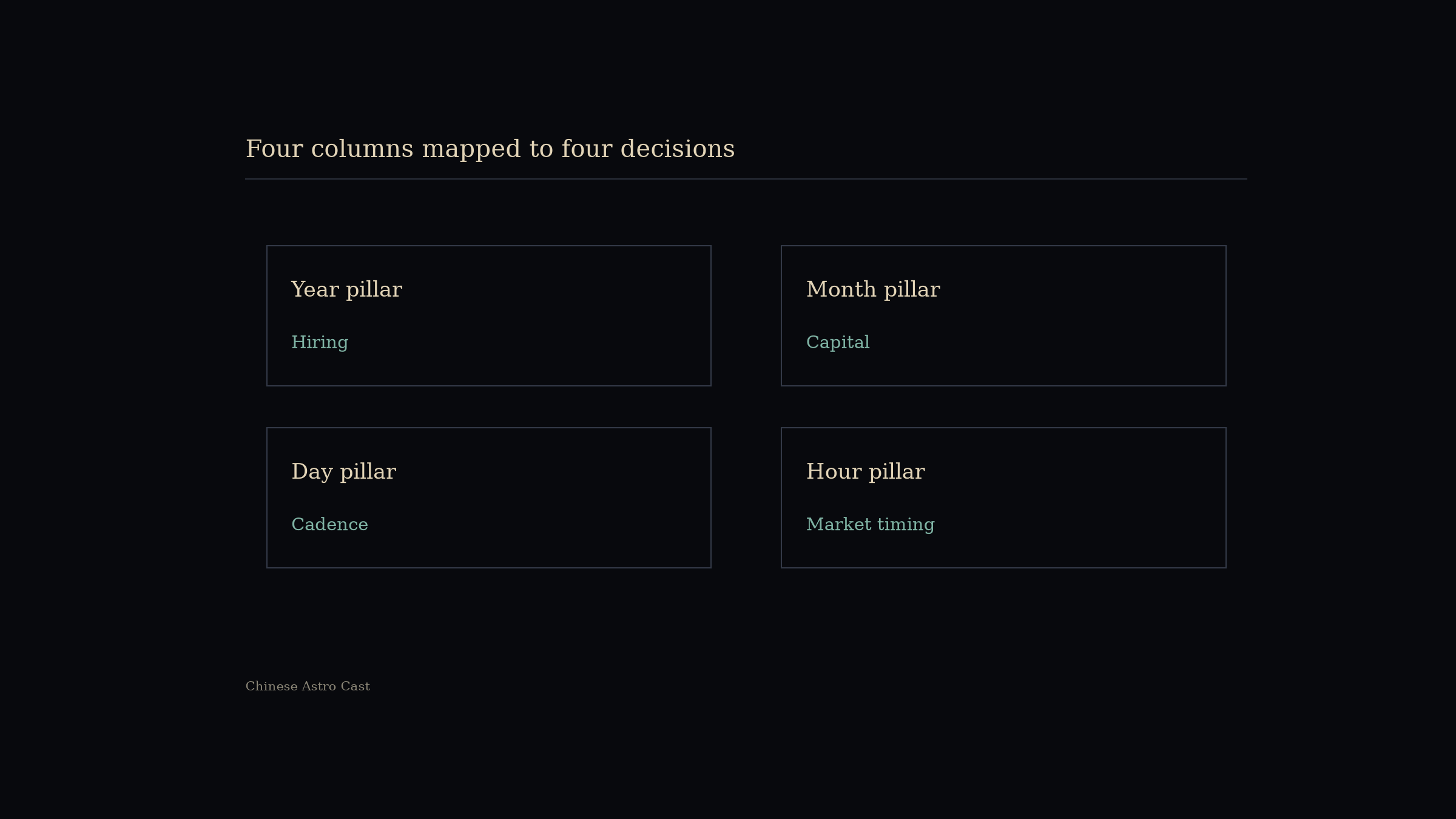
    • Four columns map to four decisions: hiring, capital, operating cadence, and market timing.
    • Which pillar carries the decision matters more than which element is ‘strong’.
    • The chart names where someone will over-apply effort; that is the part worth pricing into a role.

    A bazi chart is four pairs of characters, eight in total, and none of them is a prediction. They describe capacity: how much load a person carries, which environment suits them, and where they habitually overreach. Read as a capability map, a bazi chart belongs in the boardroom. Read as a script, it gets expensive fast.

    What a bazi chart actually measures

    The chart comes from the birth moment expressed in the Chinese solar calendar. Four pillars, each a heavenly stem above an earthly branch, for the year, month, day and hour. The year pillar describes the inherited field: generation, family baseline, the conditions nobody chose. The month pillar describes season, and it carries the most weight, because season is the industry, the market climate, the social field a person was formed inside. The day pillar holds the Day Master, the stem that describes the self. The branch beneath it describes the private register, meaning partnership, the body, and whatever a person returns to when unobserved. The hour pillar describes how output gets executed and what is wanted after the visible career ends.

    Capacity is not a score

    Eight characters do not add up to a rating. They describe where capacity is stored, what it costs to move it, and which conditions make it expensive to run. A candidate with a heavy month pillar and a thin day pillar is not weaker than the reverse — they are load-bearing in a different place, and the role has to match that place.

    What matters is never which elements are present but the ratios and the direction of flow. A chart with three Wood and no Water is not “a Wood person”. It is a system that expands without replenishment. The reading is structural: what supports the Day Master, what drains it, whether the month branch leaves it exposed. All of that describes operating conditions, and it sits closer to a balance sheet than to a forecast.

    Stems and branches do different work, a point most summaries skip. Stems describe function, the visible capability a person can deploy on demand. Branches describe context: the ground the capability stands on, including season, relationships and the hidden stems inside each branch. Two charts with identical stems can read differently because the ground beneath them is not the same. A capability is only as usable as the context holding it up, and the chart records both on one page.

    The stem-and-branch cycle the chart is built from, and the calendar it is read against, are both published in the Hong Kong Observatory’s calendar reference.

    Why it matters for decision-makers

    For an executive the value sits in cost curves, not verdicts. Two people can be equally capable and carry very different marginal cost for the same role. A structure with strong Metal and Fire tolerates confrontation, short feedback loops and public reversals; it gets sharper under friction. A structure heavy in Earth and Water does its best work across long horizons and low noise, and pays a visible price in a chaotic room. Hiring, delegation and even deal structure can be modelled against that. None of it replaces judgment. It tells you where judgment will be expensive.

    The chart also times. Luck pillars are ten-year segments, each with its own stem and branch, and they change the weighting of the natal structure rather than replacing it. A decennial that reinforces the Day Master is one to expand in. A decennial that attacks it is one to consolidate and renegotiate commitments. The structure does not choose. It prices one choice against another across a decade.

    Applied to capital, that distinction becomes concrete. A structure well supported in the current decennial can carry a longer payback period: eighteen to thirty months of build before a real return is tolerable. The same operator facing an attacking decade should shorten duration. Smaller cheques, more frequent checkpoints, and a preference for revenue that starts inside two quarters. The strategy does not change; its term structure does, because the chart says the carrying cost changed.

    Common misreadings

    Three errors recur. First, counting elements and reading the count as a score, when a balanced chart is not better than an unbalanced one, only differently constrained. Second, reading the year pillar as identity when the month branch sets the season and usually dominates it. Third, lifting one archetypal force out of the chart, the Strategic Commander or the Iconoclast, and treating it as a personality label. What matters is whether that force is supported, exposed or duplicated. A force that appears twice is rarely twice as strong; more often it is a fixed cost.

    Capability map diagram mapping the year, month, day and hour pillars to hiring, capital, cadence and market timing decisions
    Four columns, four decisions: the mapping is the reading.

    How to read it in your own chart

    Work in order and do not skip the first step. One: fix the birth time to the minute and calibrate it to true solar time. Nearly every online tool reads civil clock time, which is a different quantity. Two: locate the Day Master, the day stem, and ignore everything else until you can state its element and polarity plainly. Three: read the month branch. It is the season, and it outranks the year. Four: map the other seven characters onto the ten gods by their relationship to the Day Master. Same element gives Peer and Competitor. What it produces gives Creator and Iconoclast. What it controls gives Steward and Venture Capitalist. What controls it gives Institutional Architect and Strategic Commander. What produces it gives Scholar and Visionary Tactician. Five: tally support against drain. Six: only then add the luck pillars as a timeline.

    Which pillar carries the decision

    A board decision usually has one column behind it. Hiring a COO is a day-pillar question about load and appetite; opening a market is a month-pillar question about season and available support; pricing a launch is an hour-pillar question about output. Naming the column first keeps the reading from turning into a general description of a person, which is exactly the failure mode executives distrust.

    Worked example

    A founder in industrial distribution, born in an autumn month, runs a Wood Day Master. Autumn is Metal’s season, and Metal cuts Wood. On paper the structure reads as a person permanently under pressure, and for the first fifteen years that is what the operating record looked like: strong at winning mandates, thin on recovery. The structural correction was Water, the element that lets Metal generate Wood instead of cutting it. He moved his own role toward origination and advisory work, hired operators for delivery, and stopped taking the negotiation seat in every deal. Revenue was flat for a year. Senior-team churn was not.

    The downstream damage had been quiet for a long time. Roughly two departures a year, each explained as a bad fit, each a symptom of a role that demanded continuous exposure from a structure already under attack. The rule worth keeping: when a chart is structurally pressured, change the interface before increasing the effort. Effort against an attacking season buys endurance, and endurance has a ceiling.

    Where this goes wrong

    Two failure modes are common and one is expensive. The common ones are an uncalibrated chart, where an hour pillar off by one two-hour window changes the hour stem and sometimes the whole downstream reading, and treating the output as a fixed type, which turns a structural description into a label within a month. The expensive one is letting a chart override diligence. A favourable decennial is not evidence that a counterparty is solvent. A chart models the operator’s conditions, not the other side’s books. Where external facts exist, the chart is the last input, never the first. If you want capacity and palace topology cross-checked instead of consulted separately, the $29 Master Astrological Codex Bundle runs both systems against one birth record.

    Operating directive

    Calibrate the birth time before you read anything, because an uncalibrated hour is a different chart. Write the Day Master, the month branch and the four element ratios on a single page. If it does not fit on a page, you are reading too much. Separate capacity from timing: capacity is natal structure, timing is the decennial overlay, and confusing them produces either fatalism or overconfidence. When a decade attacks the Day Master, renegotiate scope instead of raising effort. Use the chart to ask better questions in hiring and deal review, never to close one. The $19 The BaZi Blueprint produces the structural reading described above; the interpretive judgment still belongs to you.

    The free BaZi calculator returns the same columns without interpretation — a place to practise reading before paying for one.

    A bazi chart is a discipline of reading constraints, not a label to wear. The moment it becomes an identity, it stops being information.

    About the editor. Edward reviews every article against the site’s chart tables and the engine output quoted here. Last updated November 2026.

  • The Day Master in BaZi: Reading Constitutional Capacity

    The Day Master in BaZi: Reading Constitutional Capacity

    • The day master is the one character describing you; the other seven describe the field you operate in.
    • It is a default operating mode under pressure — what the system spends first — not a personality label.
    • Ten stems, five elements, two polarities: the reading is the relation between that stem and the other seven characters.
    • Constitution tells you whether someone under load borrows support, burns output, or absorbs the hit.

    A Day Master is the one character in a BaZi chart that describes you rather than your circumstances. The other seven characters describe the field you are operating in — the season, the available support, the competition, the exposure. Read the day master first and most of the vocabulary in a Chinese astrology report stops being decorative and starts behaving like instrumentation.

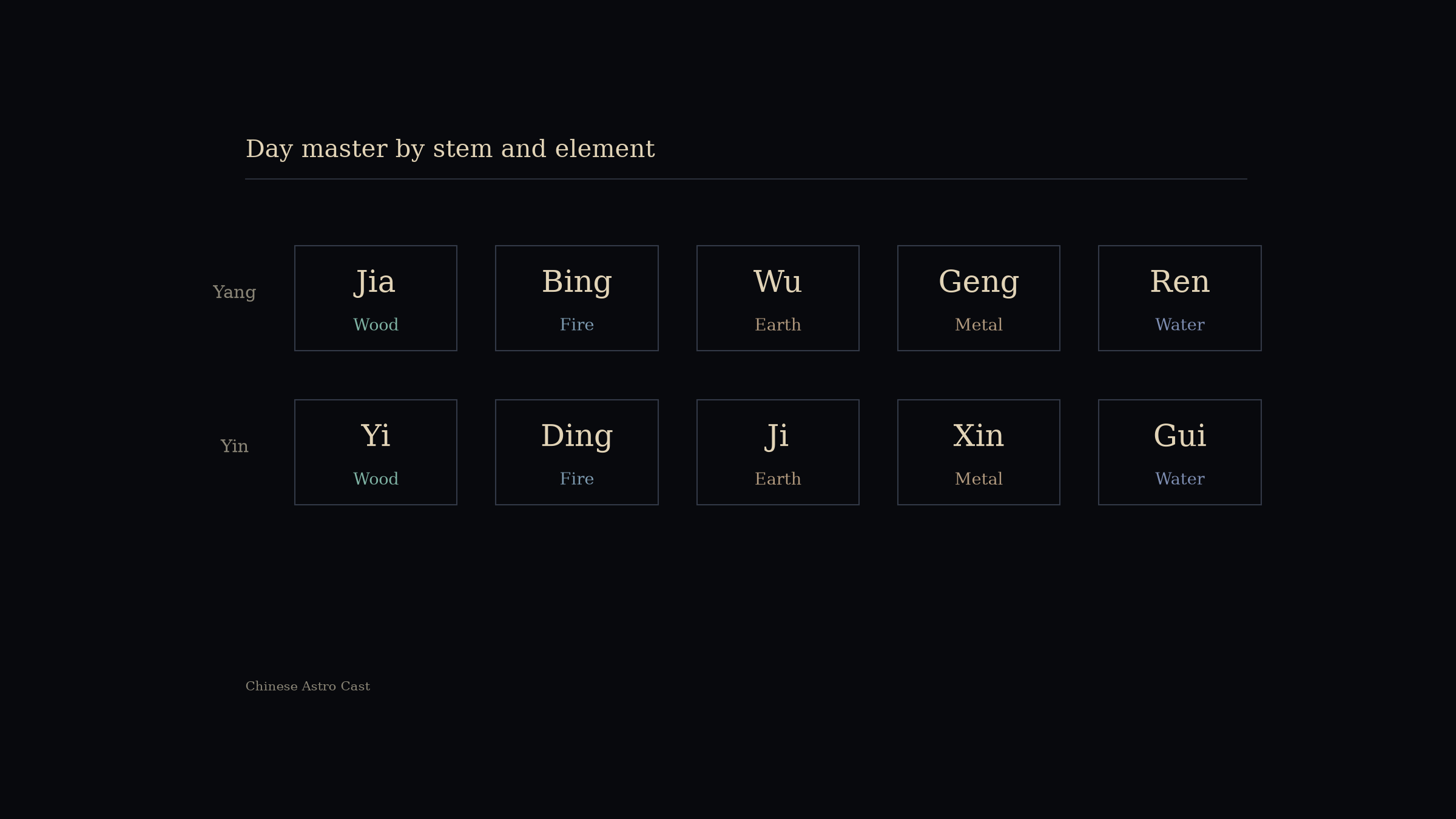
    In the four pillars, the day master is the upper character of the day pillar: one of ten stems, produced by combining the five elements with yin and yang polarity. Jia and Yi are wood; Bing and Ding fire; Wu and Ji earth; Geng and Xin metal; Ren and Gui water. Ten possible defaults, and every other character in the chart is interpreted as a relationship to that one.

    What the day master actually measures

    The day master is a reference point, not a verdict. Once it is fixed, the remaining stems and branches are translated into the Ten Gods — Resource, Output, Wealth, Officer, Peer — each of which is simply a statement about how that character stands in relation to you. Resource supports the day master; Output drains it into expression; Wealth is what the day master can control; Officer constrains it; Peer competes with it.

    That makes the day master closer to a capitalization structure than to a personality label. It describes the default mode in which you metabolize pressure: whether you absorb it and convert it into structure, export it immediately as output, or borrow capacity from allies until the season turns. A strong day master can carry weight without support and will often be restless without an outlet. A weak day master with abundant Resource has depth but can drown in preparation; the same day master with Output has speed but burns reserves.

    The Jungian parallel is deliberate and imperfect. The day master behaves like a typological baseline — the function you default to before you have decided anything. It does not predict what you will do. It predicts what the first move costs you, and which moves are cheap.

    The ten stems and their element assignments are fixed in the stem-and-branch reference published by the Hong Kong Observatory, not a matter of interpretation.

    Why it matters for decision-makers

    Because it prices your options. Two founders can hold the same strategy and face wildly different execution costs depending on whether their day master is reinforced by the month branch or isolated in it. The one with seasonal support can hold a position through a bad quarter without restructuring. The one without it will interpret the same quarter as a signal to change course, and will often be wrong about which variable moved.

    It also governs how support should arrive. Resource-type support — advice, capital, mentorship, credentials — feeds a day master that is structurally thin. The same support smothers a day master that is already strong and needs Output instead: shipping, hiring operators, and putting decisions into the world where they can be tested. Executive coaching that ignores this distinction produces highly polished people who still cannot commit.

    There is a second-order effect on visibility. Charts with prominent Officer structures tend to carry public exposure at low internal cost; charts dominated by Output carry it at high cost, because the same visibility that looks like authority to the market registers internally as exposure. Knowing which one you are is the difference between a keynote and three weeks of recovery.

    Common misreadings

    Strong is not good and weak is not bad. Strength is a structural statement about how much support the day master receives from the season and the branches. It says nothing about competence, character, or outcomes. Plenty of high-functioning operators run thin day masters and build systems precisely because they cannot rely on raw capacity.

    Element is not temperament cliché. Metal is not cold, Fire is not charismatic, Water is not emotional. The element describes a mode of transformation — refinement, expansion, consolidation, crystallization, circulation — and the same element behaves differently depending on whether it is rooted, exposed, or clashed.

    A missing element is not a deficiency. Charts do not owe you five elements. What matters is whether the structure functions: whether the day master has a route to output, whether wealth has a container, whether authority has a check.

    How to read it in your own chart

    Five steps, in order, and the order matters more than the vocabulary.

    1. Fix the day stem. Not the year, not the animal — the upper character of the day pillar. Everything downstream is relative to it.
    2. Read the month branch. This is the season, and in classical practice it carries more weight than any other single character. It tells you whether the day master is in its own season, in a supportive one, or in a hostile one.
    3. Count the Ten Gods. Not to score them, but to see distribution: is the chart dominated by Resource, by Wealth, by Officer? The dominant category is where the person spends attention by default.
    4. Check rooting. A stem with a hidden counterpart in a branch is anchored; the same stem without one is a preference rather than a capacity.
    5. Only then read the luck pillars. The decennial sequence tells you when the structure is subsidized and when it is taxed. Reading luck pillars before the natal structure is the most common inversion in commercial astrology.

    One methodological note that separates a usable chart from a decorative one: the hour pillar requires true solar time, not civil clock time. A birth at 23:40 civil time can fall into the preceding solar day, which changes the day pillar and therefore the day master itself. Calculators that skip the calibration produce a different chart, not a slightly less accurate one.

    Worked example

    An anonymised case: a founder born into a Wu (戊) earth day master in a Zi (子) month — earth in the depth of winter, structurally cold and thin. The chart carries three water characters and no fire at all. Read naively, this is a “weak” chart that should pursue support. Read structurally, it is a chart whose wealth is abundant and whose container is thin: the person can generate opportunity faster than they can hold it, and the correct intervention is not more opportunity but a container — contracts, operators, and a shorter list of active commitments. Every attempt to grow revenue before fixing retention reproduced the same failure at a larger scale.

    Diagram of the ten heavenly stems arranged by polarity and mapped to the five elements for day master reading
    Ten stems, five elements: the day master is one cell in this table.

    Where this goes wrong

    The first failure mode is moralizing strength. Clients who learn they are “strong” stop asking for help; clients who learn they are “weak” start treating every setback as confirmation of a defect. Both readings are lazy, and both are expensive.

    The second is single-variable diagnosis. The day master alone cannot tell you whether a business will work; it can tell you where the person will run out of energy first. Practitioners who stop at the day master produce horoscopes with better vocabulary.

    The third is timing. Structure without timing produces correct analysis that arrives late. The decennial luck pillars and the annual interactions are what convert a static reading into a schedule, and they require the full chart to be computed correctly — true solar time, late-zi handling, and consistent polarity throughout.

    Operating directive

    Identify your day master and its season this week, not this year. Write down the one category — Resource, Output, Wealth, Officer, Peer — that dominates your last twelve months of decisions. Then name the corrective: if Resource dominates, ship something unfinished; if Output dominates, build one container; if Wealth dominates, hire the person who says no.

    If you want the full structure rather than the single stem, the $19 The BaZi Blueprint computes the four pillars under true solar time, distributes the five elements quantitatively, and reads the Ten Gods as behavioral vectors rather than epithets. For a dual-system read that cross-checks the BaZi day master against the Ziwei soul palace, the $29 Master Astrological Codex Bundle runs both engines on the same birth data.

    The free day master calculator returns your day master and the elements that support or drain it, without an email address.

    The day master is not a description of who you are. It is the price list for how you operate — and price lists are only useful when read before the transaction.

    About the editor. Edward reviews every article against the site’s chart tables and the engine output quoted here. Last updated November 2026.