BaZi

  • Why BaZi Calculators Disagree: True Solar Time Explained

    Why BaZi Calculators Disagree: True Solar Time Explained

    • Three calculators return three hour pillars because each one defines noon differently.
    • True solar time = clock time + longitude correction + equation of time; both corrections are something an honest tool can show you.
    • A two-degree longitude error moves the reading by about eight minutes — enough to cross a two-hour boundary and change the pillar.
    • Calibrate before interpreting: an uncalibrated chart is simply a different chart.

    Run the same birth data through three BaZi calculators and you will often get three different hour pillars. Each engine picks a clock and most never say which one. What reads as sloppy arithmetic is usually a disagreement about the definition of noon.

    What a BaZi calculator actually measures

    A BaZi chart is a timestamp written in four pairs of characters. Each pair, or pillar, carries one Heavenly Stem and one Earthly Branch drawn from a sexagenary cycle that advances with the solar calendar rather than the Gregorian one. The year pillar turns at the Start of Spring solar term in early February, not on January the first. The month pillar turns at each of the twelve major solar terms. The day pillar advances one step per day, without gaps.

    Three of those four layers survive translation between engines intact, because they depend only on the date. The fourth depends on something no clock records: where the sun stood above the birth location at that moment. A calendar hands you civil time. A chart needs apparent solar time. The two quantities differ, and the difference is large enough to move a boundary.

    Engines also differ in how they handle the solar term edges. One rounds the Start of Spring to the nearest minute, another to the nearest hour. For a birth two days away from the term this is irrelevant. For a birth inside the boundary hour it changes the year pillar, and with it the entire frame of the reading. Precision claims on a marketing page rarely specify which of these choices the engine made.

    Why the hour pillar is the fragile layer

    The hour pillar splits the day into twelve windows of two hours each, and those windows are anchored to the sun rather than to the wrist. The noon window is centred on local solar noon. The midnight window opens at 23:00 apparent time and closes at 01:00, which is also the point where most schools roll the day pillar forward. Anything measured from that boundary inherits its precision, or its error.

    Three corrections separate clock time from solar time. Longitude comes first. Every degree east or west of the standard meridian shifts local noon by four minutes. China is the extreme case: a single zone built on 120 degrees east, while Chengdu sits near 104 degrees. That gap is 64 minutes. A birth recorded at 00:40 in Chengdu happened, in solar terms, during the previous evening’s window, so the day pillar belongs to the day before.

    The second correction is the equation of time, the gap between mean and apparent solar time created by the tilt of Earth’s axis and the eccentricity of its orbit. It runs from roughly minus 14 minutes in mid-February to plus 16 minutes in early November. The third is daylight saving, a clean 60 minutes that no birth certificate ever annotates. Add all three and a chart can drift by ninety minutes before anyone has made a mistake.

    Common misreadings

    Two errors produce most of the confusion. The first is deciding the engine is broken when two sites disagree. Usually both are internally consistent and calibrated to different conventions, and neither publishes its convention. The second is treating the hour pillar as decoration because the day master feels more personal. The hour layer governs the operational style, the later palaces and the internal balance of the ten gods. Shift it one window sideways and the reading still sounds plausible, which is precisely the problem.
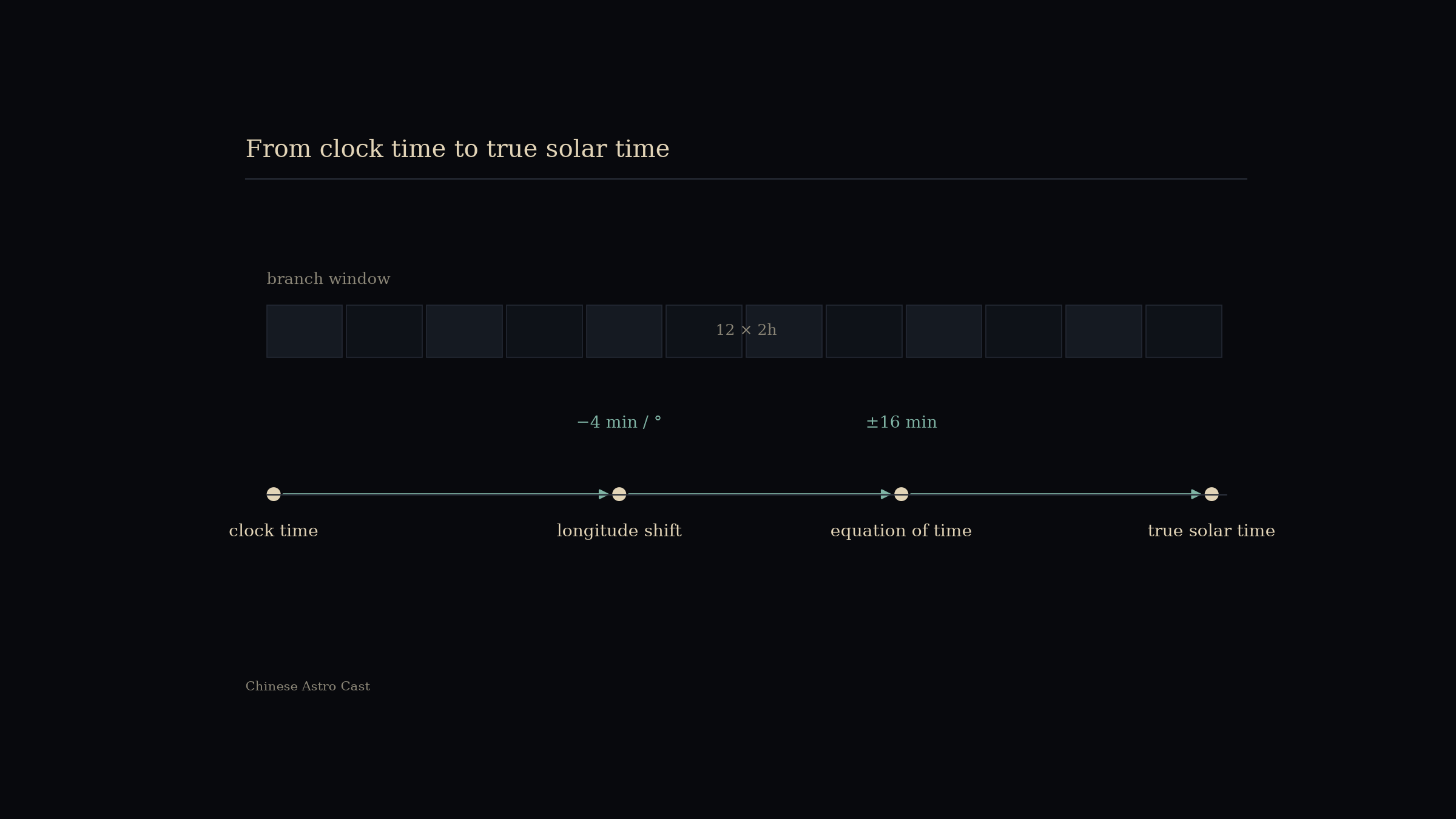
    Timeline showing clock time, longitude correction and equation of time combining into true solar time, above the twelve two-hour branch windows
    Two corrections sit between the clock on the wall and the branch window.

    How to calibrate before you read anything

    Do the arithmetic in a fixed order and write the result down before you open the chart. The sequence matters more than the precision.

    1. Strip daylight saving from the recorded time if the birth fell inside a summer-time window.
    2. Convert longitude to minutes: subtract or add four minutes for each degree between the birthplace and the zone’s standard meridian.
    3. Apply the equation of time for that date, which you can look up to the nearest half minute.
    4. Compare the result against the twelve window boundaries and note the margin.
    5. Flag any birth within twenty minutes of a boundary and run the reading twice, once in each adjacent window.

    The fifth step is where most of the value sits. A drift of six minutes changes nothing. A drift of six minutes across a boundary changes the hour stem, and with it the relationship between the hour and the day master. When the margin is thin, the honest move is to test both readings against lived behaviour rather than to pick the tidier one.

    There is one convention question the arithmetic cannot settle. A minority of schools keep the day pillar on the civil midnight, so a birth at 23:30 belongs to the same day as 22:00 and 00:30 alike. The older reckoning opens the new day at 23:00. Both are defensible, and the choice matters most for births inside that single hour. What is not defensible is switching convention between charts without saying so.

    A worked example

    A founder born in Boston in mid-July, recorded at 07:20 on the certificate during daylight saving. Strip the hour: 06:20 standard clock. Boston sits at 71.06 degrees west against a 75 degree meridian, so add 15.8 minutes for longitude and the result is 06:36 local mean time.

    The equation of time in mid-July is about minus 6 minutes, which gives 06:30 apparent solar time. That lands inside the 05:00 to 07:00 window. The uncalibrated 07:20 would have landed in the next window, with a different branch, a different hour stem and a different relationship to the day master. Fifty minutes of bookkeeping separates two different readings of the same person.

    The downstream damage is quiet. A different hour stem changes the ten god attached to the hour pillar, which changes the stated relationship between a person’s output and their authority, and it shifts the hour branch that anchors the Ziwei palaces. Nothing in the report announces the swap; the prose simply describes a neighbouring configuration with the same confidence.

    The practical fix is procedural rather than technical. Ask every chart you inherit one question — which clock produced this hour pillar. Certificate time, hospital record time and the time a parent remembers are three different inputs, and only one of them has been calibrated.

    The apparent-solar-time calculation behind both corrections is documented in NOAA’s solar calculator, with the equation-of-time curve published as a table.

    Where this goes wrong

    The expensive failure is not a wrong chart. It is a chart that is right about the wrong person. A consultant reads an hour stem that belongs to the neighbouring window and describes a decision style the client does not have. The client recognises enough of the description to accept the rest, and a strategy gets built on a mislabelled strength.

    The same error propagates into Ziwei Dou Shu, where the birth hour determines the position of the Soul Palace. One uncorrected clock reading displaces an entire twelve-palace topology, and the resulting advice can be coherent, detailed and aimed at somebody else. The cheaper failure is inconsistency: calibrate one chart and not the next, and you can no longer compare two people, which is most of what an advisory practice does with a system like this.

    Operating directive

    Record the birthplace coordinates before you record anything else, because longitude is the correction people skip. State the convention your chart uses, in writing, so a second reader can reproduce it. Run every boundary case twice and keep both versions in the file.

    Treat calibration as part of the reading rather than an IT chore. The $19 The BaZi Blueprint applies true solar time before any interpretation begins, so the hour pillar you read is the one the sky actually produced. Where the stakes justify a cross-check, the $29 Master Astrological Codex Bundle pairs the same calibrated birth data with a twelve-palace Ziwei chart, which makes a displaced hour visible rather than silently absorbed.

    The free BaZi calculator shows the true solar time it used, so the displacement is visible rather than absorbed into the result.

    A BaZi calculator is a measurement instrument, and the hour pillar is the reading that tells you whether it was calibrated.

    About the editor. Edward reviews every article against the site’s chart tables and the engine output quoted here. Last updated November 2026.

  • The Day Master in BaZi: Reading Constitutional Capacity

    The Day Master in BaZi: Reading Constitutional Capacity

    • The day master is the one character describing you; the other seven describe the field you operate in.
    • It is a default operating mode under pressure — what the system spends first — not a personality label.
    • Ten stems, five elements, two polarities: the reading is the relation between that stem and the other seven characters.
    • Constitution tells you whether someone under load borrows support, burns output, or absorbs the hit.

    A Day Master is the one character in a BaZi chart that describes you rather than your circumstances. The other seven characters describe the field you are operating in — the season, the available support, the competition, the exposure. Read the day master first and most of the vocabulary in a Chinese astrology report stops being decorative and starts behaving like instrumentation.

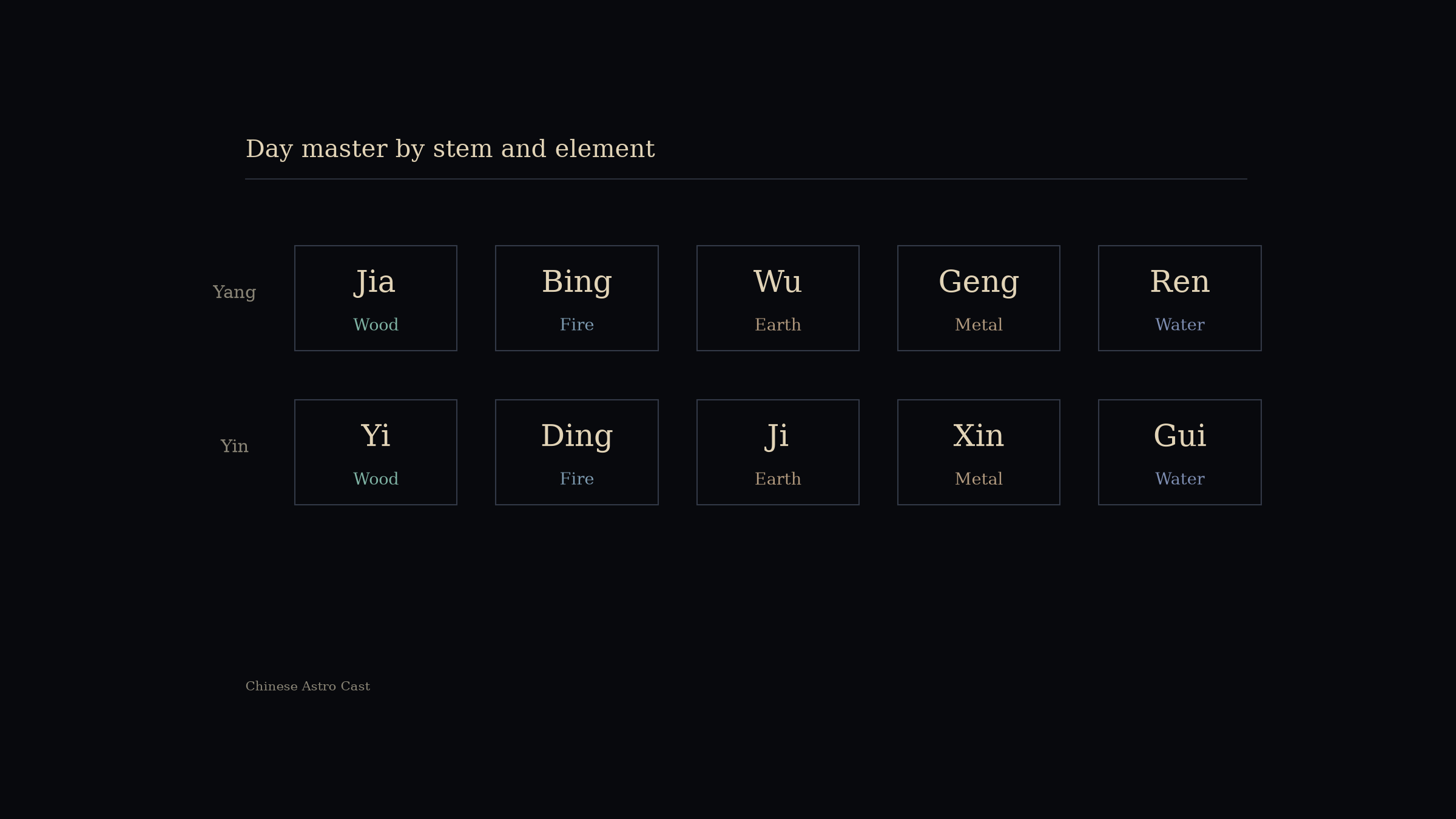
    In the four pillars, the day master is the upper character of the day pillar: one of ten stems, produced by combining the five elements with yin and yang polarity. Jia and Yi are wood; Bing and Ding fire; Wu and Ji earth; Geng and Xin metal; Ren and Gui water. Ten possible defaults, and every other character in the chart is interpreted as a relationship to that one.

    What the day master actually measures

    The day master is a reference point, not a verdict. Once it is fixed, the remaining stems and branches are translated into the Ten Gods — Resource, Output, Wealth, Officer, Peer — each of which is simply a statement about how that character stands in relation to you. Resource supports the day master; Output drains it into expression; Wealth is what the day master can control; Officer constrains it; Peer competes with it.

    That makes the day master closer to a capitalization structure than to a personality label. It describes the default mode in which you metabolize pressure: whether you absorb it and convert it into structure, export it immediately as output, or borrow capacity from allies until the season turns. A strong day master can carry weight without support and will often be restless without an outlet. A weak day master with abundant Resource has depth but can drown in preparation; the same day master with Output has speed but burns reserves.

    The Jungian parallel is deliberate and imperfect. The day master behaves like a typological baseline — the function you default to before you have decided anything. It does not predict what you will do. It predicts what the first move costs you, and which moves are cheap.

    The ten stems and their element assignments are fixed in the stem-and-branch reference published by the Hong Kong Observatory, not a matter of interpretation.

    Why it matters for decision-makers

    Because it prices your options. Two founders can hold the same strategy and face wildly different execution costs depending on whether their day master is reinforced by the month branch or isolated in it. The one with seasonal support can hold a position through a bad quarter without restructuring. The one without it will interpret the same quarter as a signal to change course, and will often be wrong about which variable moved.

    It also governs how support should arrive. Resource-type support — advice, capital, mentorship, credentials — feeds a day master that is structurally thin. The same support smothers a day master that is already strong and needs Output instead: shipping, hiring operators, and putting decisions into the world where they can be tested. Executive coaching that ignores this distinction produces highly polished people who still cannot commit.

    There is a second-order effect on visibility. Charts with prominent Officer structures tend to carry public exposure at low internal cost; charts dominated by Output carry it at high cost, because the same visibility that looks like authority to the market registers internally as exposure. Knowing which one you are is the difference between a keynote and three weeks of recovery.

    Common misreadings

    Strong is not good and weak is not bad. Strength is a structural statement about how much support the day master receives from the season and the branches. It says nothing about competence, character, or outcomes. Plenty of high-functioning operators run thin day masters and build systems precisely because they cannot rely on raw capacity.

    Element is not temperament cliché. Metal is not cold, Fire is not charismatic, Water is not emotional. The element describes a mode of transformation — refinement, expansion, consolidation, crystallization, circulation — and the same element behaves differently depending on whether it is rooted, exposed, or clashed.

    A missing element is not a deficiency. Charts do not owe you five elements. What matters is whether the structure functions: whether the day master has a route to output, whether wealth has a container, whether authority has a check.

    How to read it in your own chart

    Five steps, in order, and the order matters more than the vocabulary.

    1. Fix the day stem. Not the year, not the animal — the upper character of the day pillar. Everything downstream is relative to it.
    2. Read the month branch. This is the season, and in classical practice it carries more weight than any other single character. It tells you whether the day master is in its own season, in a supportive one, or in a hostile one.
    3. Count the Ten Gods. Not to score them, but to see distribution: is the chart dominated by Resource, by Wealth, by Officer? The dominant category is where the person spends attention by default.
    4. Check rooting. A stem with a hidden counterpart in a branch is anchored; the same stem without one is a preference rather than a capacity.
    5. Only then read the luck pillars. The decennial sequence tells you when the structure is subsidized and when it is taxed. Reading luck pillars before the natal structure is the most common inversion in commercial astrology.

    One methodological note that separates a usable chart from a decorative one: the hour pillar requires true solar time, not civil clock time. A birth at 23:40 civil time can fall into the preceding solar day, which changes the day pillar and therefore the day master itself. Calculators that skip the calibration produce a different chart, not a slightly less accurate one.

    Worked example

    An anonymised case: a founder born into a Wu (戊) earth day master in a Zi (子) month — earth in the depth of winter, structurally cold and thin. The chart carries three water characters and no fire at all. Read naively, this is a “weak” chart that should pursue support. Read structurally, it is a chart whose wealth is abundant and whose container is thin: the person can generate opportunity faster than they can hold it, and the correct intervention is not more opportunity but a container — contracts, operators, and a shorter list of active commitments. Every attempt to grow revenue before fixing retention reproduced the same failure at a larger scale.

    Diagram of the ten heavenly stems arranged by polarity and mapped to the five elements for day master reading
    Ten stems, five elements: the day master is one cell in this table.

    Where this goes wrong

    The first failure mode is moralizing strength. Clients who learn they are “strong” stop asking for help; clients who learn they are “weak” start treating every setback as confirmation of a defect. Both readings are lazy, and both are expensive.

    The second is single-variable diagnosis. The day master alone cannot tell you whether a business will work; it can tell you where the person will run out of energy first. Practitioners who stop at the day master produce horoscopes with better vocabulary.

    The third is timing. Structure without timing produces correct analysis that arrives late. The decennial luck pillars and the annual interactions are what convert a static reading into a schedule, and they require the full chart to be computed correctly — true solar time, late-zi handling, and consistent polarity throughout.

    Operating directive

    Identify your day master and its season this week, not this year. Write down the one category — Resource, Output, Wealth, Officer, Peer — that dominates your last twelve months of decisions. Then name the corrective: if Resource dominates, ship something unfinished; if Output dominates, build one container; if Wealth dominates, hire the person who says no.

    If you want the full structure rather than the single stem, the $19 The BaZi Blueprint computes the four pillars under true solar time, distributes the five elements quantitatively, and reads the Ten Gods as behavioral vectors rather than epithets. For a dual-system read that cross-checks the BaZi day master against the Ziwei soul palace, the $29 Master Astrological Codex Bundle runs both engines on the same birth data.

    The free day master calculator returns your day master and the elements that support or drain it, without an email address.

    The day master is not a description of who you are. It is the price list for how you operate — and price lists are only useful when read before the transaction.

    About the editor. Edward reviews every article against the site’s chart tables and the engine output quoted here. Last updated November 2026.