Most executives treat auspicious dates as a calendar of permissions. The classical almanac is a narrower instrument than that, and reading it precisely changes what a date can tell you about a decision.
- An auspicious date is a day-level reading — stem, branch, duty officer, suitable/avoid columns. None of those layers knows who is signing.
- The personal layer is a relation, not a verdict: how the candidate day’s branch sits against your own day pillar’s branch.
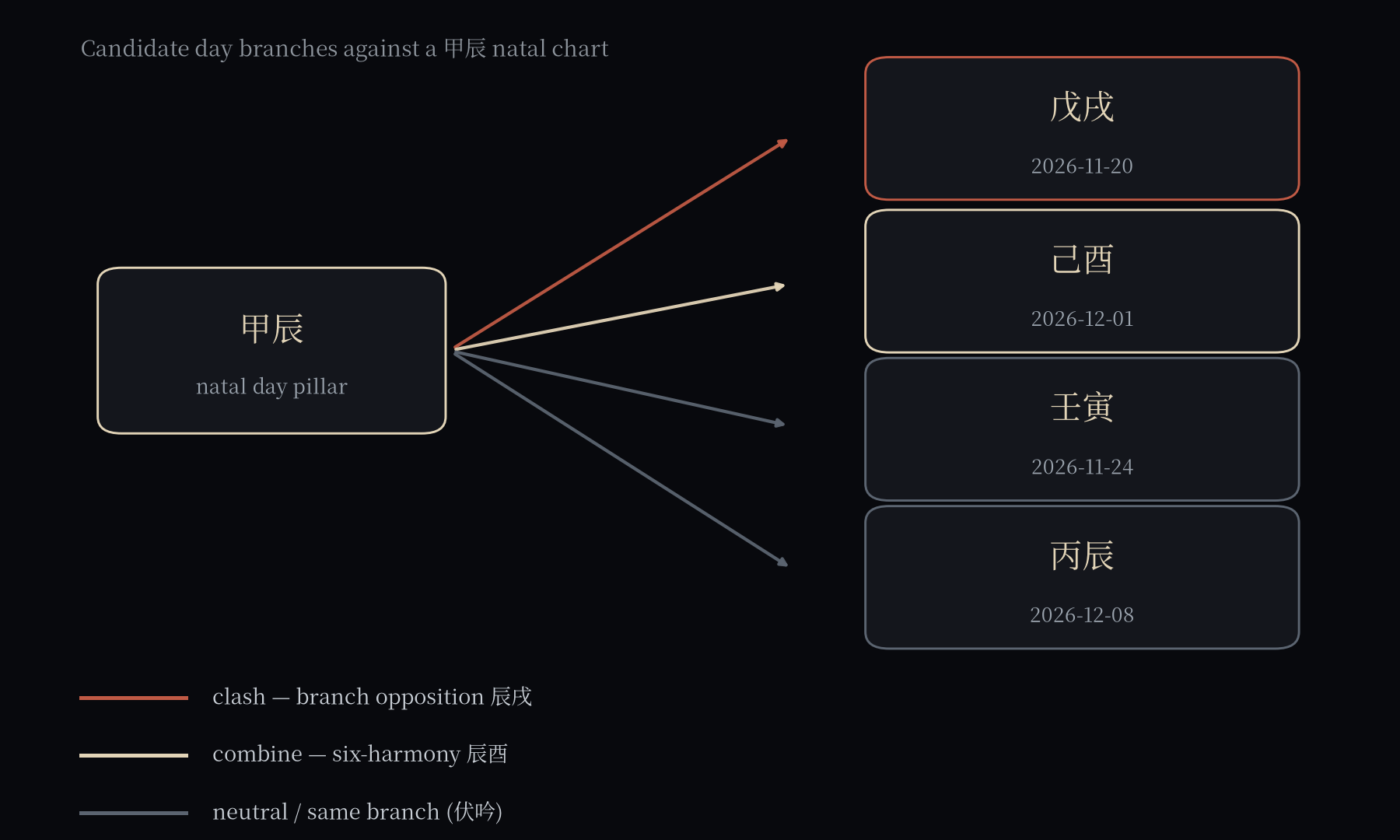
- Our engine returns 甲辰 as the day pillar for a founder born 20 July 1982, 13:21 in Changshu — then 戊戌 for 20 November 2026 (opposition) and 己酉 for 1 December 2026 (harmony).
- Dates sequence high-friction work; they do not license decisions. A clash day raises the cost of improvisation, not the right to decide.
What an auspicious date actually measures
The Chinese almanac (通書 in the book trade, 黃曆 in common usage) is a day calendar, not a personal reading. For each date it records three things. First, the day’s own stem-and-branch pair, one of sixty in the cycle, which advances by one every day without reference to you. Second, a duty officer (建除十二神) drawn from a twelve-day sequence: 建, 除, 滿, 平, 定, 執, 破, 危, 成, 收, 開, 閉, each naming the kind of action a day favours or resists. Third, the suitable-and-avoid columns (宜 / 忌) that most readers actually consult.
All three are computed for the day as a public object. The same date reads “suitable for signing agreements” for a thousand people holding a thousand different charts, because nothing in the almanac’s arithmetic consults the person doing the signing. That is not a flaw; it is what a calendar can do. A day calendar answers “what kind of day is this”, and it answers it identically for everyone.
The two layers that get merged
The duty officer is anchored to the month branch, and the month branch changes at a solar term (節氣), not on the first of the Gregorian month. The sequence restarts with 建 on the first day whose branch matches the current month branch. So in any given month the officer list is offset from the calendar grid, and it resets in the middle of a month rather than at its start. Two almanacs that disagree about a date near a solar-term boundary are usually disagreeing about which month branch is current, not about the day. The Hong Kong Observatory publishes the solar-term tables that fix those boundaries.
Why it matters for decision-makers
Capital decisions cluster. A fund closes in a two-week window; a board reviews a financing round on one of four possible Fridays; a founder signs a term sheet or an executive contract in a week that also contains three other commitments. The question is never “is this a good day in general” but “which of my available days can carry the improvised part of this conversation”.
The asymmetry matters more than the superstition. A negotiation where you must think on your feet draws on a different reserve than a negotiation where you read a prepared position. Scheduling the second kind onto a day the almanac calls closed for new business costs you nothing; scheduling the first kind there costs you the walk-away line you had not written down. Reading dates structurally is a form of load management, and load management is an executive discipline rather than a belief system.
Where the almanac stops working
It stops at the boundary of the person. A day’s officer describes the day’s texture; it cannot tell you whether your structure meets that texture well or badly. For that you need the one branch of your chart that moves daily in relation to the calendar: the branch of your day pillar. Everything else in the almanac is context.
How to read a date against your own chart
The procedure is short and entirely mechanical, which is why it can be done before a calendar meeting rather than after.
- Get your day pillar. Not the year animal, not the month — the day pillar, the third of the four in a BaZi chart. Its branch is the fixed point everything else is measured against.
- Get the candidate date’s day pillar. Any deterministic engine returns it; our preview endpoint returns it alongside the four pillars for a birth profile, and the same call run with a candidate date returns that date’s day pillar.
- Compare branches. Two relations recur in practice: opposition (沖), where the branches stand opposite each other in the twelve-branch ring — 辰 against 戌, for instance — and six-harmony (合), where they pair — 辰 with 酉. A third case is duplication, where the day repeats your own branch.
- Assign consequence, not permission. Opposition days are where improvised commitments get expensive. Harmony days are where the conversation tends to land where you intended. Duplication days are where you tend to repeat your own default, for better and worse.
Worked example
Our engine returns the following for a male profile born 20 July 1982 at 13:21 in Changshu: year pillar 壬戌, month 丁未, day 甲辰, hour 辛未, with a true-solar-time correction of −3.28 minutes against civil clock time. The day master is 甲, the yang Wood stem; the element distribution comes back as Earth 30.0, Fire 22.5, Wood 18.8, Metal 15.0, Water 13.8 — an Earth-heavy late-summer chart, and the current ten-year pillar is 辛亥 for ages 36 to 45.
Read two dates for the same person. The engine returns 戊戌 for 20 November 2026: the day branch 戌 stands in direct opposition to the natal day branch 辰, the strongest of the twelve clashes. For 1 December 2026 it returns 己酉, whose branch combines with 辰 — the six-harmony pair. Same person, same almanac columns, opposite structural readings. That difference is invisible to anyone scheduling from a public calendar.
Where this goes wrong
Three failure modes recur. The first is buying a date for a decision that has not been defined: no day fixes a term sheet whose walk-away price is unset. The second is using an almanac verdict as a personal one, which is the error the whole distinction above exists to prevent. The third is the expensive one: treating an opposition day as a prohibition, postponing a decision that was already ready, and signing it three weeks later in a worse market because the calendar said wait. A clash day is a day to prepare more, not a day to stop.
Operating directive
For this quarter: put your improvised conversations on harmony days and your rehearsed ones on opposition days. Do not reschedule a decision that is already made; reschedule the improvisation around it. Keep one written record of the day pillars you chose, so that next year’s claims can be checked against outcomes instead of memory. Read the solar-term boundary before trusting any almanac, because that is where most disagreements between published calendars actually live.
If the reading has to be done for a counterparty (a founder, a successor, a co-investor), the structural version of that work is what the $19 The BaZi Blueprint produces: four pillars, element distribution, and the ten-year pillar sequence, without a forecast attached. Where the question is which of two systems to trust for a given date, the $29 Master Astrological Codex Bundle cross-checks the BaZi reading against the twelve-palace topology rather than doubling the same answer.
A date is one constraint you can see before you commit anything. Treating it that way is not belief; it is one more variable in the schedule, and it is available to you whether or not you use it.
About the editor. Edward edits ChineseAstroCast and reviews every article against the site’s chart tables before publication. Last updated November 2026.
Leave a Reply