BaZi vs Western astrology is usually framed as a contest between two forecasts of one life. It is not. Both turn a birth moment into a diagram, but they index different quantities: BaZi a sixty-step sexagenary cycle bounded by solar terms, Western astrology the angular position of bodies on the ecliptic.
- BaZi reads element relations inside a repeating sixty-term cycle; Western astrology reads angular separation on a 360-degree ecliptic.
- The two disagree on the year boundary: BaZi turns it at Lichun, tropical practice at the March equinox.
- BaZi has no planets and no houses, so borrowed vocabulary produces sentences neither tradition supports.
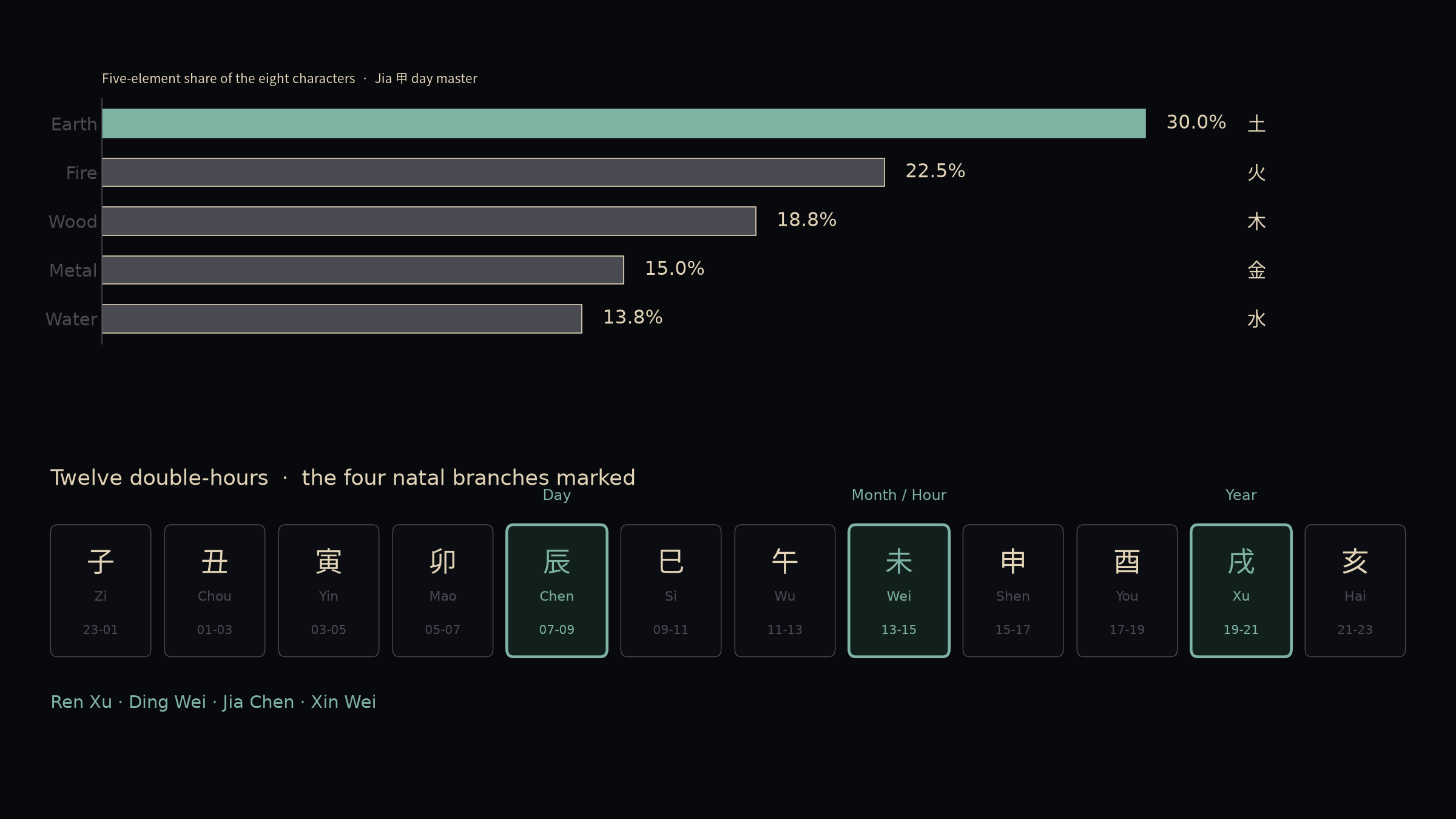
- Only one reduces to figures: for the profile below the engine returns Earth 30.0, Fire 22.5, Wood 18.8, Metal 15.0, Water 13.8 per cent.
What each system actually measures
A BaZi chart is four pillars, each written as one heavenly stem above one earthly branch: eight characters drawn from a cycle of ten stems and twelve branches that repeats every sixty steps. The year pillar turns at Lichun, the month pillar at each of the twelve major solar terms, the day pillar at the start of the Zi hour rather than at midnight. Nothing in that construction refers to a planet. The reference point is the day stem, the day master, and every other character is classified by its element relation to that one stem.
Western astrology starts from a different instrument. It divides the ecliptic, the Sun’s apparent annual path, into twelve sectors of thirty degrees measured from the March equinox, then places each body by its ephemeris position. Interpretation reads angular separations between bodies, called aspects, and the division of the sky into houses, which depends on latitude and on the clock time of birth. The chart is a wheel of positions.
Both traditions assign elements to their signs and branches, but only BaZi is normally read as a distribution: shares that can be printed and tracked through a decade. That is why the systems feel incommensurable side by side. They are not disagreeing about a shared variable; they are measuring different variables with similar-sounding names.
Why the distinction matters at the decision table
Western chart language is dispositional narrative. It describes a temperament, expressive or reserved, comfortable with conflict or not, and its natural use is self-description and coaching. BaZi is structural in a narrower sense: it names which function carries the weight, where in the chart that function sits, and how much of each element is present. A reader deciding who should hold authority over a function is served better by a component map than by a mood description.
Timing differs the same way. BaZi supplies discrete decennial pillars plus an annual pillar, so a ten-year step can be put on a planning calendar. Western transits are continuous, which suits narrative reading but resists scheduling. A founder choosing a launch window inside a three-year build is asking a question with year-shaped boundaries, and the system with year-shaped units answers it more directly.
Two misreadings that cost the comparison its credibility
The first is treating the sun sign as the Western equivalent of the day master. A sun sign is one placement among many; the day master is the reference point against which every other character is classified. The second is treating the zodiac animal as a BaZi result. The animal is the year branch, one of eight characters, and a reading built on it alone discards the month, day and hour pillars entirely.
Reading the two side by side without confusing them
Order matters, because the two systems disagree about the input before they disagree about the interpretation. Fix the moment first: convert clock time to true solar time for the birth longitude, then locate the moment inside the solar-term year. Our engine does both and reports the correction it applied, which is the only honest way to compare two charts of one person.
Then read in layers. The year pillar describes inherited conditions. The month pillar describes professional method, because it is the pillar bounded by the seasonal term. The day pillar carries the day master and is the reference point for everything else. The hour pillar describes execution and the later part of life. Only after those positions are fixed does element share become meaningful, and it is read as balance rather than as a score.
A Western chart read alongside is not a second opinion on the same layer. Its contribution is temperament language and relational pattern: how someone presents under pressure, and which conflicts recur. Keep the two readings in separate columns. The moment a report says a day master is Leo, the reader has lost both systems at once.
Worked example: one birth record, two boundaries
Take a birth on 20 July 1982 at 13:21 in Changshu, longitude 120.75 degrees east. Clock time becomes 13:17:43 true solar time, an adjustment of minus 3.28 minutes: the longitude term adds about three minutes against the 120-degree standard meridian, and the equation of time subtracts about six in late July. The engine returns four pillars, Ren Xu in the year, Ding Wei in the month, Jia Chen in the day and Xin Wei in the hour, with a Jia day master, yang wood, on a distribution of Earth 30.0, Fire 22.5, Wood 18.8, Metal 15.0 and Water 13.8 per cent. The decennial sequence begins at age six and runs forward; the current step, ages 36 to 45, is Xin Hai.
Now move the boundaries, because that is where the comparison usually collapses. The same engine read at noon on 3 February 1983 returns a Ren Xu year; read at noon the next day it returns Gui Hai. The year changed on 4 February, five weeks after the Gregorian calendar did. The day boundary behaves the same way: a chart read at 23:30 civil time on 20 July had already moved to the Yi Si day, and the same Yi Si day appears after midnight. Someone comparing two apps will find one of them a day ahead, and the cause is a convention, not an error.
Where this goes wrong
The expensive failure is buying two reports, finding that they contradict, and using neither. The contradiction is usually a convention split inside one tradition rather than a clash between East and West. Western practice has its own version: tropical and sidereal zodiacs have drifted more than twenty degrees apart through precession, roughly one degree every seventy-two years, so two Western astrologers can disagree about a sun sign without either being careless. BaZi has the equivalent in true solar time and in the treatment of the late Zi hour.
The second failure is vocabulary mixing, which sounds sophisticated and means nothing. A sentence that borrows relation types from one system and angular patterns from the other is not a synthesis; it is a category error with good production values.
Operating directive
State the question before choosing the instrument: disposition, component structure, or timing. Convert to true solar time and locate the solar-term year before comparing anything. Use Western language for temperament and relational pattern, and BaZi for element share and the pillar that carries a function. Staff the expensive function instead of training it. Never translate one vocabulary into the other, and record which convention each reading used.
For a component-level map of one chart — element distribution, the ten gods by pillar, and the decennial sequence around them — the $19 BaZi Blueprint reports the arithmetic rather than the folklore. Readers who want the same birth record read through both systems at once use the $29 Master Astrological Codex Bundle, which runs the four pillars and the twelve-palace topology against one set of inputs.
The year boundary used above is not a calendar convention but an astronomical one: the twelve month pillars are bounded by the major solar terms, and the Hong Kong Observatory publishes the tables that define them, alongside its notes on time conversion between clock time and solar time.
BaZi and Western astrology are two disciplines of measurement rather than two claims about the future, and a measurement is only as good as the convention printed beside it.
About the editor. Edward edits ChineseAstroCast and reviews every article against the site’s chart tables. Last updated November 2026.