- Your birth-year element is a starting coordinate, not a reading of your character.
- Balance is measured across all eight characters; the year stem is the outermost layer only.
- Excess and deficit are different problems: excess over-spends, deficit borrows against something else.
- Element load shows up as a somatic pattern — a recovery question, not a virtue question.
Most people meet their Chinese zodiac element as a single word printed under their birth year: Wood, Fire, Earth, Metal or Water. A Chinese zodiac element is a starting coordinate, not a reading. It describes how a person takes in information and where they spend capacity. On its own, it says almost nothing about what they will do with either.
What a Chinese zodiac element actually measures
Classical Chinese astrology assigns one of five elements to each of the eight characters in a birth chart: the four pillars, each built from a heavenly stem and an earthly branch. The element you see under your birth year comes from the year stem, the most public layer of the chart. It is roughly how institutions, markets and strangers read you. Your day stem, the character most practitioners treat as the self, sits four positions later and often carries a different element entirely.
The year stem is one layer of eight
Reading an element off a birth year is reading the outermost layer of a chart that has four. The year pillar describes inherited conditions; the month describes the season the rest of the structure works in. That is why two people born in the same year can carry the same element word and still have opposite balances once the other six characters are counted.
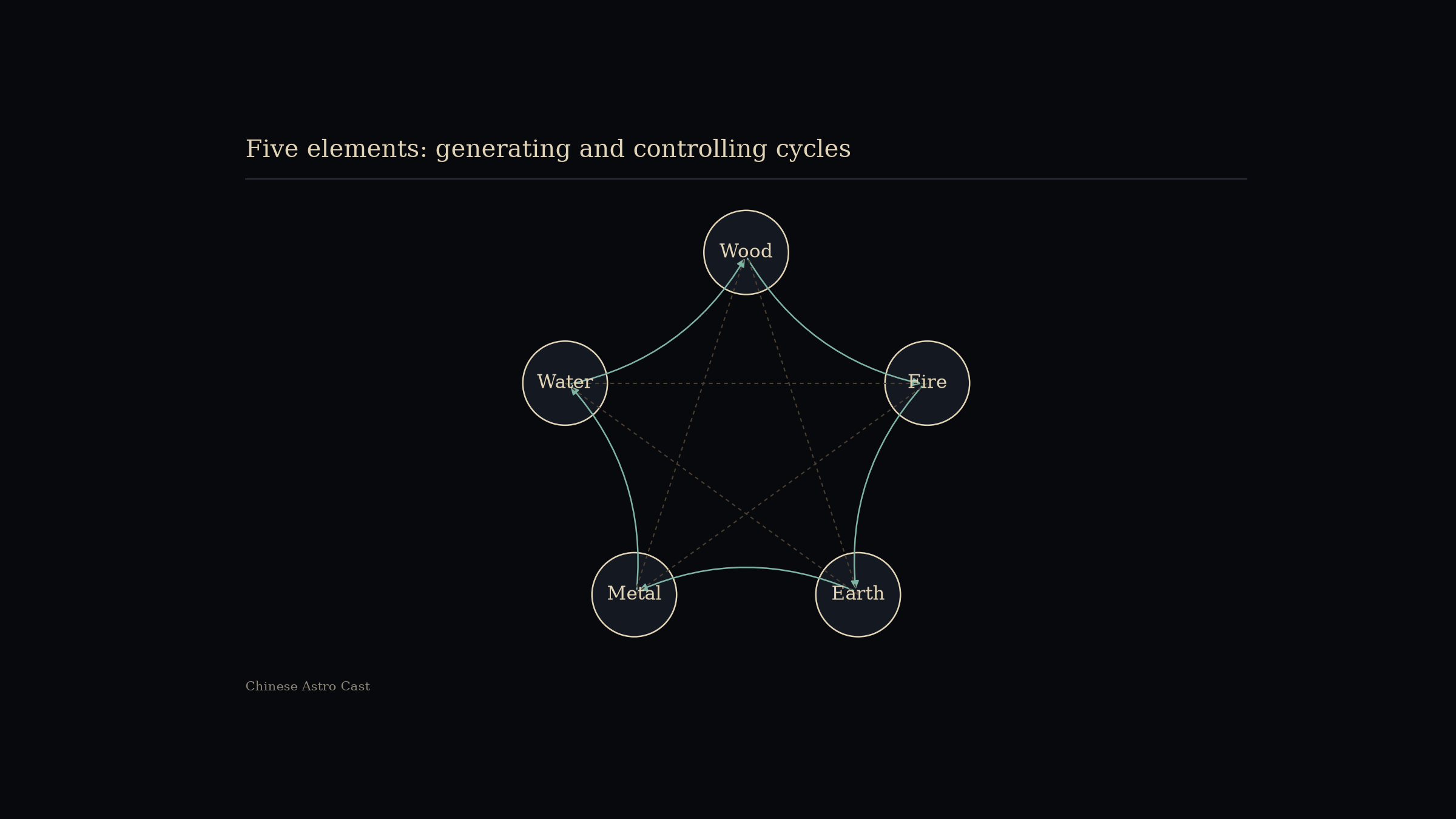
The five elements work better as psychological drivers than as substances. Wood is the growth and vision driver: curiosity, expansion, ethical ambition. Fire is the passion and charisma driver, meaning visibility, expression, and the willingness to be seen while the outcome is still uncertain. Earth is the foundation driver, which shows up as reliability, patience, and systems that keep holding after attention moves elsewhere. Metal is the precision driver: discernment, structure, the capacity to decline cleanly. Water is the intuition driver, which reads as adaptability, depth and strategic fluidity under pressure.
Counts matter more than any single label. A chart with three Water characters and no visible Fire describes surplus adaptability and a deficit of public claim. That pattern shows up in how someone negotiates, not in what they believe about themselves. Traditional Chinese medicine makes the same move with constitutional typing. The useful question is never which type you are. It is where load accumulates when the system is stressed.
The five-element scheme itself is set out in the Great Plan chapter of the Book of Documents, where 五行 first appears as a list of five capacities rather than five substances.
Why element balance matters for decision-makers
Executives usually reach this material at the moment their habitual style stops producing results. A founder whose chart is Wood-dominant builds quickly and consolidates badly, because the instinct that turns a prototype into a company also resists the operational patience a second stage requires. A Metal-dominant operator sets standards that hold, then cannot delegate, because delegated work arrives below the standard. Neither pattern is a character flaw. Both are predictable, and predictability is the whole of the value.
The practical consequence is allocation. Element excess tells you where a leader will overspend attention without noticing. Element deficit tells you where they will under-invest until the gap surfaces as an incident. Read before a hiring round, this changes the brief. A Water-heavy leadership team does not need another strategist. It needs someone constitutionally willing to commit to a single number and defend it in a room. The same reading applies to risk appetite, to delegation depth, and to how a quarter gets laid out.
There is a somatic layer here too, which is why the framework travels well with people who already track their own physiology. Excess tends to appear as a specific, repeatable form of strain rather than a vague malaise. Fire-dominant operators commonly run a sympathetic pattern: late sleep, early waking, a nervous system that will not stand down after the meeting ends. Water-dominant operators report the opposite failure mode. They can absorb an unreasonable load for months and then stop, with no gradient in between. Neither observation is a diagnosis. Both are load patterns worth scheduling around.
Common misreadings
Two mistakes account for most of what goes wrong. The first is reading the birth-year animal as the whole chart. The animal belongs to the year branch and describes a social register, not a constitution. Two people born in the same year share an animal and may hold opposite day stems, which is why the year label predicts so little. The second is treating a missing element as a permanent deficit. Absence from the visible eight characters does not mean absence from the structure. The month branch governs seasonal strength, and hidden stems inside the branches often supply what the surface appears to lack. A chart with no visible Fire can still hold Fire in the month branch, dormant until a Fire luck pillar arrives.
How to read your own elements
Work in order, and do not skip the first step. Fix the birth data first: date, clock time, birthplace. Convert clock time to true solar time, because a two-hour pillar boundary is easy to cross by accident and an hour-pillar error changes the element count. Then list all eight characters and mark the element of every stem and every branch. Weight them: the day stem carries the most, the month branch governs how strong every other element is, and the year and hour pillars describe the public and the private register respectively. Note any excess above three characters of one element, and note absence entirely. Finally read the demand the structure makes, which is what it asks a person to build rather than what it hands them.
The visible metal-wood clash and the structural version behave differently. Metal is boundary and Wood is expansion. When both are strong and adjacent, decisions stall at the point of commitment, because the same person argues for the opening and then argues against the terms. When the clash is only apparent, with Metal thin in the visible characters and Wood supplied by the month, there is no stall. There is a preference for movement that occasionally costs precision.
Worked example
A chief operating officer, born in the late 1970s, presents a chart with Water in the year, month and hour stems, a Yang Wood day stem, and no visible Fire. Three channels of adaptation feed one growth axis, and the visibility driver sits absent from the surface.
The downstream consequence is consistent and expensive. She reads rooms faster than anyone else in the company and still loses the internal argument for her own budget, because she waits for a consensus her chart never required. The pattern is not indecision. It is surplus intake with insufficient claim. The rule that follows is a calendar rule: one visible commitment per week, meaning a decision announced, a number owned, a position staked in writing, scheduled the way a board meeting gets scheduled. Fire becomes an operational item rather than a personality transplant, and success is measured by whether the commitments land on the record, not by whether she feels more assertive afterwards.
Where this goes wrong
The expensive failure is buying a regimen keyed to one element: supplements, colours, direction-based seating charts, a diet built from a reading of one character out of eight. Cost without evidence, plus a false sense that the structure has been addressed. The second failure is using the chart as a licence. “I am Wood, so detail is not my strength” converts a description of load into an exemption from the work. The third, and the one that quietly damages careers, is reading the element in isolation from the role. A deficit only exists relative to a demand. Metal-thin is a liability in audit, a relief in a turnaround, and irrelevant in a research function nobody is measuring.
Operating directive
Get the birth data right before interpreting anything, and verify the hour pillar against true solar time. Count elements across all eight characters, recording excess and not only absence. Name the one place your dominant element overspends attention, then cap it with a rule rather than a resolution. Name the one place your deficit shows up under load, and put a procedure there. Re-read the chart in twelve months and compare it against what actually happened, because the only honest test of a structural reading is its hit rate on decisions. $19 The BaZi Blueprint does the counting and weighting for you and returns the demand rather than a label. If you want a second map of the same structure, the $29 Master Astrological Codex Bundle sets the twelve-palace topology alongside it.
The free five elements chart renders that balance as a weighted map, which is worth looking at before you read any interpretation of it.
Treat an element as a description of how capacity moves. Capacity can be scheduled; identity cannot.
About the editor. Edward reviews every article against the site’s chart tables and the engine output quoted here. Last updated November 2026.