- Three calculators return three hour pillars because each one defines noon differently.
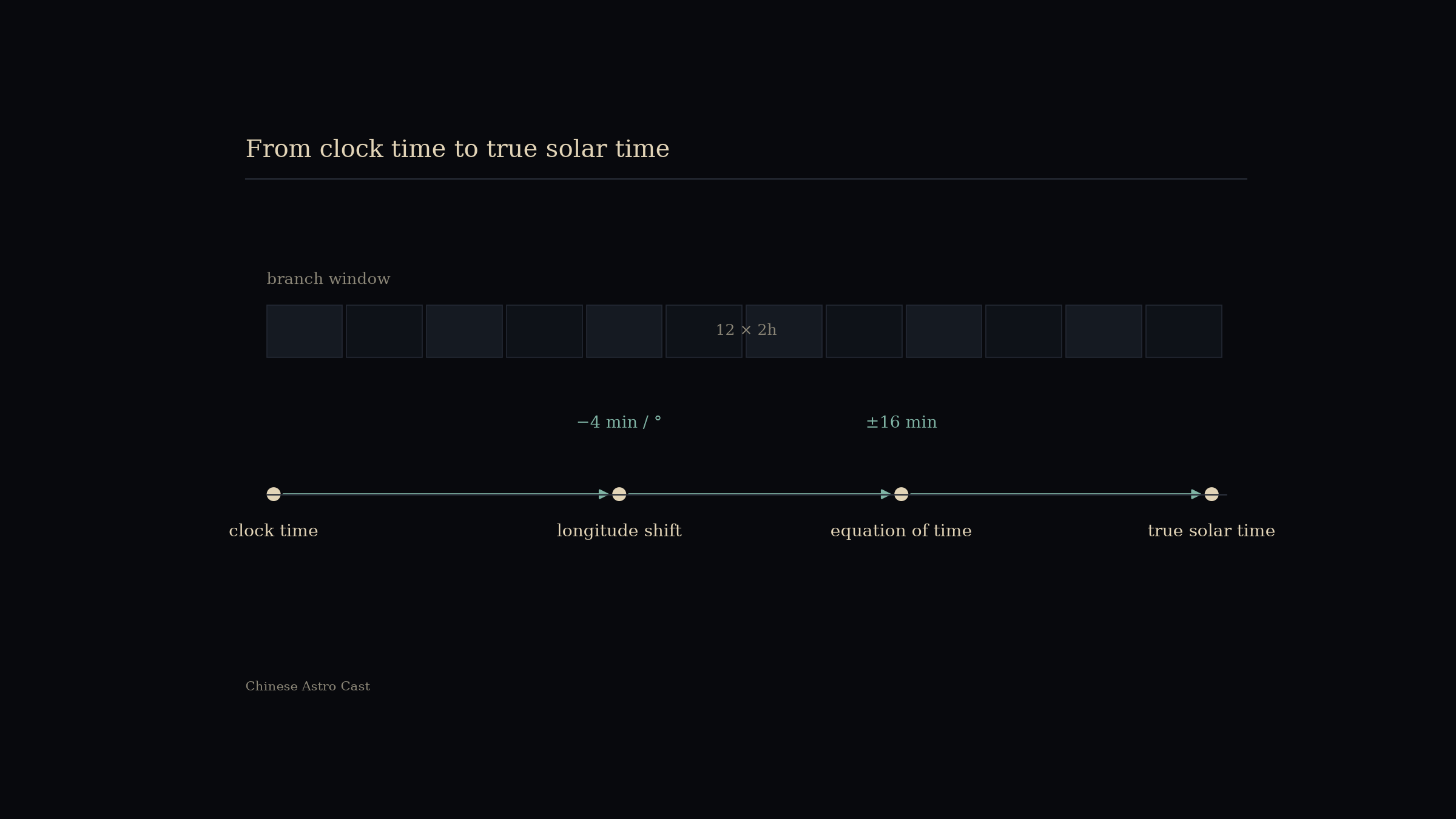
- True solar time = clock time + longitude correction + equation of time; both corrections are something an honest tool can show you.
- A two-degree longitude error moves the reading by about eight minutes — enough to cross a two-hour boundary and change the pillar.
- Calibrate before interpreting: an uncalibrated chart is simply a different chart.
Run the same birth data through three BaZi calculators and you will often get three different hour pillars. Each engine picks a clock and most never say which one. What reads as sloppy arithmetic is usually a disagreement about the definition of noon.
What a BaZi calculator actually measures
A BaZi chart is a timestamp written in four pairs of characters. Each pair, or pillar, carries one Heavenly Stem and one Earthly Branch drawn from a sexagenary cycle that advances with the solar calendar rather than the Gregorian one. The year pillar turns at the Start of Spring solar term in early February, not on January the first. The month pillar turns at each of the twelve major solar terms. The day pillar advances one step per day, without gaps.
Three of those four layers survive translation between engines intact, because they depend only on the date. The fourth depends on something no clock records: where the sun stood above the birth location at that moment. A calendar hands you civil time. A chart needs apparent solar time. The two quantities differ, and the difference is large enough to move a boundary.
Engines also differ in how they handle the solar term edges. One rounds the Start of Spring to the nearest minute, another to the nearest hour. For a birth two days away from the term this is irrelevant. For a birth inside the boundary hour it changes the year pillar, and with it the entire frame of the reading. Precision claims on a marketing page rarely specify which of these choices the engine made.
Why the hour pillar is the fragile layer
The hour pillar splits the day into twelve windows of two hours each, and those windows are anchored to the sun rather than to the wrist. The noon window is centred on local solar noon. The midnight window opens at 23:00 apparent time and closes at 01:00, which is also the point where most schools roll the day pillar forward. Anything measured from that boundary inherits its precision, or its error.
Three corrections separate clock time from solar time. Longitude comes first. Every degree east or west of the standard meridian shifts local noon by four minutes. China is the extreme case: a single zone built on 120 degrees east, while Chengdu sits near 104 degrees. That gap is 64 minutes. A birth recorded at 00:40 in Chengdu happened, in solar terms, during the previous evening’s window, so the day pillar belongs to the day before.
The second correction is the equation of time, the gap between mean and apparent solar time created by the tilt of Earth’s axis and the eccentricity of its orbit. It runs from roughly minus 14 minutes in mid-February to plus 16 minutes in early November. The third is daylight saving, a clean 60 minutes that no birth certificate ever annotates. Add all three and a chart can drift by ninety minutes before anyone has made a mistake.
Common misreadings
Two errors produce most of the confusion. The first is deciding the engine is broken when two sites disagree. Usually both are internally consistent and calibrated to different conventions, and neither publishes its convention. The second is treating the hour pillar as decoration because the day master feels more personal. The hour layer governs the operational style, the later palaces and the internal balance of the ten gods. Shift it one window sideways and the reading still sounds plausible, which is precisely the problem.
How to calibrate before you read anything
Do the arithmetic in a fixed order and write the result down before you open the chart. The sequence matters more than the precision.
- Strip daylight saving from the recorded time if the birth fell inside a summer-time window.
- Convert longitude to minutes: subtract or add four minutes for each degree between the birthplace and the zone’s standard meridian.
- Apply the equation of time for that date, which you can look up to the nearest half minute.
- Compare the result against the twelve window boundaries and note the margin.
- Flag any birth within twenty minutes of a boundary and run the reading twice, once in each adjacent window.
The fifth step is where most of the value sits. A drift of six minutes changes nothing. A drift of six minutes across a boundary changes the hour stem, and with it the relationship between the hour and the day master. When the margin is thin, the honest move is to test both readings against lived behaviour rather than to pick the tidier one.
There is one convention question the arithmetic cannot settle. A minority of schools keep the day pillar on the civil midnight, so a birth at 23:30 belongs to the same day as 22:00 and 00:30 alike. The older reckoning opens the new day at 23:00. Both are defensible, and the choice matters most for births inside that single hour. What is not defensible is switching convention between charts without saying so.
A worked example
A founder born in Boston in mid-July, recorded at 07:20 on the certificate during daylight saving. Strip the hour: 06:20 standard clock. Boston sits at 71.06 degrees west against a 75 degree meridian, so add 15.8 minutes for longitude and the result is 06:36 local mean time.
The equation of time in mid-July is about minus 6 minutes, which gives 06:30 apparent solar time. That lands inside the 05:00 to 07:00 window. The uncalibrated 07:20 would have landed in the next window, with a different branch, a different hour stem and a different relationship to the day master. Fifty minutes of bookkeeping separates two different readings of the same person.
The downstream damage is quiet. A different hour stem changes the ten god attached to the hour pillar, which changes the stated relationship between a person’s output and their authority, and it shifts the hour branch that anchors the Ziwei palaces. Nothing in the report announces the swap; the prose simply describes a neighbouring configuration with the same confidence.
The practical fix is procedural rather than technical. Ask every chart you inherit one question — which clock produced this hour pillar. Certificate time, hospital record time and the time a parent remembers are three different inputs, and only one of them has been calibrated.
The apparent-solar-time calculation behind both corrections is documented in NOAA’s solar calculator, with the equation-of-time curve published as a table.
Where this goes wrong
The expensive failure is not a wrong chart. It is a chart that is right about the wrong person. A consultant reads an hour stem that belongs to the neighbouring window and describes a decision style the client does not have. The client recognises enough of the description to accept the rest, and a strategy gets built on a mislabelled strength.
The same error propagates into Ziwei Dou Shu, where the birth hour determines the position of the Soul Palace. One uncorrected clock reading displaces an entire twelve-palace topology, and the resulting advice can be coherent, detailed and aimed at somebody else. The cheaper failure is inconsistency: calibrate one chart and not the next, and you can no longer compare two people, which is most of what an advisory practice does with a system like this.
Operating directive
Record the birthplace coordinates before you record anything else, because longitude is the correction people skip. State the convention your chart uses, in writing, so a second reader can reproduce it. Run every boundary case twice and keep both versions in the file.
Treat calibration as part of the reading rather than an IT chore. The $19 The BaZi Blueprint applies true solar time before any interpretation begins, so the hour pillar you read is the one the sky actually produced. Where the stakes justify a cross-check, the $29 Master Astrological Codex Bundle pairs the same calibrated birth data with a twelve-palace Ziwei chart, which makes a displaced hour visible rather than silently absorbed.
The free BaZi calculator shows the true solar time it used, so the displacement is visible rather than absorbed into the result.
A BaZi calculator is a measurement instrument, and the hour pillar is the reading that tells you whether it was calibrated.
About the editor. Edward reviews every article against the site’s chart tables and the engine output quoted here. Last updated November 2026.