BaZi compatibility is a structural comparison of two charts, not a verdict on a relationship. The classical method weighs the day pillar first — the position that describes how a person meets the world — and then the balance of the five elements across both charts. What comes out is a description of where two operating styles will grate and where one chart supplies what the other lacks.
- Compatibility is read on the day pillar of each chart, not on the birth-year animal; the animal is a twelve-year unit shared by roughly one person in twelve.
- The fixed tables that pair the twelve branches — six harmonies, six clashes, six harms — describe process friction, not affection. A harmony does not promise a happy partnership and a clash does not forbid one.
- Element percentages are the second axis: a chart carrying 0% Metal and a chart carrying 15% Metal are describing a supply relationship, not a personality match.
- For a co-founder or a key hire, the useful output is a list of decisions that should not be shared, not a score out of ten.
What compatibility actually compares
Two people born in the same year share an animal and almost nothing else. The year pillar is the outermost ring of a BaZi chart — it describes the environment a person was born into, not the person. Compatibility readings that stop at the animal are comparing two twelve-year cohorts, which is why they produce the same answer for millions of people and no useful answer for any one of them.
The classical method (合婚, the reading of a pair) works on the day pillar instead. The day stem is the Day Master, the reference point the whole chart is interpreted around; the day branch is the position that classical texts assign to the spouse palace. Whatever else a chart says, that branch is where a practitioner starts when two charts are laid beside each other.
The day branch is the hinge
The twelve branches have three fixed relation tables, each a lookup rather than a judgement. Six pairs form a harmony (子丑, 寅亥, 卯戌, 辰酉, 巳申, 午未). Six pairs clash, sitting directly opposite each other on the ring (子午, 丑未, 寅申, 卯酉, 辰戌, 巳亥). Six pairs harm (子未, 丑午, 寅巳, 卯辰, 申亥, 酉戌).
Most readings skip the third table; it matters most in working relationships. A clash is loud. Two positions pull in opposite directions and the first meeting shows it. A harm is quiet — classically the least dramatic of the conflict pairs, describing friction in routine coordination rather than open opposition. Two people who agree on strategy and cannot agree on sequencing are usually looking at a harm, not a clash.
Why the hour pillar is worth the trouble
The hour pillar is where clock time becomes a problem. Our engine calibrates every birth to local apparent solar time before it assigns a branch; a birth recorded at 13:21 civil time in Changshu on 20 July 1982 resolves to 13:17:44 after a −3.27 minute correction. That shift is small enough to leave the hour unchanged. In Singapore the same correction runs to −74 minutes, and a 09:45 birth lands in the previous branch entirely. The Hong Kong Observatory’s conversion tables make that adjustment auditable.
Two charts, side by side
Take a worked pair from the engine. Chart A: 20 July 1982, 13:21, Changshu — 壬戌 year, 丁未 month, 甲辰 day, 辛未 hour, Day Master 甲 (Wood). Chart B: 17 February 1979, 07:40, New York — day pillar 乙卯, Day Master 乙 (Wood).
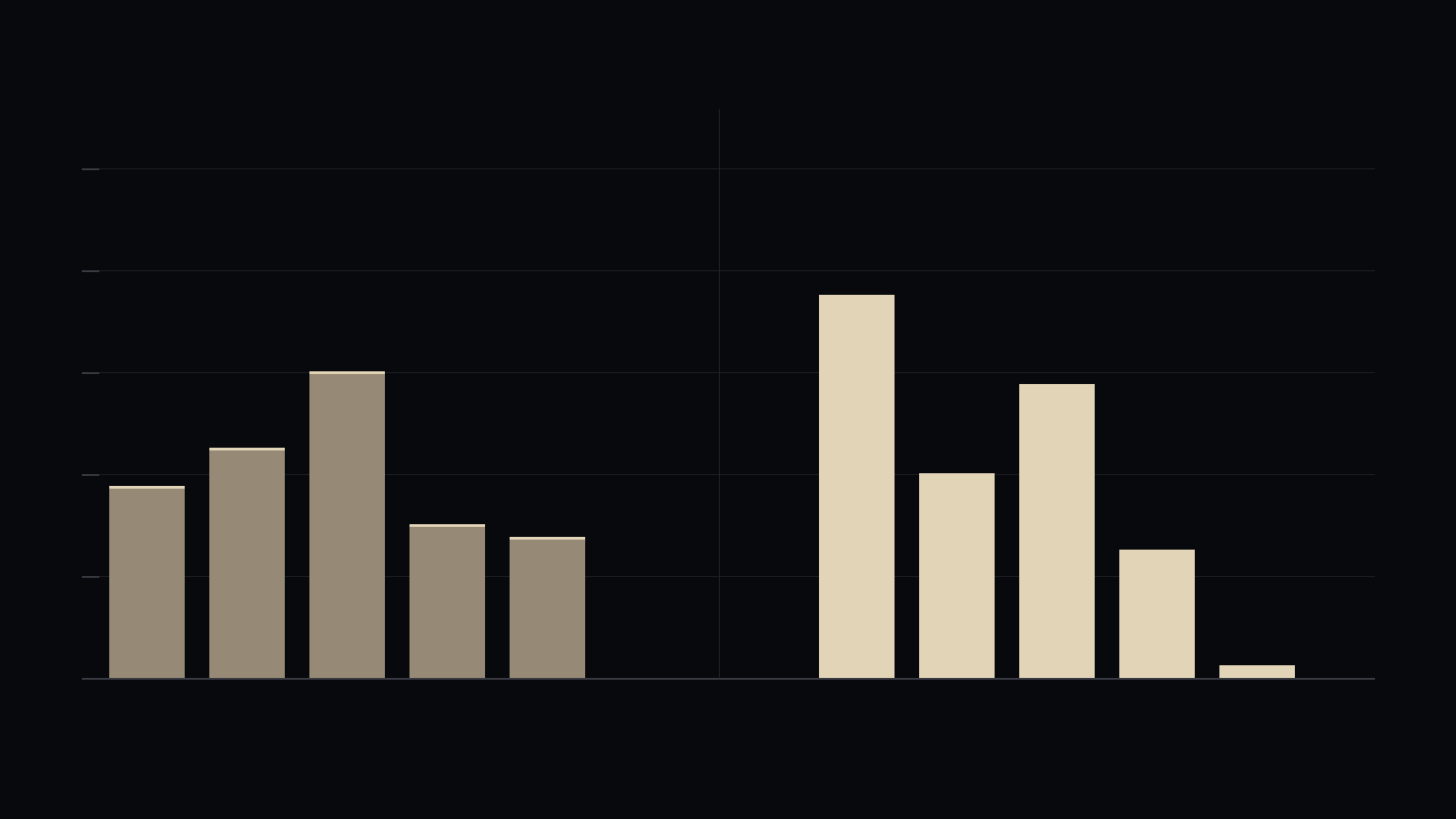
They look similar on the element axis. A carries Wood 18.8%, Fire 22.5%, Earth 30.0%, Metal 15.0%, Water 13.8%. B carries Wood 37.5%, Fire 20.0%, Earth 28.8%, Metal 12.5%, Water 1.2%. Fire and Earth sit within two points of each other; Metal within three. A reading that scored element similarity would call this a strong match.
The day branches disagree. A’s day branch is 辰; B’s is 卯. On the harm table, 卯 and 辰 are a pair. Two charts elementally close and relationally awkward are the combination every founder recognises: “we get along until we have to run something together”.
Reading the second axis
B’s Water sits at 1.2%. A supplies 13.8%. In the classical frame that is a supply relationship: the position B is thinnest in is the position A carries most comfortably. It does not make the pair harmonious, since the harm stands, but it does explain why the pairing feels useful in one direction and tiring in the other. B’s chart absorbs from A what it does not generate; A receives very little in return on the Wood axis, where B is nearly double.
We ran the same comparison against a third chart as a control: 14 March 1988, 09:45, Singapore — 戊辰 day, Earth 47.5%, Metal 0.0%. Same day branch as A, which the tables treat as the weakest conflict class, a self-punishment that stays internal. On elements it is the more interesting pairing: a chart with no Metal meeting one carrying 15.0%. Similar structure, complementary material — the opposite arrangement to A and B.
What the comparison cannot say
It cannot rank people. No arithmetic in these tables produces a score, and any product handing you 87% has invented a scale and then attributed it to the tradition. The relation tables are categorical: a pair either sits on a listed pair or it does not.
What a clash is not
A clash between day branches is not a prohibition. It is a description of how two people handle the same decision: one moves first and refines later, the other refines first and moves late. Durable partnerships are often built on exactly that tension: the pair covers both failure modes. The clash becomes expensive only when both parties are asked to do the same job at the same moment.
Putting it to work: the co-founder case
This reading earns its place in an executive context because it produces constraints, not comfort. When a harm sits between two day branches, the practical translation is that routine coordination — scheduling, sequencing, who signs first — is the friction point, while strategic direction may be perfectly aligned. That is a governance finding, and it has cheap fixes.
- Separate the calendars. A harm pair usually coordinates badly on shared timelines; give each partner their own operating cadence and one shared decision log rather than a joint sprint.
- Do not co-sign. Split signature authority by domain, so a sequencing disagreement cannot stall a transaction.
- Use the element gap deliberately. If one chart is the Metal supply and the other carries none, make the Metal-carrying partner the one who owns standards and review, and say so in the operating agreement.
For a hire rather than a partner, the logic runs one direction: does the candidate’s day branch and element profile add a capability the team lacks? That question is answered by the second axis far more often than the first — and it is the kind of structural read a full BaZi Blueprint sets out position by position, day and hour pillars included.
A three-step reading order
Step one: fix both birth times
Before anyone consults a table, both charts have to be cast from calibrated times. A 74-minute solar correction moves an hour pillar; a birth near a branch boundary without that correction produces a different chart, and two different charts cannot be compared. This is the most common way a compatibility reading goes wrong before it starts.
Step two: read the day branches, then the elements
Look up the pair on the three relation tables. Then — and only then — compare element percentages, looking for the position one chart supplies and the other lacks. Report both; they routinely disagree, and the disagreement is the finding.
Step three: translate into decisions
Convert each finding into one operating constraint. A harmony needs no action. A clash needs a decision-right split. A harm needs separate cadences and a written escalation path. If the pair of charts is going to govern money or a company, the Master Codex Bundle adds the twelve-palace topology that shows which domain each person’s chart concentrates authority in — the palace layer that a day-branch comparison alone cannot reach.
About the editor. Edward edits ChineseAstroCast and reviews every article against the site’s chart tables. Last updated November 2026.