Chinese Zodiac

  • Year of the Horse 2026: Reading the Bing Wu Pillar

    Year of the Horse 2026: Reading the Bing Wu Pillar

    2026 is 丙午, Bing Wu, the fire horse, and the honest structural reading of it is a pressure pattern rather than a forecast. An annual pillar names the elemental weather a year imposes on every chart at once; what it does to your own chart depends on which of your branches it meets. BaZi does not predict events, and any version of 2026 that tells you what will happen is selling something the system cannot produce.

    • Chinese year 2026 is 丙午 (Bing Wu): yang fire over the horse branch, the forty-third pillar of the sixty-term cycle.
    • The year opens at 立春 on 4 February 2026, not on 1 January and not on Chinese New Year, which falls on 17 February. The thirteen days between them matter.
    • 丙午 is one element doubled, yang fire standing on the branch where fire peaks, so it reads as a single univocal pressure: visibility, exposure, speed.
    • What it does to an individual chart is a relation question. In the example below, 午 forms six-harmony with 未, a fire frame with 戌, and no relation whatever with 辰.

    What an annual pillar measures

    A natal chart is four stem-and-branch pairs, fixed at birth: year, month, day, hour. The annual pillar, 流年, is a fifth layer laid over that structure one year at a time. It is a single pair, the same pair for every person alive, and 2026 returns 丙午 from our engine’s annual series, followed by 丁未 in 2027 and 戊申 in 2028.

    The annual pillar is not a second natal chart, so it cannot describe a temperament. Nor is it a planetary transit, though Western year-ahead readings occupy the same slot in a client’s mind. And it carries no verdict: nothing in the sixty-term cycle contains the word success or failure.

    One pair, read at three levels

    The stem names a quality of movement, something close to what the year’s activity looks like from outside. The branch names a field or a season: the environment that activity happens inside. The third level is the only personal one, and it is a relation. How does that branch sit against the four branches you already carry, through clash (沖), six-harmony (六合), punishment (刑), harm (害) or the three-part frames (三合)? Two people born the same week can meet one year with a harmony and a clash respectively, which is why a year-level reading that ignores the chart is a horoscope column in older vocabulary.

    Why the Horse year starts in February

    Search volume for the year of the horse 2026 predictions clusters in the last quarter, which is also when the two calendars start disagreeing in public. Chinese New Year 2026 falls on 17 February. In chart terms the Horse year begins on 4 February, at the solar term 立春 (Spring Commences). Both dates come from the Hong Kong Observatory’s Gregorian-Lunar conversion table for 2026, which lists Bing Wu as the year name on its own first line.

    The thirteen days that change a reading

    The sexagenary year rolls at a solar term because the cycle is keyed to the sun’s position, not to the moon. The lunar new year is a festival date; 立春 is an astronomical boundary. Anyone born between 4 and 17 February 2026 therefore carries 丙午 in a properly built chart while every consumer zodiac page calls them a snake, 乙巳, the year that ended. It is also why two apps can return different animals for one birth certificate: one uses the lunar new year, the other uses 立春. That is a design decision rather than a bug, and our comparison of why BaZi calculators disagree runs the same boundary through a real timestamp.

    Reading 丙午

    丙 is yang fire: the light that falls on things, the will to be seen, clarity used as an instrument. The classical twelve-stage table puts 丙 at 帝旺, peak prosperity, in 午, the branch where fire is strongest. So the stem stands on the ground it was built for, and the two hidden stems inside 午, 丁 (yin fire) and 己 (yin earth), supply the only internal texture the pillar has.

    Why doubling reads as one signal and not two

    Because both halves point the same way, 丙午 holds no internal argument. A mixed pillar negotiates with itself; this one does not. The practical consequence is that the year behaves as one pressure applied at one angle, which makes it easier to read and harder to soften. For a 丙 day master, 午 is 羊刃, the blade, so the pillar doubles that person’s own element and sharpens the edge it lands on.

    For anyone else the pillar converts into ten-god language. Against a 甲 day master, 丙 reads as 食神, the Creator; the branch’s 丁 reads as 傷官, the Iconoclast; its 己 reads as 正財, the Steward. Output, expression and a wealth channel arrive together, along with the exposure that comes from being legible.

    What 2026 does to one chart

    Our engine returns one worked profile for 20 July 1982, 13:21 in Changshu: 壬戌 year, 丁未 month, 甲辰 day, 辛未 hour, day master 甲 (yang wood). True solar time corrects that timestamp by −3.28 minutes, the element distribution reads Wood 18.8, Fire 22.5, Earth 30.0, Metal 15.0, Water 13.8, and the luck sequence runs forward from age 6 with 辛亥 current across ages 36 to 45.

    2026’s 午 meets three of those branches. It forms six-harmony with both 未, the month and hour branches, and a half fire frame with the 戌 in the year pillar. The day pillar, 甲辰, stands clear: 辰 and 午 share no relation at all. Read structurally, the year presses on the month column (the working environment) and the hour column (output, and what gets built late), not on the day pillar where identity sits.
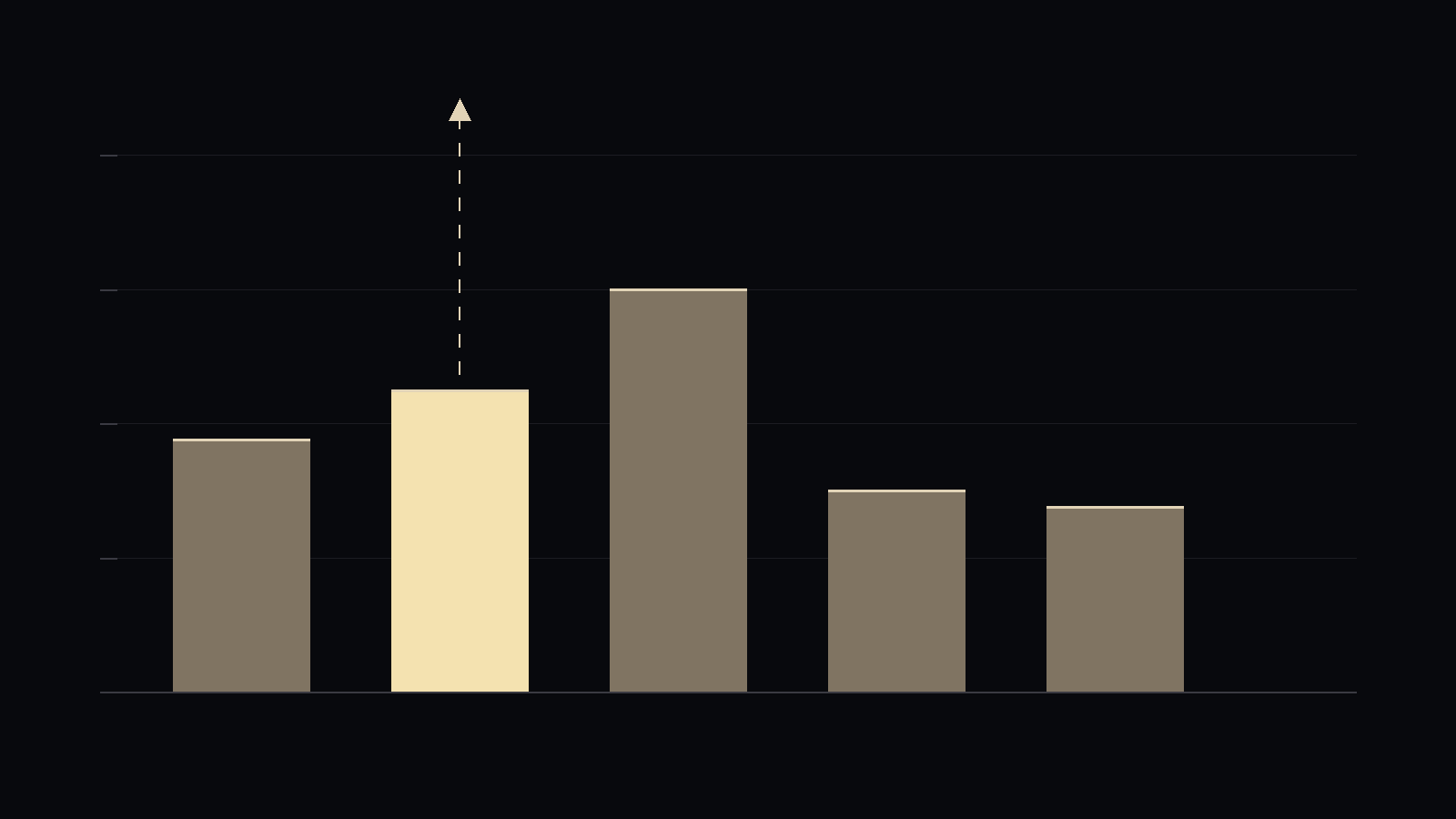
    Bar chart of the five-element distribution for a 1982 BaZi chart, fire at 22.5 percent marked as the element the 2026 Bing Wu pillar doubles
    The example chart’s element distribution as the engine returns it: Wood 18.8, Fire 22.5, Earth 30.0, Metal 15.0, Water 13.8. Earth already leads. The gold column is fire, the element 丙午 doubles in 2026, sustained at 22.5 but given a second source rather than a new ceiling.

    Where the reading stops

    It stops short of naming an event, a month or a number. The relations above say where pressure lands and in what register, not what the person will do about it. A chart already carrying 30.0 earth and 22.5 fire enters a fire year with the fire channel fed twice and the earth channel still dominant, which describes more visible output over an unchanged base. That is a description of conditions, not an outcome.

    The procedural rule that follows is narrow enough to use. When an annual pillar meets a branch by six-harmony, treat that column’s subject as the year’s live surface; when it misses a pillar entirely, treat that pillar as a protected channel and keep its most exposed work out of the year. For this chart the month and hour columns carry 2026, and the day pillar, which governs how a decision is actually made, is left to its own rhythm.

    The operating directive

    One scenario, read as tradition reads it. A software company wants to close a funding round in the second half of 2026 and has the choice of running its disclosure and diligence work in spring or pushing it into autumn. 丙午 favours what is already legible: documentation, published metrics, named references. The classical implication is that fire years reward work moved into the open early and cost more for work left latent, so the directive is to advance the disclosure work rather than delay it. Avoid scheduling the close on a day whose branch clashes the signatory’s own day branch, which is a separate discipline covered in the guide to auspicious dates.

    The same logic applies to a hire. A public-facing role, a chief financial officer or a head of communications, inherits the year’s register, which is why the classical reading treats visibility roles as heavier in a 丙午 year than in the two earth-metal years that follow. The reading produces a map; the decision stays with the person holding it. The BaZi Blueprint is the $19 single-chart document that produces that map: four pillars, element distribution, luck sequence. Where a reading has to reconcile two systems, the annual pillar against palace topology, the Master Codex Bundle carries both in one volume.

    About the editor. Edward edits ChineseAstroCast and reviews every article against the site’s chart tables. Last updated November 2026.
  • Chinese Zodiac Elements: Excess, Deficit and Somatic Load

    Chinese Zodiac Elements: Excess, Deficit and Somatic Load

    • Your birth-year element is a starting coordinate, not a reading of your character.
    • Balance is measured across all eight characters; the year stem is the outermost layer only.
    • Excess and deficit are different problems: excess over-spends, deficit borrows against something else.
    • Element load shows up as a somatic pattern — a recovery question, not a virtue question.

    Most people meet their Chinese zodiac element as a single word printed under their birth year: Wood, Fire, Earth, Metal or Water. A Chinese zodiac element is a starting coordinate, not a reading. It describes how a person takes in information and where they spend capacity. On its own, it says almost nothing about what they will do with either.

    What a Chinese zodiac element actually measures

    Classical Chinese astrology assigns one of five elements to each of the eight characters in a birth chart: the four pillars, each built from a heavenly stem and an earthly branch. The element you see under your birth year comes from the year stem, the most public layer of the chart. It is roughly how institutions, markets and strangers read you. Your day stem, the character most practitioners treat as the self, sits four positions later and often carries a different element entirely.

    The year stem is one layer of eight

    Reading an element off a birth year is reading the outermost layer of a chart that has four. The year pillar describes inherited conditions; the month describes the season the rest of the structure works in. That is why two people born in the same year can carry the same element word and still have opposite balances once the other six characters are counted.

    The five elements work better as psychological drivers than as substances. Wood is the growth and vision driver: curiosity, expansion, ethical ambition. Fire is the passion and charisma driver, meaning visibility, expression, and the willingness to be seen while the outcome is still uncertain. Earth is the foundation driver, which shows up as reliability, patience, and systems that keep holding after attention moves elsewhere. Metal is the precision driver: discernment, structure, the capacity to decline cleanly. Water is the intuition driver, which reads as adaptability, depth and strategic fluidity under pressure.

    Counts matter more than any single label. A chart with three Water characters and no visible Fire describes surplus adaptability and a deficit of public claim. That pattern shows up in how someone negotiates, not in what they believe about themselves. Traditional Chinese medicine makes the same move with constitutional typing. The useful question is never which type you are. It is where load accumulates when the system is stressed.

    The five-element scheme itself is set out in the Great Plan chapter of the Book of Documents, where 五行 first appears as a list of five capacities rather than five substances.

    Why element balance matters for decision-makers

    Executives usually reach this material at the moment their habitual style stops producing results. A founder whose chart is Wood-dominant builds quickly and consolidates badly, because the instinct that turns a prototype into a company also resists the operational patience a second stage requires. A Metal-dominant operator sets standards that hold, then cannot delegate, because delegated work arrives below the standard. Neither pattern is a character flaw. Both are predictable, and predictability is the whole of the value.

    The practical consequence is allocation. Element excess tells you where a leader will overspend attention without noticing. Element deficit tells you where they will under-invest until the gap surfaces as an incident. Read before a hiring round, this changes the brief. A Water-heavy leadership team does not need another strategist. It needs someone constitutionally willing to commit to a single number and defend it in a room. The same reading applies to risk appetite, to delegation depth, and to how a quarter gets laid out.

    There is a somatic layer here too, which is why the framework travels well with people who already track their own physiology. Excess tends to appear as a specific, repeatable form of strain rather than a vague malaise. Fire-dominant operators commonly run a sympathetic pattern: late sleep, early waking, a nervous system that will not stand down after the meeting ends. Water-dominant operators report the opposite failure mode. They can absorb an unreasonable load for months and then stop, with no gradient in between. Neither observation is a diagnosis. Both are load patterns worth scheduling around.

    Common misreadings

    Two mistakes account for most of what goes wrong. The first is reading the birth-year animal as the whole chart. The animal belongs to the year branch and describes a social register, not a constitution. Two people born in the same year share an animal and may hold opposite day stems, which is why the year label predicts so little. The second is treating a missing element as a permanent deficit. Absence from the visible eight characters does not mean absence from the structure. The month branch governs seasonal strength, and hidden stems inside the branches often supply what the surface appears to lack. A chart with no visible Fire can still hold Fire in the month branch, dormant until a Fire luck pillar arrives.

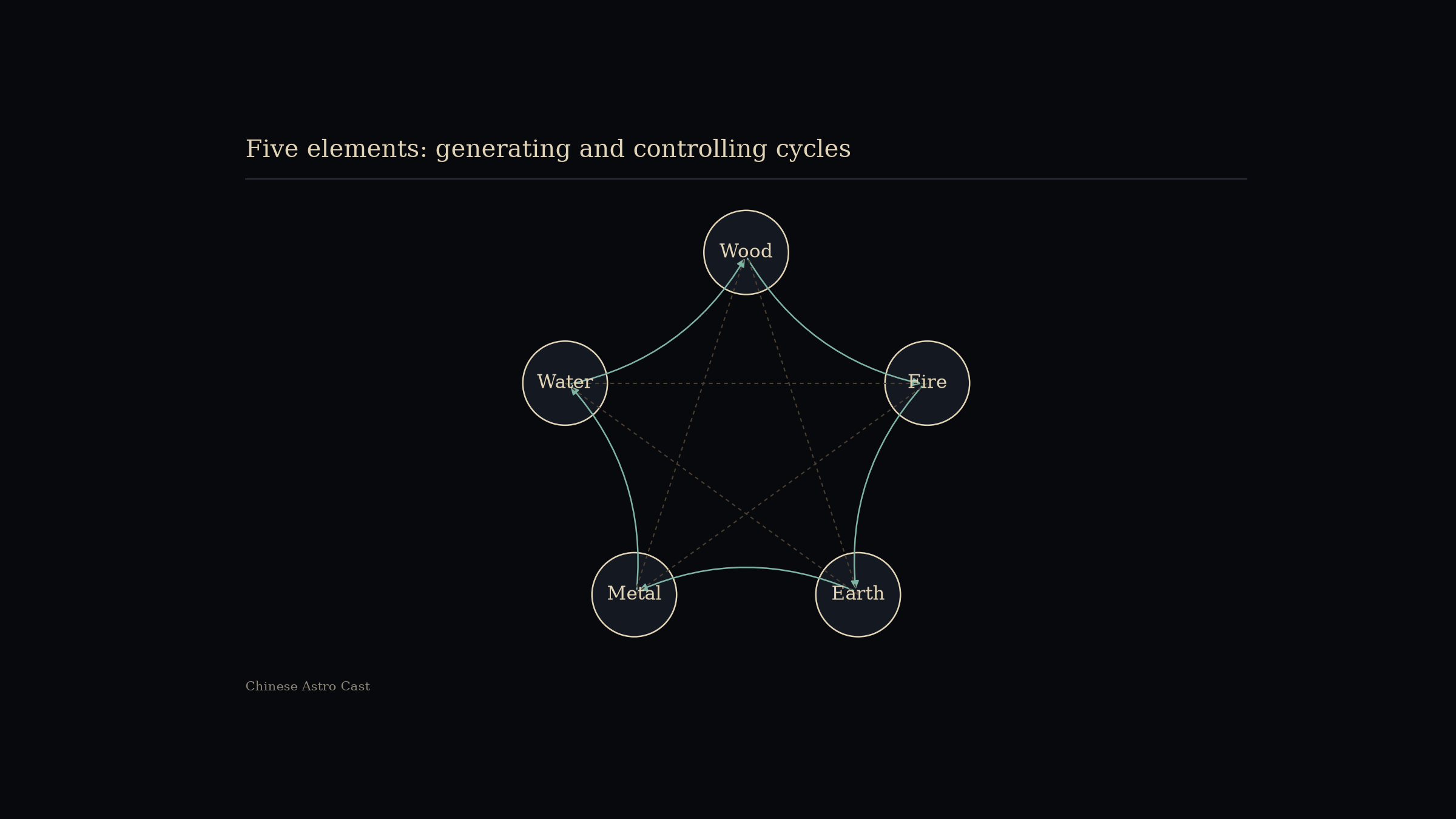
    Diagram of the five elements with the generating cycle in solid arrows and the controlling cycle in dashed lines
    Generating and controlling cycles: excess moves along one, deficit along the other.

    How to read your own elements

    Work in order, and do not skip the first step. Fix the birth data first: date, clock time, birthplace. Convert clock time to true solar time, because a two-hour pillar boundary is easy to cross by accident and an hour-pillar error changes the element count. Then list all eight characters and mark the element of every stem and every branch. Weight them: the day stem carries the most, the month branch governs how strong every other element is, and the year and hour pillars describe the public and the private register respectively. Note any excess above three characters of one element, and note absence entirely. Finally read the demand the structure makes, which is what it asks a person to build rather than what it hands them.

    The visible metal-wood clash and the structural version behave differently. Metal is boundary and Wood is expansion. When both are strong and adjacent, decisions stall at the point of commitment, because the same person argues for the opening and then argues against the terms. When the clash is only apparent, with Metal thin in the visible characters and Wood supplied by the month, there is no stall. There is a preference for movement that occasionally costs precision.

    Worked example

    A chief operating officer, born in the late 1970s, presents a chart with Water in the year, month and hour stems, a Yang Wood day stem, and no visible Fire. Three channels of adaptation feed one growth axis, and the visibility driver sits absent from the surface.

    The downstream consequence is consistent and expensive. She reads rooms faster than anyone else in the company and still loses the internal argument for her own budget, because she waits for a consensus her chart never required. The pattern is not indecision. It is surplus intake with insufficient claim. The rule that follows is a calendar rule: one visible commitment per week, meaning a decision announced, a number owned, a position staked in writing, scheduled the way a board meeting gets scheduled. Fire becomes an operational item rather than a personality transplant, and success is measured by whether the commitments land on the record, not by whether she feels more assertive afterwards.

    Where this goes wrong

    The expensive failure is buying a regimen keyed to one element: supplements, colours, direction-based seating charts, a diet built from a reading of one character out of eight. Cost without evidence, plus a false sense that the structure has been addressed. The second failure is using the chart as a licence. “I am Wood, so detail is not my strength” converts a description of load into an exemption from the work. The third, and the one that quietly damages careers, is reading the element in isolation from the role. A deficit only exists relative to a demand. Metal-thin is a liability in audit, a relief in a turnaround, and irrelevant in a research function nobody is measuring.

    Operating directive

    Get the birth data right before interpreting anything, and verify the hour pillar against true solar time. Count elements across all eight characters, recording excess and not only absence. Name the one place your dominant element overspends attention, then cap it with a rule rather than a resolution. Name the one place your deficit shows up under load, and put a procedure there. Re-read the chart in twelve months and compare it against what actually happened, because the only honest test of a structural reading is its hit rate on decisions. $19 The BaZi Blueprint does the counting and weighting for you and returns the demand rather than a label. If you want a second map of the same structure, the $29 Master Astrological Codex Bundle sets the twelve-palace topology alongside it.

    The free five elements chart renders that balance as a weighted map, which is worth looking at before you read any interpretation of it.

    Treat an element as a description of how capacity moves. Capacity can be scheduled; identity cannot.

    About the editor. Edward reviews every article against the site’s chart tables and the engine output quoted here. Last updated November 2026.