An astrology chart is a coordinate reading of one moment, not a description of a person. Every wheel and every set of pillars fixes a time and a place inside a repeating cycle, and the interpretation comes afterwards.
- A chart records where a moment sits in a coordinate system. Interpretation is downstream of that recording step.
- The wheel measures ecliptic geometry; the four pillars measure a sixty-step cycle. Vocabulary does not transfer between them.
- Both need the clock: the wheel for house cusps, the pillars for the local apparent Sun.
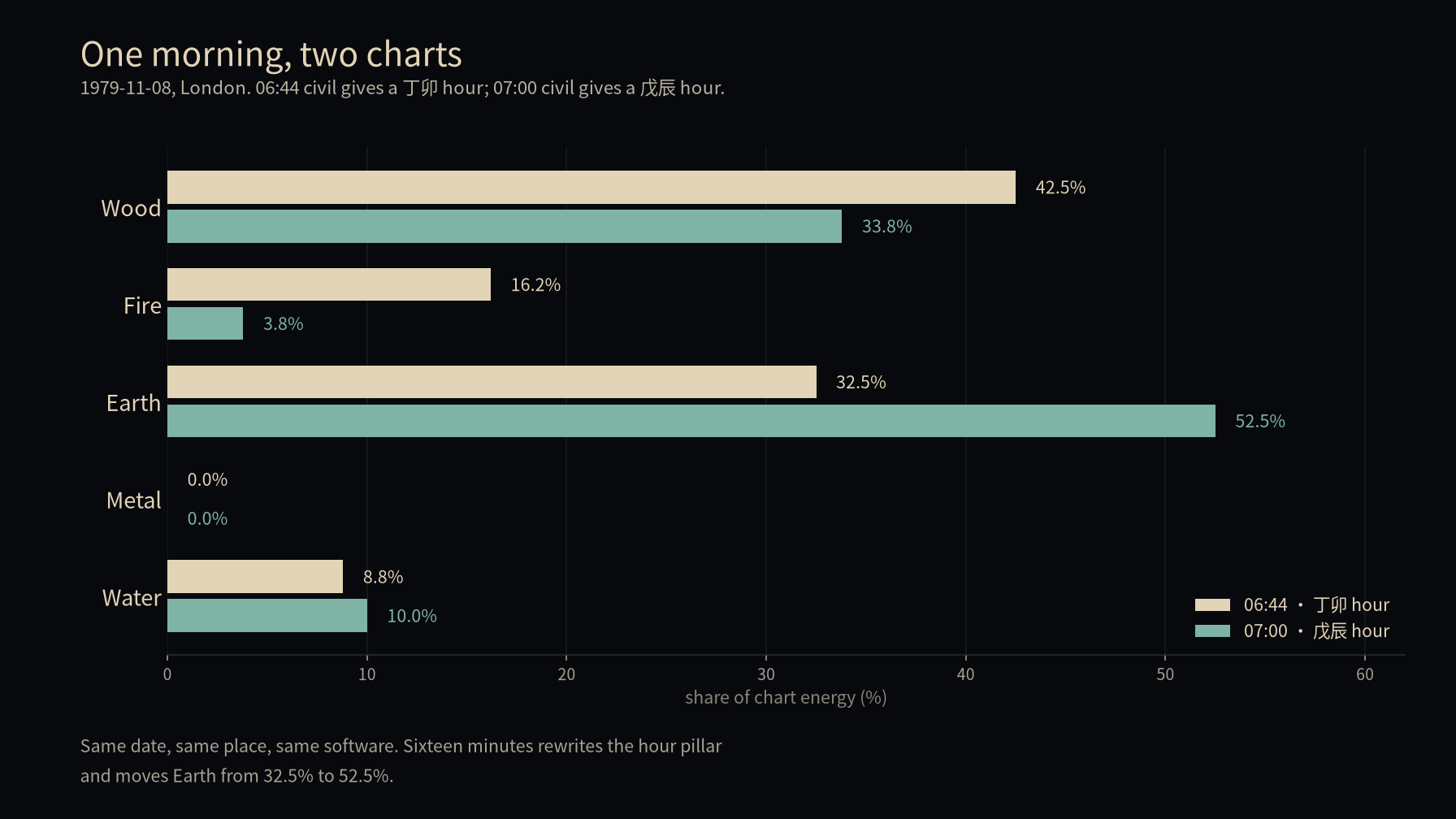
- Our engine returns 32.5% Earth at 06:44 and 52.5% at 07:00 on the same London morning.
What an astrology chart actually measures
Strip the symbolism and a chart is a timestamp with an address. It takes one moment of local time, one latitude and one longitude, and converts them into positions on a ruler that repeats: the ecliptic divided into signs, or the sexagenary cycle divided into stems and branches. Nothing in the diagram is about character until a reader assigns meaning to a position.
Two rulers over one snapshot
The Western wheel divides the ecliptic into twelve sectors of thirty degrees measured from the March equinox, then plots each body by its ephemeris position. Aspects are angular separations. Houses are the local sky split by a system that depends on latitude and clock time. Reading it is geometry.
The four pillars take four slices of the same moment, year through hour, and write each as one heavenly stem over one earthly branch, drawn from a cycle that repeats every sixty steps. The year turns at Lichun rather than on 1 January. The month turns at each major solar term rather than on the first of the month. There are no planets in it and no houses. Reading is relational: every other character is classified by its elemental relation to the day stem.
The psychological parallel holds if you keep it precise. A chart behaves like a well-normed instrument, constraining what can be said before interpretation begins. Jung treated such systems as structured projective surfaces, useful because they force a reader to account for the parts of a life he would rather skip. The instrument is not the error. The error is a reader who takes the scale for the object being measured.
Why chart structure matters at a decision table
Executives reach for chart language because it is compact and non-accusatory. Saying that a chart carries no output channel lands differently from saying a founder never says what he thinks, and it invites a different reply. That is a fair use of the vocabulary: a short way to hold a hard conversation about functions and costs.
The use turns bad when the diagram becomes evidence about a candidate. A chart can name an over-supplied function and an absent one. For a 己 Earth day master, Wood is the officer element, the authority imposed from outside, and Metal is the output element, what the person makes and says. A profile with Wood at 42.5 per cent and Metal at 0.0 describes a heavy external mandate and a thin expressive channel. That is a structural claim, and it converts into a staffing question rather than a judgement.
Three questions a chart cannot answer
- Whether a person will perform. No distribution of elements predicts competence at a specific job.
- Which of two candidates is better. A chart reads one profile; selection compares profiles against a role specification.
- When an event will happen. Timing layers describe pressure and receptivity, and the class of event is not specified.
How to read a chart in the right order
Most bad readings are sequencing errors rather than symbol errors. The order below is the one our own tools follow, and skipping a step is what produces confident nonsense.
- Fix the record. Civil date, civil time, city. A chart without a birth time cannot place houses or an hour pillar, and no later step repairs that.
- Convert the clock. Move civil time to local apparent solar time. In London on 8 November 1979 the correction is +15.57 minutes; in Shanghai in July it runs the other way.
- Place the axes. Houses and ascendant for the wheel, year through hour pillars for the Chinese chart. This is where two apps first disagree.
- Locate the reference point. The day stem in a BaZi chart, the ascendant and its ruler in a Western one. Everything else is classified relative to it.
- Read the distribution, not the keywords. Shares across five elements carry more information than any single term in a glossary.
- Attach one decision. A reading that changes nothing you were going to do this quarter was entertainment.
Worked example: one morning, sixteen minutes apart
Our engine returns four pillars for a London birth on 8 November 1979 at 06:40: 己未 year, 乙亥 month, 己卯 day, 丁卯 hour, with a day master of 己 Earth and Wood at 42.5, Earth at 32.5, Fire at 16.2, Water at 8.8 and Metal at 0.0 per cent. The month stem 乙 classifies as the Strategic Commander, the hour stem 丁 as the Visionary Tactician, the year stem 己 as the Peer.
Move the clock to 07:00 and the hour pillar becomes 戊辰. Earth rises to 52.5 per cent and Fire falls to 3.8. The reading changes from a chart with a working resource channel to one crowded with peers, and nothing about the person changed except the minute on the certificate. That is the argument for treating the fixing step as data and the interpretation as argument. The day master calculator prints the first half of that record with no interpretation attached, which is the right place to start, and we set out the boundary rules in more detail in the BaZi versus Western astrology comparison.
Where this goes wrong
Three failure modes cover most of the damage. The first is a chart built on a guessed birth time: rectification by anecdote produces an hour pillar that is fiction, and fiction at the hour layer propagates into every timing claim after it. The second is vocabulary transfer, reading a 冲 as an opposition aspect or a palace as a house, which yields sentences no tradition would defend. The third, and the expensive one, is treating a distribution as a verdict in a hiring or equity conversation, where a compact metaphor should have stayed a metaphor.
Operating directive
Confirm the birth record before you accept any chart of your own, and keep the civil time, the true solar time and the correction in one document. Read the reference point first and the glossary last. Ask of every reading which decision it would change, then discard the ones that change nothing. When a chart enters a room, say plainly that it describes a structure and not a performance record.
The full structural reading, including the ten-god classification of all four pillars, is what $19 The BaZi Blueprint produces for one profile. The $29 Master Codex Bundle adds the twelve-palace layer for readers who want the second geometry beside the first.
Hong Kong Observatory publishes the solar-term tables that fix the month and year boundaries used above.
An astrology chart rewards fixing before it rewards meaning, which is why the checkable half of it belongs first.
About the editor. Edward edits ChineseAstroCast and reviews every article against the site’s chart tables before publication. Last updated November 2026.