The ten gods in a BaZi chart are the layer Western readers abandon first, because the standard English labels read like a crime report. “Seven killings”, “hurting officer”, “rob wealth”: none of those phrases describes a behaviour. Each describes a relationship.
- They are neither deities nor events: ten relationship types between the day-master stem and every other stem.
- The label is relative, so the same stem is a different god under a different day master and literalism explains nothing.
- Ten collapse into five families (same, output, wealth, power, resource) split by polarity: two axes, not ten mysteries.
- Read by pillar: year for inherited conditions, month for professional method, hour for execution.
What the ten gods actually measure
A BaZi chart is four pillars, each written as one heavenly stem above one earthly branch. Eight characters in total, and the day stem is the only one that refers to the person. Call it the day master. One element, one polarity, yang wood for instance, and it becomes the origin point for everything else in the chart.
The ten gods classify every other visible stem with two questions. What is the element relation between that stem and the day master: identical, produced by it, controlled by it, controlling it, or producing it. Then, does the stem share the day master’s polarity or oppose it. Five relations times two polarities gives ten labels. None of that arithmetic predicts anything. It is grammar.
The closest Western analogue is a function-attitude typology, not a horoscope. Jung’s eight types describe a mode of functioning relative to the ego, and the same function behaves differently when it is introverted rather than extraverted. The ten gods work the same way. They name the relation, then the polarity, and leave the behaviour to be inferred from the whole chart.
Five families, ten archetypes
Because five families crossed with two polarities generate the ten, they hold in the mind as a map rather than a list. Each family answers a different question about what a person does with capacity: replicate it, express it, monetise it, govern it, or absorb it.
- In the same-element family sit the Peer and the Competitor: colleagues, siblings, rivals, and the instinct to solve alone.
- The output family holds the Creator and the Iconoclast, which is what the self produces. The Creator refines the craft. The Iconoclast dismantles the received method.
- Wealth covers what the self controls. The Steward builds systems that hold assets. The Venture Capitalist finds the asymmetric bet.
- Power covers what controls the self. The Institutional Architect works through legitimate structure, the Strategic Commander through force and tempo.
- Resource is what produces the self. The Scholar absorbs codified knowledge, the Visionary Tactician reads patterns nobody has written down.
Polarity is not virtue
Classical Chinese marks one of each pair 正, proper, and the other 偏, lopsided. Those words describe the alignment of the pairing rather than a grade. A Direct Officer and a Seven Killings are the same metal meeting the same day master from two directions, one with polarity opposed, one with polarity matched. The matched pair tends to be frictionless and repetitive. The opposed pair tends to differentiate, and it is harder to regulate. Neither one is the better employee.
Why it matters for decision-makers
The practical value sits in the balance between families, not in any single label, because the five describe five different drains and supplies on the person. Output and wealth consume the day master. Resource and peers support it. A chart whose two largest shares sit on the consuming side and whose two smallest sit on the supporting side belongs to someone who can generate a great deal and replenish very little. That constraint surfaces in calendar design long before it shows up in any forecast.
It also reframes the executive question. Instead of asking what kind of person this is, the chart asks which function is expensive for this person and which one is free. Free functions get delegated toward. Expensive ones get staffed. A founder whose professional method is production and critique should not be the person governing the institution, however capable the founder is. That is an org-design answer, not a prediction.
Common misreadings
Two errors recur. The first is reading a god as a trait: calling someone a Seven Killings personality fixes a relation into an identity, and then the hiring decision runs on the label. The second is reading absence as deficit. No visible stem of a family does not mean the function is missing. Classical readings also weigh the hidden stems inside the branches, and daily expression shifts with the luck pillars regardless.
Reading them in your own chart
Order matters more than vocabulary here. Work through the sequence once and the labels stop being intimidating.
- Fix the day master. Take the day pillar’s stem and note its element and polarity.
- List the remaining visible stems: year, month, hour. The day stem never gets a god because it is the reference.
- Assign each stem its family by element relation, then its polarity by comparison with the day master.
- Weigh by position rather than count. Month carries professional method, year carries inherited conditions, hour carries execution and the later trajectory.
- Leave the luck pillars out of the first pass. They re-weight everything every ten years and blur a structural reading done too early.
Worked example
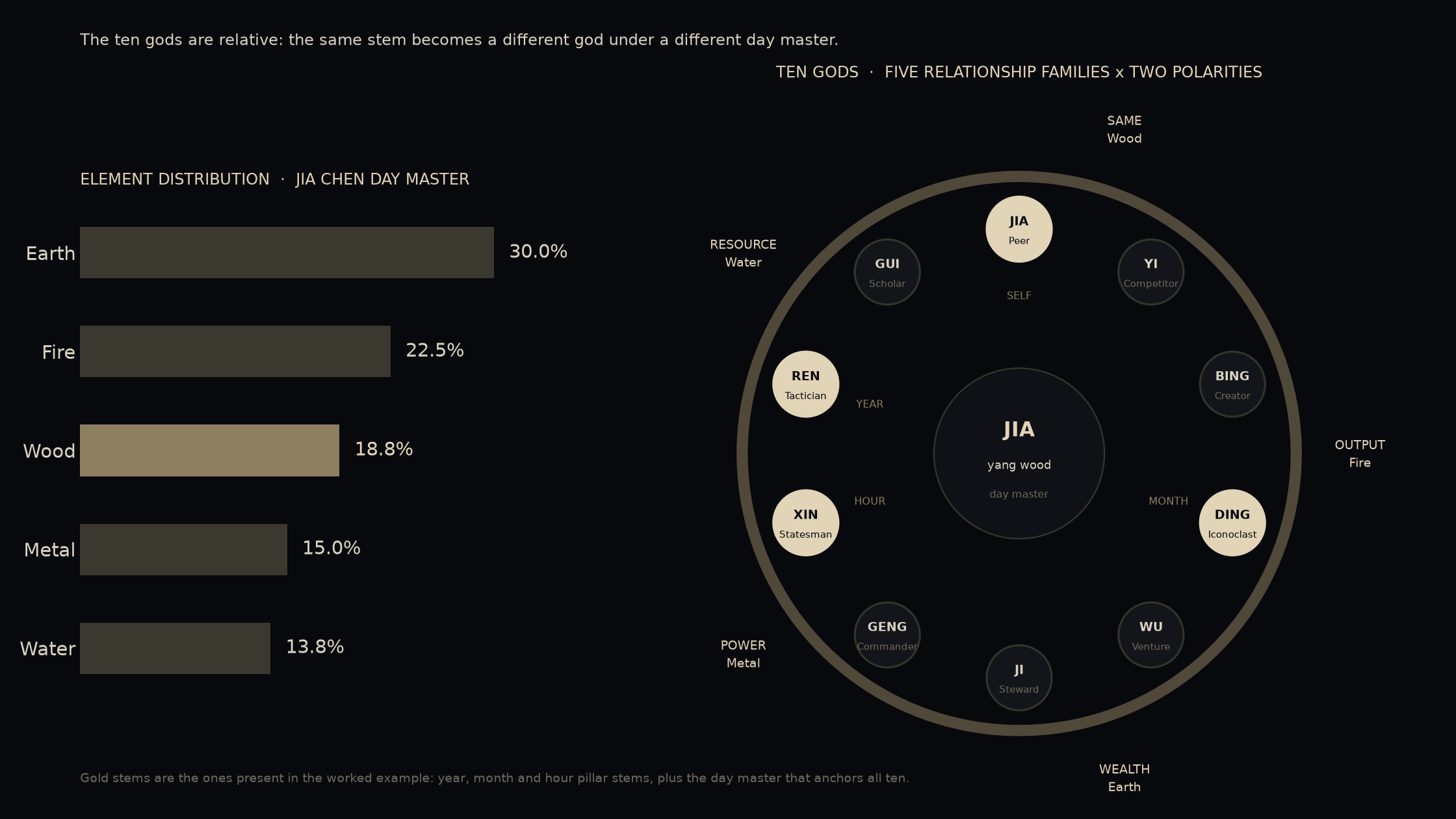
Our engine returns a clean case for a birth on 20 July 1982 at 13:21 in Changshu: true solar time 13:17:43, a correction of −3.28 minutes, and the pillars Ren Xu (壬戌) year, Ding Wei (丁未) month, Jia Chen (甲辰) day, Xin Wei (辛未) hour. The day master is Jia, yang wood, on a distribution of Earth 30.0, Fire 22.5, Wood 18.8, Metal 15.0, Water 13.8 per cent.
Three visible gods follow. Ren in the year is yang water producing yang wood at matched polarity: the Visionary Tactician, the Contrarian. Ding in the month is yin fire produced by yang wood at opposed polarity: the Iconoclast. Xin in the hour is yin metal controlling yang wood at opposed polarity: the Institutional Architect, the Statesman.
Read the positions rather than the names. Professional method sits in the month, and this month carries the Iconoclast, so the default working move is to dismantle the received method rather than perfect it. The Statesman appears only in the hour, which is where execution lives. Innovation upstream, governance downstream. That configuration reads cleanly until the organisation needs the downstream layer staffed by someone who is not the founder.
Where this goes wrong
The expensive failure is hiring on a label. A report that translates a stem as “seven killings” and stops there invites a reader to hear ruthlessness in what is really a description of matched-polarity power, which is the capacity to act without waiting for legitimacy. Used as a personality filter, the phrase disqualifies good operators.
The second failure is symmetry hunting. Readers count two of one god and one of another, then conclude the chart is unbalanced. The classical method weighs position, season and support first. One month stem usually matters more than three scattered ones.
Operating directive
Name the day master before reading anything else. Map the three remaining visible stems to families, then to polarity, and record the balance rather than the labels. Identify which function is expensive for this person and staff it instead of training it. Read position before count, and treat every translated god name as a relationship rather than a character reference.
For the full structural map, including element distribution, the ten gods by pillar and the luck sequence around them, the $19 BaZi Blueprint reports the arithmetic rather than the folklore. Readers who want the same profile cross-checked against the twelve-palace Ziwei topology use the $29 Master Astrological Codex Bundle, which runs both systems against one birth record.
The month pillar above is bounded by solar terms rather than calendar months. The Wei month runs from Minor Heat to the Start of Autumn, and the Hong Kong Observatory publishes the authoritative tables for those boundaries.
The ten gods are a discipline of relation rather than a set of titles, and a relation, unlike a title, can be redesigned.
About the editor. Edward edits ChineseAstroCast and reviews every article against the site’s chart tables before publication. Last updated November 2026.